
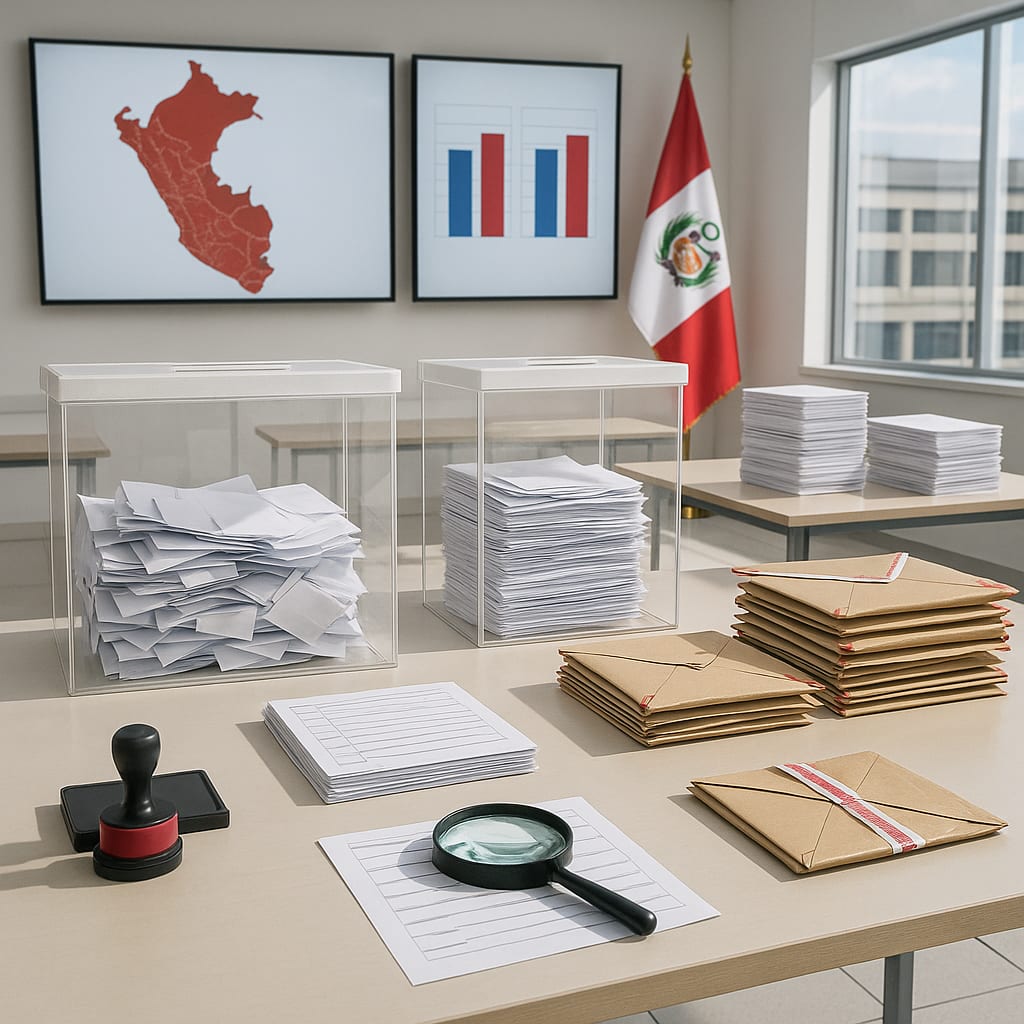
Peru’s presidential runoff remains too close to call amid overseas ballots and contested tallies
Narrative Snapshot
- Broad agreement: coverage converges on a razor-thin margin and a protracted count, with overseas ballots and the adjudication of contested tally sheets potentially decisive (DW; Al Jazeera; SCMP; Japan Times; ANSA; Le Monde; Clarín).
- Moving target on “who’s ahead”: outlets captured different moments of a fluid tally—early figures had Keiko Fujimori narrowly up (Clarín, 8 Jun), while subsequent updates showed Roberto Sánchez inching ahead by 15,000–26,000 votes with roughly 95% processed (The Hindu; Le Monde; Clarín, 9 Jun).
- Divergent frames: some emphasize institutional instability and crime as the election’s core context (DW; BBC; The Hindu; Folha), while others foreground ideological stakes—Fujimori’s lineage and “fujimorismo vs. antifujimorismo” (SCMP; The Guardian; Clarín, 2 Jun) or regional geopolitics (Fox News).
- Procedural risk is a shared concern but with different emphases: the weight of the diaspora (Japan Times; ANSA; Clarín, 9 Jun) versus the scale and timing of contested tally sheets—about 450,000 votes to review, potentially taking days (Le Monde)—and the prospect of delays given earlier logistical issues (Al Jazeera).
What Happened
Peruvians voted on June 7 in a runoff between right‑wing Keiko Fujimori and left‑wing Roberto Sánchez after a campaign dominated by crime and political instability (DW; BBC; The Hindu; SCMP). Exit polling indicated a technical tie (Folha). As of June 8, with more than 90% of ballots counted, the race remained too close to call; early partials briefly put Fujimori at 50.2% to 49.8% (DW; BBC; Clarín, 8 Jun). By June 9, Sánchez had inched ahead—by around 15,000 votes with 18 million ballots counted, and with a similar edge after 95% of votes were processed (The Hindu; Le Monde). Overseas votes—whose final batches arrive mid‑week and cover roughly 2,506 polling tables—are deemed pivotal (Japan Times; Clarín, 9 Jun). Separately, roughly 450,000 votes tied to contested tally sheets must be adjudicated, a process that could take days (Le Monde). Several outlets caution the final declaration could be delayed (SCMP; ANSA).
Why It Matters
The runoff sits atop a decade of institutional churn—Peru is selecting its ninth head of state in ten years—complicating governability regardless of who prevails (DW; SCMP; The Guardian). The incoming president will face a Congress that has removed four presidents in a decade, underscoring persistent executive‑legislative conflict risks (Folha). Procedurally, an extended adjudication of contested tally sheets, a decisive overseas vote, and earlier logistical issues from the first round collectively test electoral management capacity (Le Monde; Japan Times; Al Jazeera). Substantively, public demand for responses to crime and instability defined the race, signaling immediate pressure for policy delivery under tight political constraints (BBC; DW; The Hindu; SCMP). Internationally, some coverage frames the outcome through regional alignment lenses—casting Fujimori as a pro‑U.S. conservative and Sánchez as a leftist—highlighting potential diplomatic and economic positioning implications (Fox News), even as institutional continuity concerns dominate other reporting.
Diverging Narratives
Outlets differ on the center of gravity. Institutional lenses stress systemic instability, voter fatigue, and crime as the defining context (DW; BBC; The Hindu; Folha), while ideological framings emphasize a left‑right binary, Fujimori’s familial legacy, and a long‑standing “fujimorismo vs. antifujimorismo” cleavage (The Guardian; SCMP; Clarín, 2 Jun). On process, Japan Times, ANSA, and Clarín center the diaspora as the likely tie‑breaker, whereas Le Monde foregrounds the scale and timeline of adjudicating contested tally sheets (about 450,000 votes), which may outsize any single late‑count tranche. Timelines also diverge: several reports anticipate days of additional counting and reviews (Le Monde; SCMP), while ANSA cautions the final outcome may not be settled until July. The live tallies themselves illustrate fluidity: Clarín (8 Jun) showed Fujimori marginally ahead with over 92% counted, while The Hindu (9 Jun) and Le Monde reported Sánchez edging ahead with roughly 95% processed. Across coverage, all emphasize that margins remain within the range where procedural determinations can still shift the result.
What Happens Next
- Overseas vote integration: With the remaining overseas tally sheets arriving by mid‑week (Clarín, 9 Jun), returns that disproportionately favor either candidate could erase or entrench the current narrow lead (Japan Times; ANSA). Watch the sequence and geographic composition of diaspora counts and their cumulative impact on the margin.
- Adjudication of contested tally sheets: Review of roughly 450,000 votes could take days (Le Monde). The volume of validated (or annulled) tally sheets and the pace of resolutions will signal whether the margin hardens or remains volatile.
- Certification timeline: If disputes proliferate, the certification window could stretch, as flagged by ANSA’s suggestion of a potential July outcome; a quicker review cycle would imply earlier consolidation (ANSA; Le Monde; SCMP).
- Post‑result governability: Regardless of the winner, executive‑legislative dynamics with a Congress that has removed four presidents in ten years will shape agenda viability (Folha). Monitor early coalition signals and legislative outreach once a victor is declared.
- Stability signals: Given prior concerns about a tight, contested outcome (Clarín, 5 Jun), track candidate statements on accepting results and calls from institutions to maintain calm.