
Lead
A powerful offshore earthquake measuring magnitude 7.8 struck the southern Philippines near Mindanao, killing dozens, injuring well over a hundred, and damaging buildings and infrastructure in and around General Santos and nearby provinces. Initial tsunami warnings prompted coastal evacuations across parts of the southern Philippines and alerts in neighboring areas of the Pacific, but the threat later eased. As rescue teams searched collapsed structures and landslide-hit communities, officials and aid agencies warned the toll could still rise amid hundreds of aftershocks, disrupted access, and widespread displacement.
What Happened
The quake hit in the waters south of Mindanao, with reporting clustering around an epicenter offshore near the General Santos area and a moderate depth. In the immediate aftermath, authorities urged residents in vulnerable coastal zones to move to higher ground as tsunami warnings were issued. Several outlets described small tsunami waves being observed in parts of the region, including outside the Philippines, before alerts were later lifted as the feared larger surge did not materialize.
On land, the strongest impacts were reported across parts of Mindanao, with General Santos frequently cited as among the hardest-hit urban areas. Accounts converged on a picture of structural damage—buildings swaying, some collapsing—alongside power and communications disruptions in certain locations. Video-centered coverage focused on dramatic scenes of a restaurant collapse and widespread street-level destruction, while other reporting emphasized more dispersed damage: cracked roads, damaged public buildings, and homes rendered unsafe by shaking.
Casualty figures shifted rapidly over the first 24–48 hours, reflecting the usual pattern after large earthquakes when local governments consolidate reports from hospitals, police, and disaster offices. Early tallies ranged from single digits to the teens, before rising to figures in the 30s and then higher as authorities reached more remote areas and verified deaths linked to landslides and collapsed structures. By the second day, multiple outlets were using numbers in the high 30s to low 40s for deaths, with injuries described as exceeding 100 and, in some reports, surpassing 200. Rescue operations were repeatedly described as complicated by continued aftershocks and safety concerns around unstable buildings.
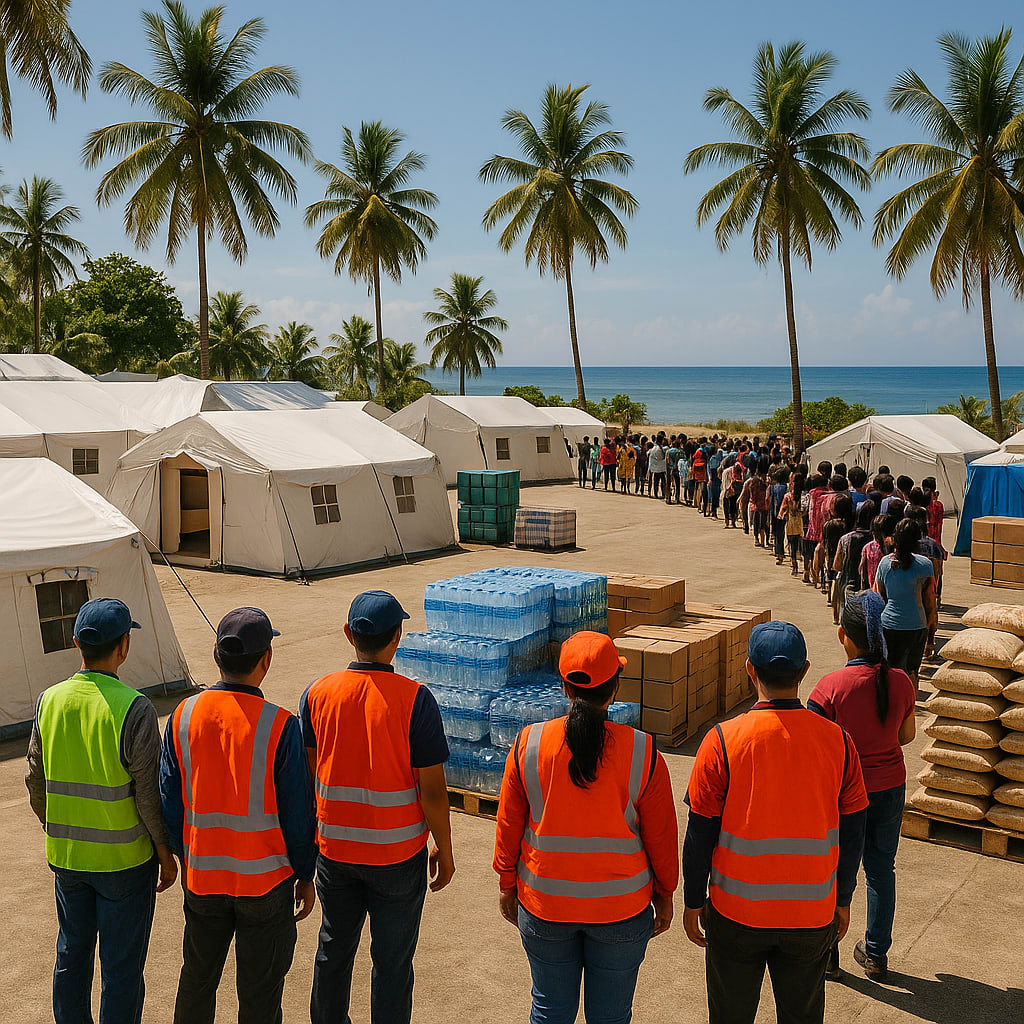
Beyond the immediate fatalities and injuries, large-scale displacement emerged as a central theme. Several reports converged on roughly 20,000 people being forced from their homes, with makeshift or outdoor medical facilities established in the hardest-hit areas. In at least one province, access constraints were severe enough that some communities were described as reachable only by helicopter, underscoring the combined effect of rugged terrain, quake damage, and landslide risk.
Why It Matters
The disaster landed in a country accustomed to seismic hazards but still repeatedly exposed by the gap between risk and resilience. The Philippines sits on a complex junction of tectonic plates, and even when buildings survive the initial shaking, cascading effects—landslides, liquefaction, road failures, and prolonged aftershocks—can turn a single event into a multi-day emergency. The widespread emphasis on evacuations and tsunami warnings also reflects the Philippines’ long memory of coastal disasters, where minutes matter and false alarms are tolerated as the cost of caution.
Operationally, the quake stressed the Philippines’ disaster response architecture in a region where geography can be as challenging as the hazard itself. Mindanao’s mix of dense cities, coastal settlements, and hard-to-reach rural areas means that a single offshore event can create multiple, simultaneous emergencies: urban search-and-rescue for structural collapses, medical triage for injuries, and aerial logistics for isolated towns cut off by landslides or damaged roads. Reports of outdoor hospitals and warnings to avoid entering damaged buildings point to the ongoing risk picture—aftershocks and secondary collapses often claim additional victims if residents return too quickly.
The quake also re-ignited a broader national conversation about the “Big One”—the long-anticipated major earthquake expected to affect the capital region of Metro Manila. Some coverage treated the Mindanao quake as a warning shot for the rest of the country: that even outside the capital, large events can overwhelm local capacity, and that enforcement of building standards, retrofitting, and public drills remain essential. That framing carries political and economic weight because preparedness investments compete with other national priorities, and because public confidence can be shaken when casualty numbers rise in real time.
Regionally, the episode again demonstrated the Pacific’s interconnected hazard environment. Tsunami advisories were not confined to the Philippines; they rippled outward to neighboring countries and territories, driving coordinated monitoring and public messaging. Even when the waves are small, these alerts test early-warning systems, communication networks, and public compliance—an increasingly important measure as coastal populations expand and climate-related coastal vulnerabilities intensify.
Diverging Narratives
The death toll story: from “at least one” to “over 40.”
The most visible divergence was numerical, not interpretive. Early reports cited very low confirmed fatalities—down to a single death—while others on the same day used figures around 15. Within hours, some outlets moved to totals in the 30s, and by the next day several cited totals approaching or reaching the low 40s. Rather than a simple contradiction, the differences reflected timing, sourcing, and counting methods: some relied on initial local confirmations from city officials or police spokespeople, while others amplified later consolidated national tallies and wire-service updates. Some also separated confirmed deaths from feared or unconfirmed fatalities, while others used “at least” language that shifted as counts solidified.
Magnitude labeling and the “8.2” shadow.
While the dominant figure across coverage was magnitude 7.8, some reporting referenced a higher number in headlines or early alerts. This likely reflected initial automated seismic solutions that are often revised as more data comes in. The variation mattered less for lived experience—both magnitudes signal a major, damaging quake—but it shaped tone: higher magnitude references tended to be paired with more urgent tsunami language and a broader regional framing.
Tsunami emphasis: a central peril or a passing scare.
Outlets diverged in how much narrative weight they gave the tsunami threat. Some placed coastal evacuations and warnings at the center of the story, foregrounding official instructions to move to higher ground and the Pacific-wide alert posture. Others treated tsunami risk as a secondary element that receded quickly, shifting attention back to structural collapse, aftershocks, and casualty updates. A related divergence was how explicitly small tsunami waves were described—some reports highlighted them as observed impacts in multiple countries, while others focused on the warnings and their subsequent lifting.
Urban drama versus systemic vulnerability.
Video- and image-driven coverage leaned into visceral moments: a restaurant collapsing, crowds fleeing, and buildings swaying. Other reporting treated the quake as a case study in disaster readiness, emphasizing building integrity, enforcement of standards, and the Philippines’ broader vulnerability—especially the persistent fear of a catastrophic Metro Manila event. This difference was not about disputing facts on the ground; it was about the lens: immediate spectacle and human fear versus structural governance and long-term risk.
Cause of deaths: collapse, landslides, and what gets named.
Where details were provided, fatalities were attributed mainly to collapsed buildings and landslides. Some coverage stressed landslides as a major driver of deaths, which aligns with Mindanao’s terrain and the known lethality of slope failures after strong shaking. Others spoke more generally of “damage” and “collapsed buildings,” focusing on urban impacts. The underlying picture is consistent—multiple lethal mechanisms—but the emphasis changed the implied policy lesson: slope management and access for remote areas versus urban construction safety.
Current Situation
By the second day, the situation had shifted from immediate shock to sustained emergency operations. Rescuers were still searching damaged structures for survivors, with the strongest focus on areas reporting building collapses and on communities affected by landslides. Hundreds of aftershocks were widely reported, reinforcing official warnings to avoid re-entering damaged buildings and slowing rescue work due to safety risks.
Displacement remained substantial, with reports clustering around roughly 20,000 people forced from their homes. Medical care continued under strain in hard-hit areas, including the use of outdoor or improvised hospital setups. Access challenges persisted in some locations, where damaged routes and terrain limited movement and required aerial support.
The near-term outlook was defined less by tsunami risk—which had receded after alerts were lifted—than by the continuing aftershock sequence, the risk of additional collapses and landslides, and the time-consuming process of verifying casualties across scattered communities. Authorities signaled that the death toll could still rise as search efforts continue and as remote areas report in, while the broader national debate on preparedness—particularly for a future major earthquake in more densely populated regions—was reignited by the scale of damage in the south.