
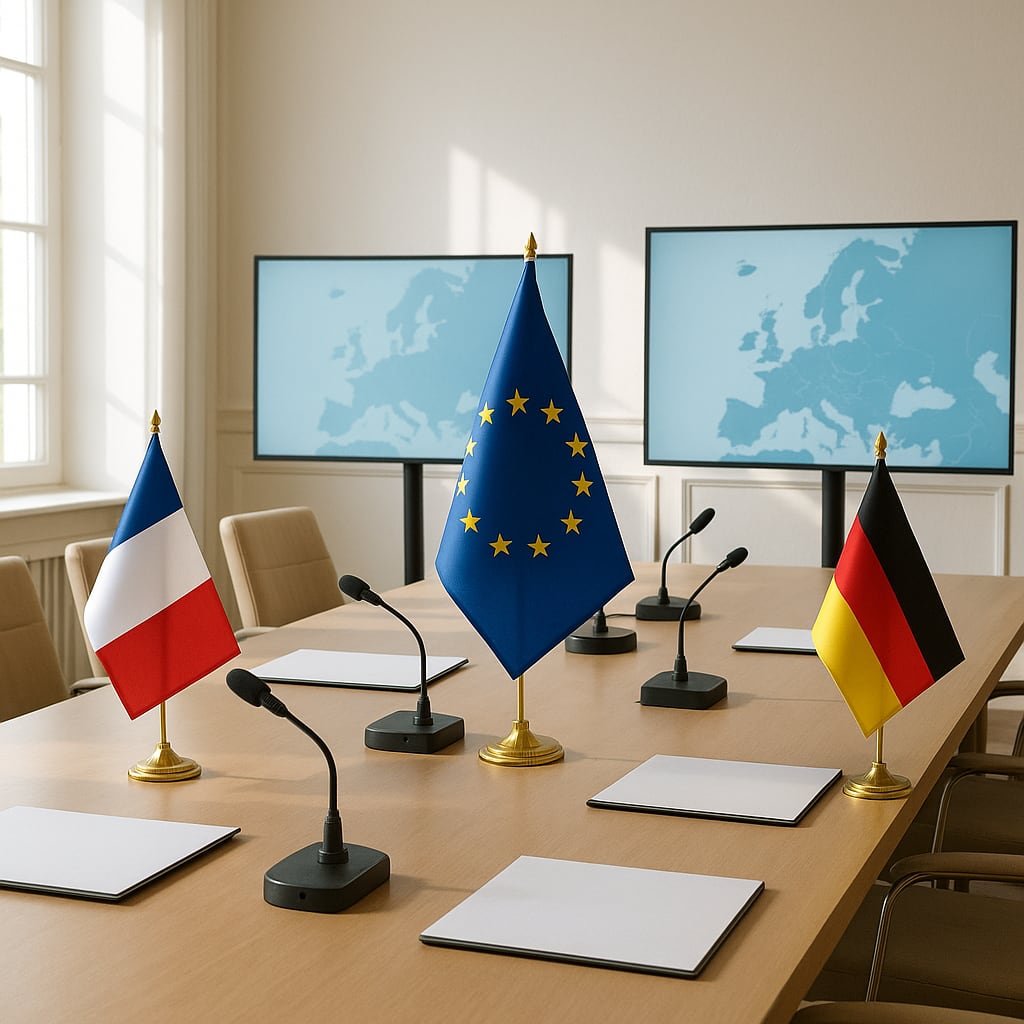
France and Germany scrap FCAS/SCAF joint fighter jet after industry deadlock
Narrative Snapshot
- Cross-outlet consensus pins the collapse on unresolved industry disagreements: Paris and Berlin concluded firms could not agree on a way forward (The Guardian; Deutsche Welle; Kyiv Independent). Le Monde names Dassault and Airbus as the central impasse.
- French and German papers stress scale and symbolism: an estimated €100 billion program meant to embody European “strategic autonomy” (Le Monde; Corriere della Sera). UK and global outlets frame a setback for Europe’s common defence ambitions (The Guardian; Al Jazeera; Deutsche Welle).
- National leadership choices are foregrounded in Italy’s Corriere, which highlights decisions by Chancellor Merz and President Macron, and asks what Berlin does next and what, if anything, remains of the effort.
- Asia-focused coverage situates the news in a wider pattern: Japan Times links it to the Russia threat and US pressure to rearm, while the South China Morning Post reports parallel strain in a separate UK–Japan fighter effort due to UK funding shortfalls.
What Happened
Berlin and Paris halted their joint Future Combat Air System (FCAS/SCAF) project after concluding that the companies involved could not agree on a path forward. Le Monde reports that, despite political backing since 2017, Dassault and Airbus failed to reach an accord, leading both governments to formalize the program’s termination on June 8, 2026, and to pledge a refocusing of industrial cooperation. Multiple outlets characterize the decision as driven by an industry dispute and confirm the project’s scale, with estimates near €100 billion (Le Monde; Corriere della Sera; Deutsche Welle; The Guardian; Kyiv Independent). International coverage underscores timing and context: Al Jazeera notes intensifying US pressure on Europe to bolster military self-reliance, and Japan Times highlights parallel Western warnings about a growing Russian threat as the decision was taken.
Why It Matters
Outlets converge on the broader significance: the failure is a setback for Europe’s drive toward more integrated defence capabilities and strategic autonomy (Le Monde; The Guardian; Deutsche Welle; Al Jazeera). The decision lands as Washington presses Europe to rearm and assume greater responsibility for its security (Al Jazeera; Japan Times), raising questions about Europe’s ability to deliver high-end capabilities through complex, multi-national industrial arrangements. Le Monde’s reporting that Paris and Berlin will “recenter” cooperation suggests continuity of bilateral defence ties, but through narrower or differently structured projects. Corriere della Sera’s focus on Berlin’s next steps underscores procurement implications for Germany. Regionally, the South China Morning Post’s account of UK funding shortfalls affecting a separate Anglo-Japanese fighter program indicates that next-generation air combat collaborations face fiscal and governance headwinds beyond the Franco-German context.
Diverging Narratives
- Cause and locus of failure: European outlets largely attribute the collapse to intra-industry deadlock—specifically the inability of Dassault and Airbus to agree on key terms (Le Monde; The Guardian; Deutsche Welle). Corriere della Sera centers the political decision by Merz and Macron that companies “are not able to continue,” sharpening the leadership dimension.
- Strategic framing: Le Monde emphasizes the loss of a €100 billion flagship for European “autonomie stratégique,” while The Guardian, Deutsche Welle, and Al Jazeera highlight the blow to Europe’s collective defence push. Al Jazeera and Japan Times stress the external context—US pressure and the Russia threat—heightening the policy stakes of the timing.
- Path forward: Le Monde reports that Paris and Berlin intend to refocus cooperation, softening the narrative of rupture. Corriere explicitly raises uncertainty over “what will remain” of FCAS and what Germany will do next, signaling unresolved questions about salvageable technologies, workstreams, or alternative procurement paths.
- Comparative lens: The South China Morning Post’s separate reporting on UK funding strain in a different fighter program offers a broader readout on the vulnerability of multinational next-gen air projects, but does not ascribe those external dynamics to the Franco-German split.
What Happens Next
- Paris–Berlin reset: Le Monde’s indication that both governments will “recenter” cooperation makes imminent announcements on narrower joint projects a key signal. Watch for concrete program definitions, governance structures, and workshare arrangements that avoid the Dassault–Airbus impasse.
- Germany’s fighter path: Corriere della Sera flags that Berlin must choose its next steps. Indicators include statements from Chancellor Merz and the defense ministry, budget guidance, and consultations with industry pointing to either national development, new partnerships, or off‑the‑shelf alternatives.
- Industrial disposition: Given the firms’ stalemate (Le Monde; The Guardian; Deutsche Welle), track how Dassault and Airbus redeploy R&D, handle intellectual property, and pursue adjacent unmanned, sensor, or combat cloud components that could outlive the program—an issue raised implicitly by Corriere’s “what remains” framing.
- European defence coherence: Outlets describing a blow to common defence (The Guardian; Deutsche Welle; Al Jazeera) set a watchpoint on EU/NATO-level messaging and procurement choices that test whether capability gaps will be filled collaboratively or via disparate national buys—especially amid US pressure and Russia-focused urgency (Al Jazeera; Japan Times).