
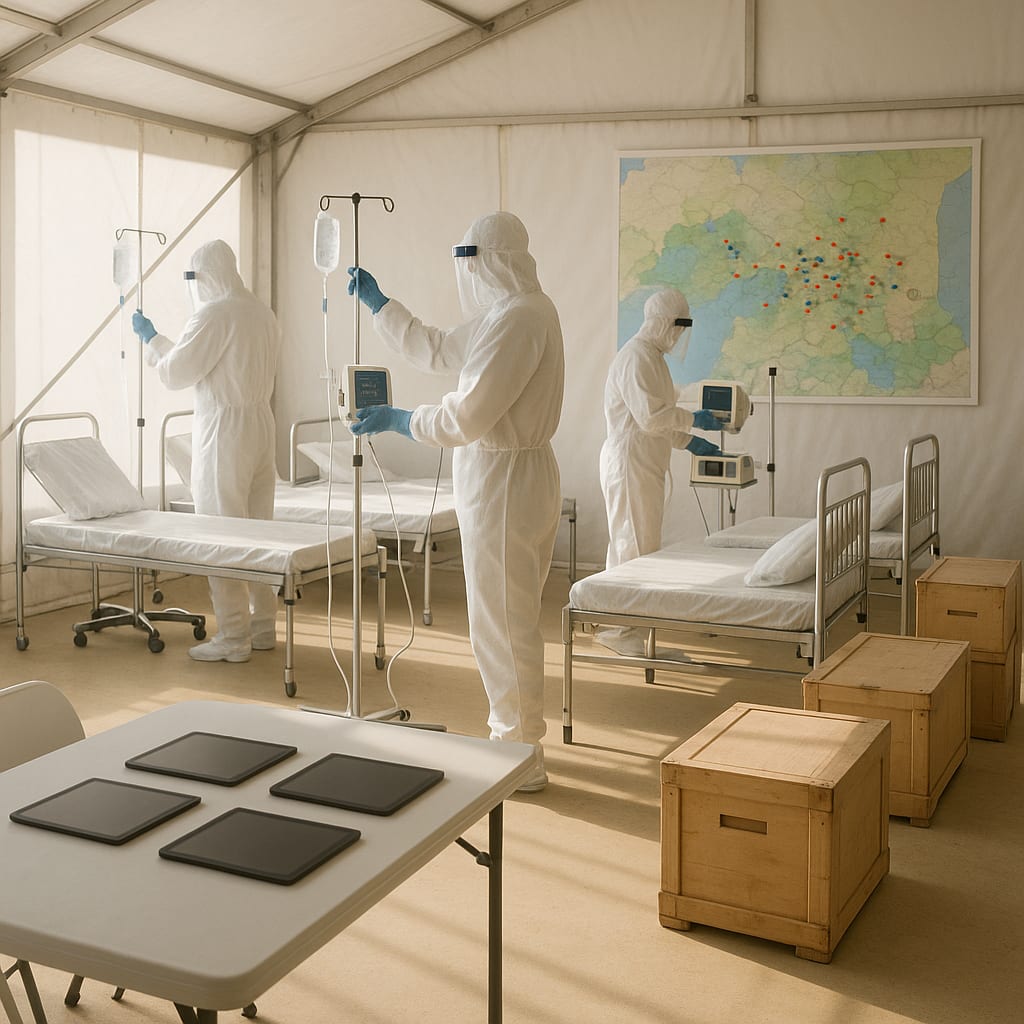
Ebola outbreak in DRC and Uganda accelerates; EU/G7 pledge support as WHO issues new filovirus guidelines
Narrative Snapshot
- Convergence on severity, divergence on scale: Multiple outlets report rapid growth and unusually high early tolls, but case and death counts vary by date and scope. CBC cites a 40% weekly jump and more than 200 deaths with up to 35,000 contacts under monitoring, drawing on Africa CDC data; Le Monde reports 875 laboratory-confirmed cases in DRC alone and a 23% case fatality rate; earlier Folha tallies are lower. Japan Times frames it as the third-largest Ebola epidemic on record; Al Jazeera and Folha (AU agency) flag the risk of becoming the “worst ever.”
- Funding narrative splits: Al Jazeera highlights slumping international financing, while DW, Daily Nation, and Folha detail new G7 and EU commitments, including €493 million from the European Commission.
- Lived realities vs. systems-level change: BBC centers safe-burial adaptations amid rising deaths; AllAfrica covers WHO’s new clinical guidance. The New York Times adds a structural U.S. shift moving global health leadership from CDC to State, raising capacity concerns not foregrounded elsewhere.
What Happened
The current Ebola outbreak—driven by the Bundibugyo virus—began in mid-May in eastern Democratic Republic of Congo and has crossed into Uganda. Africa CDC reported a nearly 40% weekly rise, more than 200 deaths in the first month, and up to 35,000 potential contacts (CBC). Le Monde cites 875 confirmed infections in DRC since May 15 and a 23% case fatality rate, noting there is no vaccine or specific treatment for Bundibugyo. Japan Times reports the epidemic is already the third largest on record and the biggest caused by this strain. G7 leaders pledged support, and the European Commission announced €493 million for response efforts (DW; Daily Nation; Folha). The WHO released its first comprehensive clinical guidelines for filovirus disease emphasizing early supportive care with 16 evidence-based recommendations (AllAfrica). On the ground, large traditional funerals are being curtailed and safe-burial practices expanded (BBC). In parallel, U.S. policy is shifting global health oversight from CDC to the State Department (NYT).
Why It Matters
This outbreak intersects with global health security architectures in flux. EU and G7 commitments signal renewed donor engagement even as some reporting points to broader funding headwinds (DW; Daily Nation; Folha; Al Jazeera). WHO’s new filovirus guidelines create a standardized clinical playbook for non-vaccine care—salient given Bundibugyo’s lack of a licensed vaccine—potentially reducing mortality if implemented at scale (AllAfrica; Le Monde). Africa CDC’s contact-tracing burden (tens of thousands) underscores the operational demands on regional systems (CBC). The U.S. reallocation of global health roles from CDC to State could reshape technical assistance and outbreak diplomacy, with critics warning of expertise gaps (NYT). For decision-makers, the case highlights the premium on surge financing that can translate quickly into deployable tracing teams, safe-burial capacity, and cross-border coordination—especially when biomedical countermeasures are absent (Le Monde; BBC; AllAfrica).
Diverging Narratives
Outlets diverge on how to characterize the outbreak’s scale and trajectory. CBC, citing Africa CDC, emphasizes a record-fast early phase (“worst known…at this stage”) with a 40% weekly rise and >200 deaths in the first month. Le Monde reports 875 confirmed cases in DRC with a 23% fatality rate, while Folha’s earlier WHO-based figures list 695 cases and 138 deaths, reflecting reporting lags. Japan Times labels it the third-largest Ebola epidemic on record; Al Jazeera and Folha (AU health agency) foreground warnings that, if transmission continues unchecked, it could become the worst ever and last up to a year, infecting thousands. Financing is framed differently: Al Jazeera points to slumping international funding, whereas DW, Daily Nation, and Folha highlight new G7/EU pledges, including €493 million from the European Commission. Coverage also splits between macro policy (NYT on U.S. restructuring) and human-centered impacts (BBC on safe burials), with Daily Nation additionally contextualizing perceived risks to global events like the World Cup.
What Happens Next
- Financing to operations: Watch whether G7 statements and the EU’s €493 million translate into rapid deployments for contact tracing, laboratory capacity, and community engagement (DW; Folha; Daily Nation). Indicators: disbursement timelines, partner implementation agreements, and surge staffing in affected provinces.
- Clinical practice uptake: WHO’s new filovirus guidelines prioritize early supportive care; monitor adoption by treatment centers and any shifts in case fatality relative to Le Monde’s 23% figure (AllAfrica; Le Monde).
- Containment vs. spread: With up to 35,000 contacts identified and a recent 40% weekly case increase, the effectiveness of tracing and safe-burial protocols will be decisive (CBC; BBC). Indicators: weekly incidence trends, proportion of cases from known contact lists, and burial team coverage.
- Governance capacity: The U.S. transition of international health leadership from CDC to State may affect technical assistance reach (NYT). Signals: field presence adjustments, interagency coordination mechanisms, and partner feedback.
- Cross-border control: The outbreak’s extension into Uganda heightens the need for regional coordination through Africa CDC and WHO. Indicators: border screening metrics, joint surveillance bulletins, and resource flows to districts along the frontier (Japan Times; CBC).