
Lead
A tense U.S.–Iran standoff in and around the Strait of Hormuz has hardened into something short of open war but far beyond routine brinkmanship: a maritime pressure campaign driven as much by sanctions, insurance risk, and shipping reroutes as by missiles and naval deployments. Across coverage from American, European, Russian, Gulf-focused, and Iranian outlets, several points recur—U.S. forces say they are interdicting traffic bound for Iranian ports, commercial vessels are being redirected in large numbers, and Iran’s security forces insist they are maintaining passage through the strait under Iranian oversight. At the same time, competing accounts describe a draft deal that could change how Hormuz is managed—possibly involving Oman and, in some versions, a path toward U.N. Security Council consideration—while Washington expands sanctions linked to Iran’s oil economy and maritime governance.
What Happened
The immediate trigger for the current phase is a U.S.-declared blockade posture aimed at stopping maritime movement to Iranian ports. U.S. Central Command figures reported by multiple outlets put the number of commercial vessels redirected since the blockade began at roughly the low hundreds—109 in one set of figures and 111 in a subsequent update—underscoring both the scale of disruption and the difficulty of measuring it precisely in a fast-moving maritime environment.
Iran, meanwhile, has projected control rather than concession. Iranian state-linked messaging and Islamic Revolutionary Guard Corps (IRGC) statements highlighted continued ship movements through Hormuz, with claims that roughly two dozen vessels transited safely within a 24-hour period “under naval control” or “in coordination” with the IRGC Navy. These assertions do not directly contradict the U.S. redirection counts—ships can move through the strait while still being denied onward routes to Iranian ports—but they frame the same waters as an arena where Iran retains sovereignty and operational leverage.
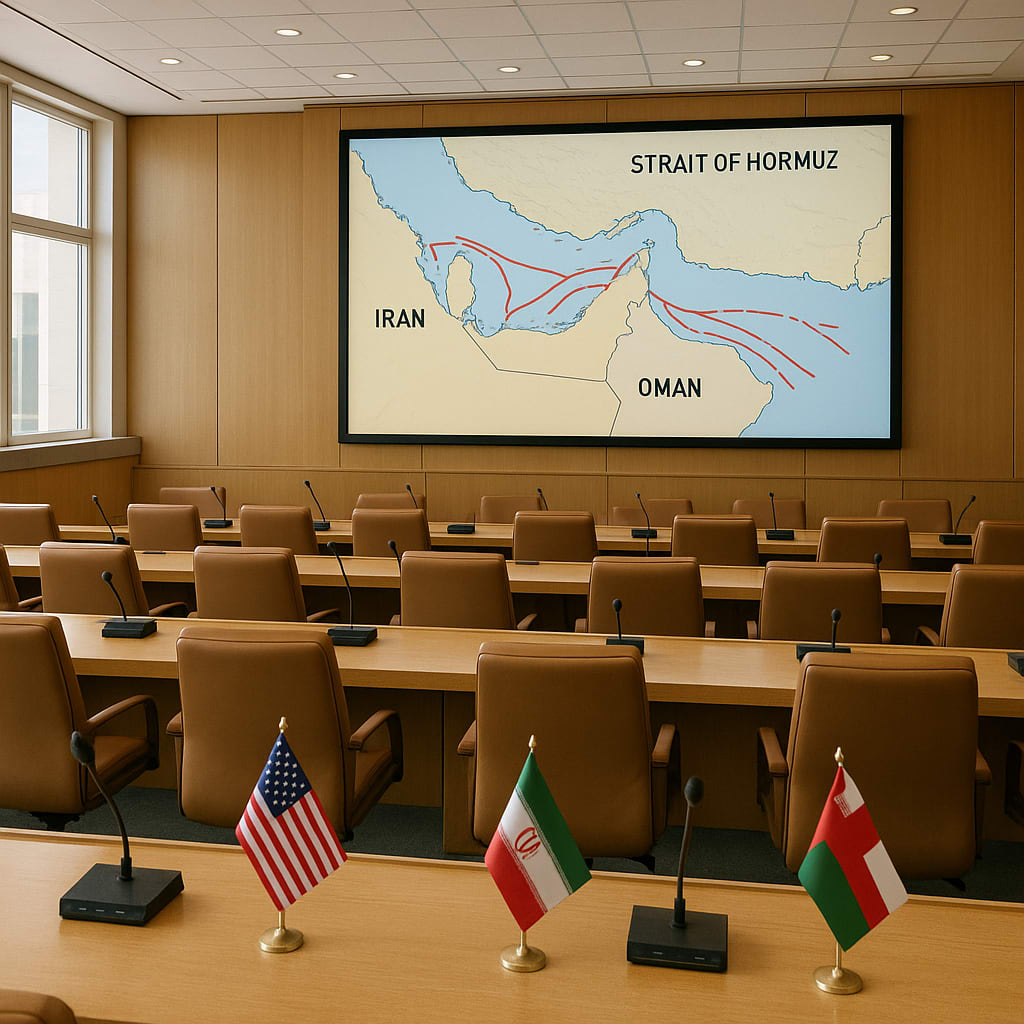
Negotiations and draft terms hovered over this military-economic contest. Reporting from several directions described mediators working toward an extension or framework arrangement to calm the confrontation. One recurring element is Oman’s role: a prospective arrangement discussed in public included some form of Omani participation in managing the strait over a defined period. Yet the political messaging around Oman became volatile after the U.S. president used incendiary language when asked about accepting a short-term arrangement involving Iran and the Gulf state—remarks that drew international attention and complicated the image of allied coordination even as some U.S. partners publicly signaled readiness to contribute to freedom-of-navigation efforts.
On the U.S. side, pressure expanded beyond maritime operations to financial tools. Coverage repeatedly notes additional U.S. sanctions targeting Iranian entities and individuals linked to Iran’s oil economy and to bodies connected with governance or administration of Gulf straits. The sanctions narrative is paired with accounts of continued U.S. military activity near key Iranian port infrastructure, including reporting of fresh strikes in the vicinity of Bandar Abbas, alongside Iranian statements of no casualties or damage.
The economic and human texture of the crisis also emerged as a prominent strand: seafarers trapped amid contested rules of passage; a market response reflected in oil price moves; and the way war-risk insurance—often negotiated through London’s marine insurance ecosystem—became an operational determinant of whether and how ships sail.
Why It Matters
Hormuz is not simply a chokepoint; it is a global pricing mechanism. Even when ships continue to pass, the perceived risk of detention, missile fire, miscalculation, or shifting rules can translate into higher freight costs, higher insurance premiums, longer voyages, and delayed deliveries. Coverage emphasizing war-risk insurance and the mechanics of underwriting points to a crucial reality: maritime commerce can be throttled without a single ship being sunk, simply by making transit economically irrational or contractually impossible.
The standoff also signals a particular style of conflict: “economic warfare” at sea. The U.S. approach—interdicting or redirecting vessels headed to Iranian ports while escalating sanctions—aims to narrow Iran’s revenue channels and constrain its oil economy. Iran’s counter-message—asserting authority over the strait, emphasizing safe passage under its naval oversight, and debating the legitimacy of fees for “services”—aims to normalize Iranian control while challenging the legality of U.S. actions.
Diplomatically, the crisis has pulled in a familiar cast with an unusually sharp edge. Oman appears not just as a mediator but as a potential co-manager or guarantor in draft arrangements, highlighting how smaller Gulf states can become pivotal when great-power naval signaling risks spiraling. References to potential U.N. Security Council involvement—if draft terms are indeed headed there—suggest an attempt to formalize rules of passage and deconflict operations, though the feasibility depends on buy-in from the permanent members and from regional stakeholders.
Finally, the stakes extend well beyond oil. European coverage stressing that a “reopening” would not equate to immediate “normality” reflects the logistics reality: petroleum flows may rebound first, but other sectors—gas, chemicals, fertilizers, and containerized trade—can face longer lags due to disrupted schedules, constrained port operations, and elevated risk pricing. That divergence matters for inflation expectations and supply chains, including seasonal fuel-demand periods.
Diverging Narratives
Legality and sovereignty are framed in opposite directions. U.S.-leaning messaging describes the blockade posture and freedom-of-navigation efforts as a response to “illegal” interference and as a necessary push to “break” Iran’s grip. Iranian outlets, in contrast, emphasize international-law arguments for Iranian actions and insist that measures such as collecting payments are either not occurring (a blanket rejection of “tolls”) or are being misunderstood (fees characterized as payments for services rather than a transit toll). The disagreement is not merely semantic: a “toll” implies coercive taxation of an international strait, while “services” suggests optional charges for pilotage, escort, or safety support.
Numbers are used as proof of control. U.S. figures on redirected ships are presented as evidence of operational effectiveness and economic pressure. Iranian and IRGC figures on dozens of ships transiting safely are presented as evidence that Iran—not the U.S.—sets the practical terms of passage. The two sets of numbers measure different things, but in public discourse they are deployed as competing indicators of who is “winning” in Hormuz.
The status of a deal is described inconsistently. Some reporting highlights a draft framework in which U.S. “blockade” measures would end and transit could return to pre-war levels, with management involving Oman within a set time window and possible referral to the U.N. Security Council. Other accounts stress Iranian rejection of U.S. terms—particularly demands linked to Iran’s uranium stockpile—casting the talks as stalled or as an attempt at coercive diplomacy rather than a mutual de-escalation. The divergence appears rooted in which elements are treated as central: maritime mechanics and deconfliction on one hand, nuclear and strategic concessions on the other.
Alliances and credibility are emphasized differently by region. Some Western coverage foregrounds allied support and coalition-building for maritime security. Other international reporting highlights strains inside that posture—pointing to inflammatory rhetoric toward Oman, and to the broader idea that regional powers are adapting to perceived limits in U.S. ability to decisively shape outcomes. In that framing, the drive toward talks is less a diplomatic choice than a response to a battlefield and maritime reality that resists clean resolution.
Human and commercial costs compete with military drama. U.S. political framing focuses on leverage and deterrence; Iranian framing focuses on sovereignty and legality; European business-oriented coverage highlights recovery timelines and commodity-specific bottlenecks; and several outlets elevate the lived experience of seafarers and the behind-the-scenes role of insurers as the true arbiters of whether commerce moves.
Current Situation
As of the latest reporting in this tranche, the maritime contest remains active on three tracks at once: U.S. forces continue to report large-scale redirections of commercial vessels bound for Iranian ports; Iran’s IRGC continues to publicize controlled, “safe” transits through Hormuz; and Washington continues to widen sanctions tied to Iran’s oil economy and maritime-related entities. UK maritime advisories warning vessels amid nearby U.S. operations reflect a risk environment that remains elevated regardless of whether a formal “closure” is in effect.
Diplomatically, a possible draft arrangement involving Oman and a pathway to formal international consideration has been discussed publicly, but its contours—and even its viability—are contested in coverage that alternates between describing a framework for reopening and highlighting Iranian rejection of U.S. terms. The practical near-term outlook described across outlets is therefore cautious: even if transit constraints ease, normalization of shipping patterns, insurance pricing, and non-oil supply chains is expected to lag behind any headline announcement of reopening.