
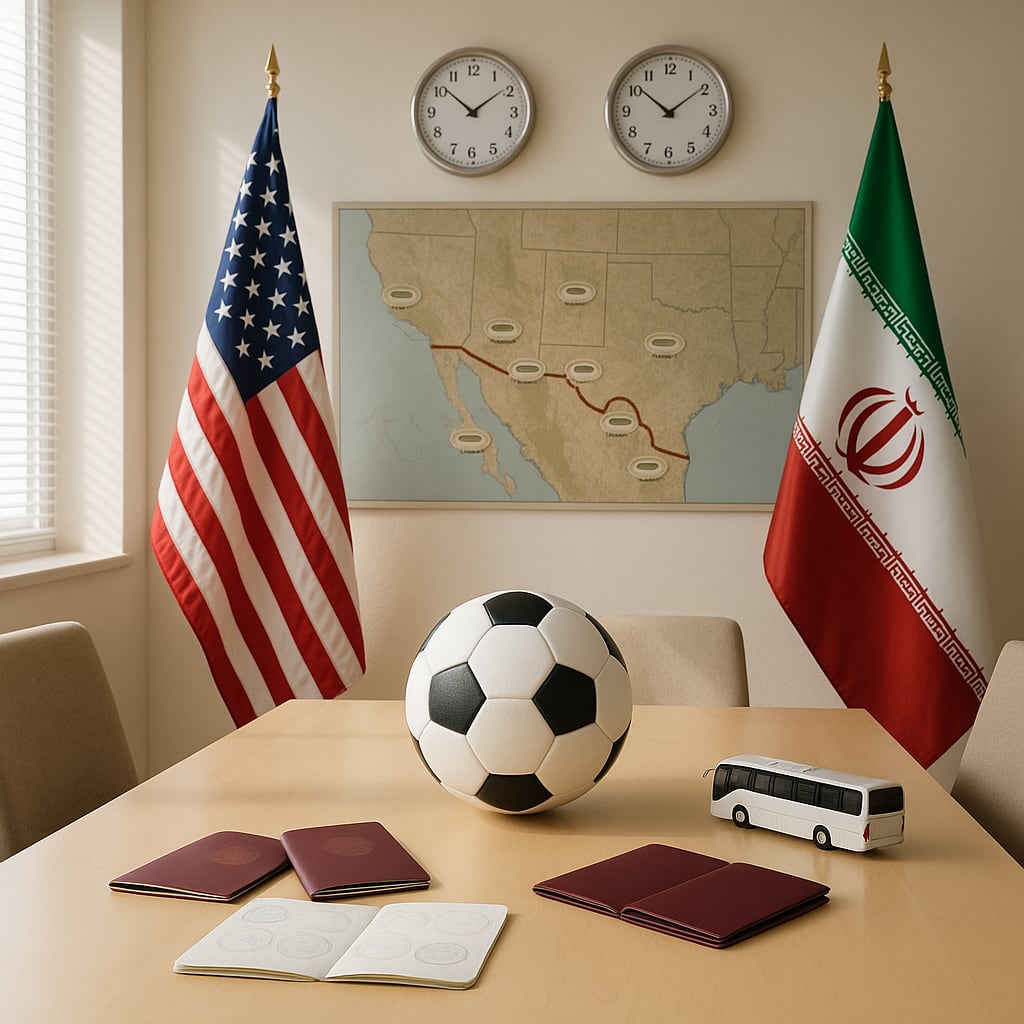
Iran’s World Cup squad bases in Mexico as US grants player visas, denies some staff, and requires same‑day entry for matches
Narrative Snapshot
- Broad agreement that Iran has established its base in Mexico and must commute to the United States for all group fixtures, with same‑day in‑and‑out entry reported by multiple outlets. Coverage uniformly notes that some delegation members were denied US visas.
- Emphases diverge: Al Jazeera foregrounds Iranian diplomatic criticism of Washington; BBC and Folha stress the logistical complexity, including a late training‑camp move; Middle East Eye disaggregates the decisions (players approved; some staff refused; same‑day rule).
- Contextual framing varies: Al Jazeera and Folha link subdued Iranian fan sentiment to war and economic crisis; Corriere focuses on on‑the‑ground arrival imagery and local reception in Mexico.
- What’s most at stake across reports is operational feasibility and competitive parity: repeated cross‑border same‑day travel versus standard multi‑day match preparation.
What Happened
Iran secured Mexican entry visas for its World Cup base early in June and played a final warm‑up against Mali before departing, then arrived in Mexico on June 7 after traveling from Turkey (Folha, Al Jazeera, Corriere, Al Jazeera 5 Jun). Middle East Eye reported that the United States granted visas to the Iranian playing squad but denied visas to some delegation staff, a development echoed by Iranian media and referenced by Al Jazeera (MEE 6–7 Jun; Al Jazeera 7 Jun). BBC, Folha, and MEE added that Iranian players and support staff would need to enter and leave the US on the same day for each match, prompting Iran to shift its training base to Mexico (BBC 7 Jun; Folha 6–7 Jun; MEE 6 Jun). All of Iran’s group games are scheduled in the US (BBC 7 Jun).
Why It Matters
This episode illustrates how bilateral constraints can shape tournament operations in a multi‑host event. The reported same‑day US entry rule and visa denials for some staff have forced Iran to reconfigure logistics—moving its camp to Mexico and planning repeated cross‑border transits (BBC; Folha; MEE). For organizers and governments, it tests coordination between hosts and immigration authorities when political frictions intersect with large sporting events. For teams, it raises competitive‑integrity questions when preparation norms (rest, recovery, staffing) are affected by security and visa regimes. Al Jazeera and Folha’s attention to domestic headwinds—war and economic crisis—highlights how off‑field factors condition public sentiment and team operations (Al Jazeera 7 Jun; Folha 7 Jun). More broadly, the contrast with other visa disruptions reported elsewhere in the tournament cycle underscores administrative vulnerabilities with policy implications for future co‑hosted events (Mail & Guardian 2 Jun).
Diverging Narratives
- Denial versus facilitation: Middle East Eye reported that the US granted visas to the squad but blocked some staff, while subsequent coverage highlighted Iranian media claims of denials to delegation members (MEE 6–7 Jun). Al Jazeera carried Iranian diplomatic criticism of US refusals (Al Jazeera 7 Jun). The difference lies in granularity—players versus staff—and timing, rather than contradiction.
- Operational framing: BBC and Folha center on the logistical burden—last‑minute visas, a moved training base, and same‑day crossings—as making Iran’s path “one of the most complex stories” of the tournament (BBC 7 Jun; Folha 7 Jun). Al Jazeera complements this with societal context of muted excitement amid war and economic strain (Al Jazeera 7 Jun).
- Information gaps: None of the cited reports include a detailed US government rationale for the same‑day rule or specific staff denials. The scope of affected personnel, criteria used, and potential for policy adjustment remain unspecified in the available coverage (MEE 6–7 Jun; BBC 7 Jun; Folha 6 Jun).
What Happens Next
- US visa and entry conditions: If US authorities maintain the reported same‑day entry requirement and staff denials, Iran will continue operating from Mexico with match‑day commutes; any relaxation or additional approvals would ease staffing and scheduling pressures (MEE 6 Jun; Folha 6 Jun; BBC 7 Jun). Watch for updated consular guidance or statements that clarify entry windows or adjudications for remaining staff.
- Team logistics execution: With all group matches in the US, Iran must coordinate repeated cross‑border travel from its Mexican base (BBC 7 Jun). Indicators include charter and border‑processing arrangements and any shifts in base location or training schedule reported by team or host authorities.
- Diplomatic signaling: Iranian officials have publicly criticized the visa denials (Al Jazeera 7 Jun). Further diplomatic engagement—or lack thereof—could signal whether conditions will change, including any follow‑on coverage from Iranian or US sources tracked by Middle East Eye and major broadcasters.