
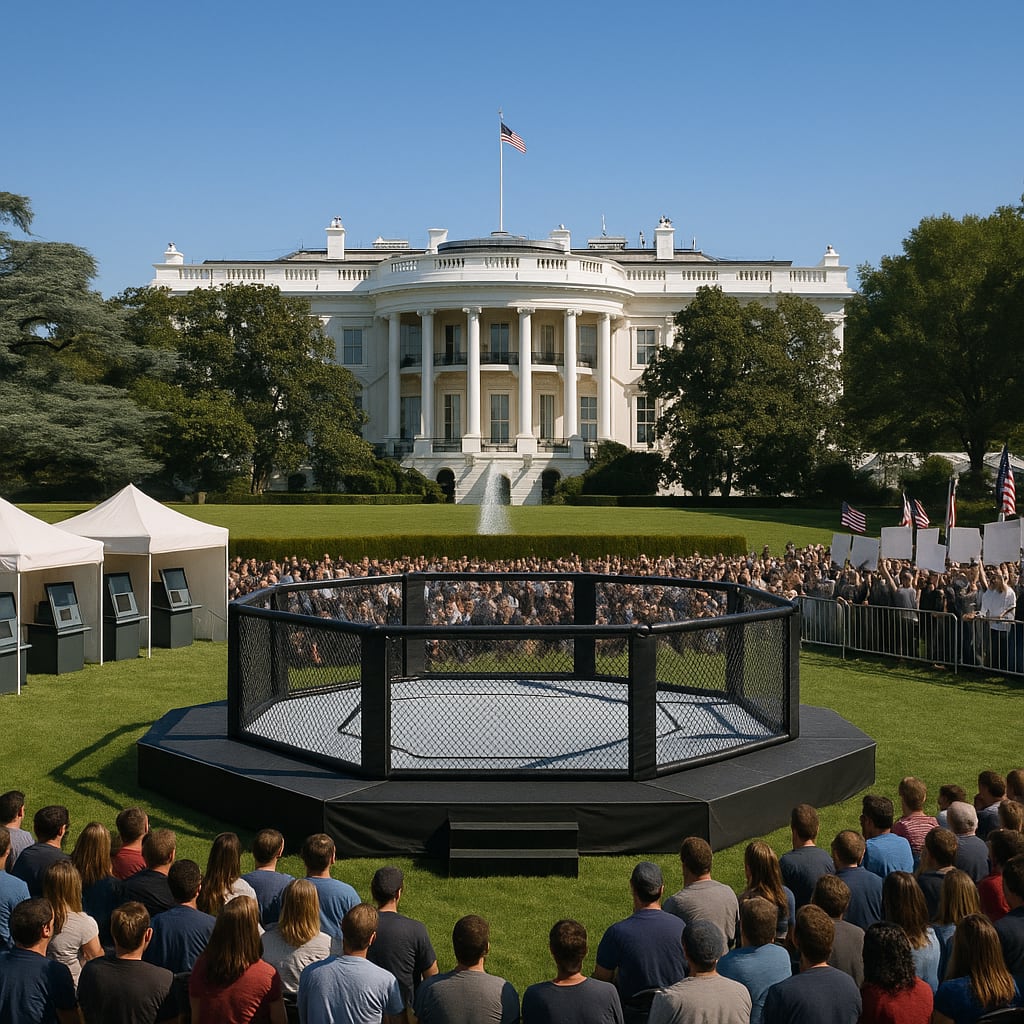
Trump hosts UFC ‘Freedom 250’ on White House South Lawn after court denies halt
Narrative Snapshot
- Legal clearance is broadly reported: a federal judge denied an emergency bid to stop the event, citing lack of standing (RT; Fox News, 12 Jun; Al Jazeera, 13 Jun). Fox foregrounds the judge’s appointment and the plaintiffs’ deficiencies; RT emphasizes the scale of preparations already in place.
- Ethics and money receive divergent emphasis. The Guardian highlights fighter bonuses paid in a stablecoin issued by a Trump family business and characterizes the event as a private, for‑profit competition on government property; the underlying lawsuit also flagged conflict‑of‑interest concerns (Guardian, 14 Jun; Fox News, 8 Jun). The Japan Times cites the Public Integrity Project calling the setup a “volcano of corruption.”
- International outlets stress spectacle, cost, and optics: a US$60 million arena, “The Claw,” military flyover and fireworks (SCMP, 12 & 14 Jun; CBC, 12 Jun; La Repubblica). Some link the timing to wartime inflation pressures (SCMP; Clarín).
- Culture and participation fault lines run through coverage: protests near the Ellipse (Guardian, 14 Jun), PBS commentators calling it “degrading” (via Fox News, 14 Jun), Dana White’s “not political” framing (Fox News, 12 Jun), a champion alleging he was barred (Guardian, 10 Jun), and star fighters stoking hype at the Lincoln Memorial (Al Jazeera, 13 Jun).
What Happened
Trump announced in 2025 that a UFC title event would be staged at the White House as part of America 250 and his 80th birthday (RT). In the lead‑up, organizers erected “The Claw,” a roughly 28‑meter‑tall, 600‑ton steel structure on the South Lawn (CBC, 12 Jun; New York Times). Two local residents sued the National Park Service and Interior to block the event, alleging permitting, environmental review, and conflict‑of‑interest issues; a federal judge denied their emergency motion for lack of standing (Fox News, 8 & 12 Jun; RT). The card—marketed as UFC Freedom 250—features seven fights and associated pageantry, including a military flyover and fireworks (SCMP, 14 Jun; BBC). UFC said some fighter bonuses will be paid in a stablecoin from Trump‑affiliated World Liberty Financial (Guardian, 14 Jun). Protests formed near the Ellipse as thousands of fans entered (Guardian, 14 Jun; BBC). Musician Zac Brown planned to perform the national anthem with the Marine Band (Fox News, 12 Jun).
Why It Matters
The event tests boundaries between public institutions and private commercial activity on federal property. Coverage raises questions about permitting and environmental review processes for large‑scale, for‑profit spectacles at the White House and national monuments (Fox News, 8 Jun; Guardian, 14 Jun). The use of a stablecoin issued by a Trump family business to pay UFC bonuses intensifies scrutiny of potential conflicts of interest when government venues host events tied to the president’s financial network (Guardian, 14 Jun). International reporting situates the showpiece amid economic strains linked to the war in Iran, underscoring the political optics of lavish state‑adjacent entertainment during elevated living costs (SCMP, 12 Jun; Clarín). For policymakers and institutional stewards, the precedent—legally cleared and logistically executed—could shape future America 250 programming and norms governing commercial branding, sponsorship, and compensation mechanisms on government grounds (Fox News, 12 Jun; CBC, 12 Jun).
Diverging Narratives
- Profit vs. public interest: The Guardian calls it the first private, for‑profit sporting event held on White House grounds and flags financial entanglements via crypto bonuses from a Trump‑linked company (Guardian, 14 Jun). By contrast, Fox News highlights UFC’s assertion that it won’t profit from the show (Fox News, 8 Jun).
- Political symbolism vs. apolitical celebration: Al Jazeera frames the event as part of Trump’s strategic use of combat sports as a political instrument with potential fallout (Al Jazeera, 13 Jun). Dana White counters that the event is “not at all” about politics (Fox News, 12 Jun). Fox also amplifies DOJ language telling critics to “avert their gazes,” reinforcing a patriotic, America‑250 framing (Fox News, 10 & 12 Jun).
- Optics and timing: International outlets emphasize the US$60 million spectacle and wartime inflation context (SCMP, 12 & 14 Jun; CBC, 12 Jun; Clarín). Domestic criticism ranges from PBS commentators calling it “degrading” (via Fox News, 14 Jun) to protests labeling it corrupt (Guardian, 14 Jun; Japan Times).
- Participation and control: The Guardian reports middleweight champion Sean Strickland’s claim he was barred over his criticisms (Guardian, 10 Jun), while other fighters like Ilia Topuria are positioned as headliners and generated pre‑fight theatrics at the Lincoln Memorial (La Repubblica; Al Jazeera, 13 Jun).
What Happens Next
- Oversight and litigation trajectory: The emergency injunction failed on standing grounds (Fox News, 12 Jun; RT). Analysts should watch whether plaintiffs amend or refile, whether additional complainants with clearer standing emerge, and whether permitting or environmental review claims prompt administrative scrutiny (Fox News, 8 Jun).
- Ethics and financial entanglements: Monitor disclosures on the stablecoin bonus program—who pays, in what amounts, and conversion terms—and any formal ethics challenges tied to the Trump‑affiliated issuer (Guardian, 14 Jun). Statements from UFC and the White House will signal how conflicts‑of‑interest concerns are addressed.
- Use of federal spaces for America 250: With the court allowing weekend events at the White House and Lincoln Memorial (Fox News, 12 Jun), track how agencies handle future proposals—permit conditions, environmental assessments, and sponsorship rules—as indicators of an emerging governance template (CBC, 12 Jun).
- Public and elite response: Protest scale, athlete participation disputes, and cultural‑prestige critiques (Guardian, 10 & 14 Jun; Fox News, 14 Jun) will shape whether this model is repeated, modified, or curtailed within the America 250 calendar.