
Lead
A strong offshore earthquake rattled western Cuba, including Havana, sending residents out of buildings and reverberating well beyond the island—felt as far as Florida and, in some coverage, parts of Mexico. With no immediate reports of major casualties or widespread destruction, the early story has been less about collapse than about exposure: the vulnerability of aging infrastructure in Cuba and the unusual reach of a Caribbean quake into major population and tourism centers across the Florida peninsula.
What Happened
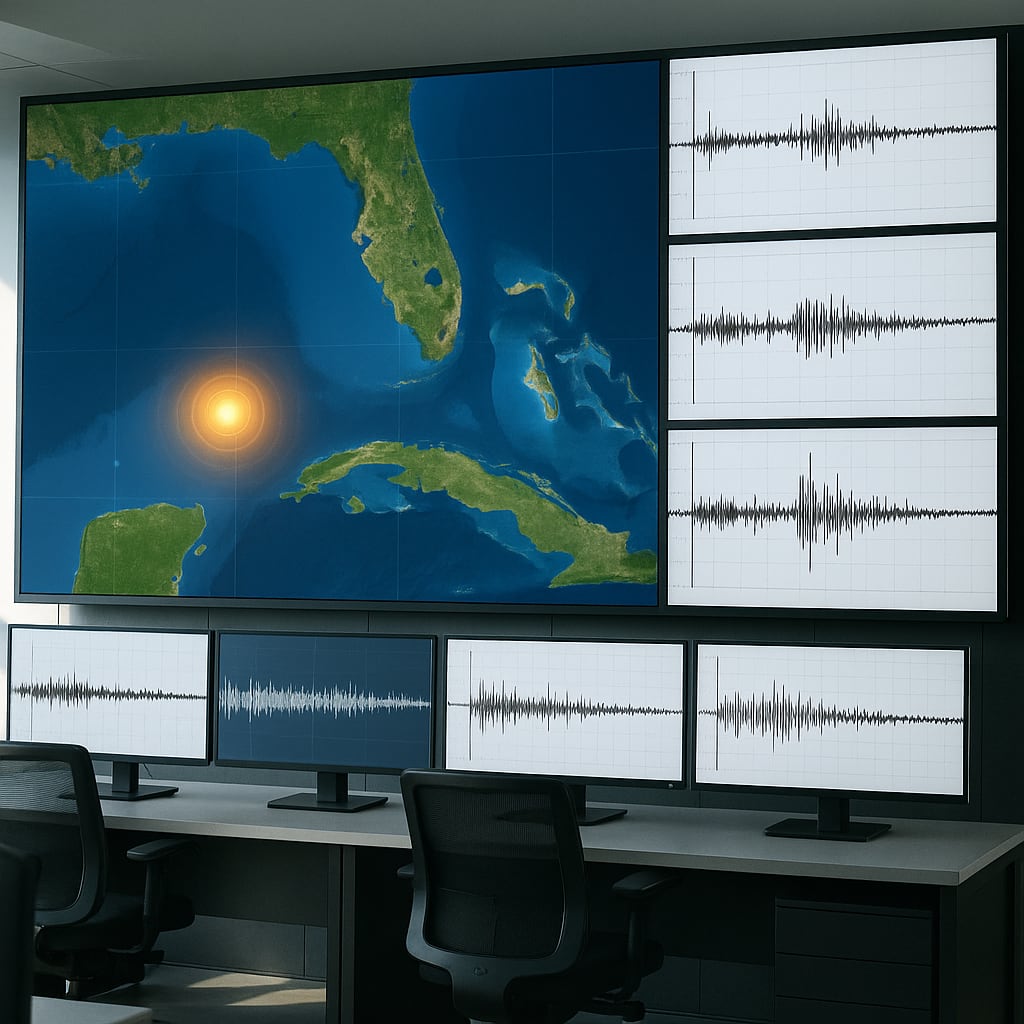
The event was widely described as a powerful tremor lasting roughly tens of seconds in Havana, where people reported feeling swaying—especially in taller buildings—and moving quickly into the streets. Multiple outlets converged on a magnitude around 6.1, with one citing 6.2, and placed the epicenter offshore in the waters to the west/northwest of Havana. The U.S. Geological Survey was repeatedly referenced for the core parameters, including a shallow depth reported as about 10 kilometers in some accounts, consistent with the strong felt shaking described in the Cuban capital.
Geography became part of the story. Reports commonly located the quake near Cuba’s western tip, roughly on the order of 100 kilometers from the island’s extreme west in one widely cited estimate, while still being close enough to Havana for residents to experience a distinct jolt. The combination of moderate-to-strong magnitude and shallow depth helped explain why shaking was felt widely despite the epicenter being offshore.
The tremors did not stop at Cuba’s borders. Several reports highlighted that the quake was felt in Florida, and some extended the felt area to Mexico. In the United States, the most concrete operational impact described was at Walt Disney World in Orlando, where certain attractions were temporarily closed or unavailable after guests reported feeling the tremor. This detail functioned as a clear marker of how an event centered off Cuba could still disrupt routines hundreds of kilometers away, even if briefly.
Initial official and media updates emphasized uncertainty typical of the first hours after a quake: monitoring for aftershocks, awaiting comprehensive damage assessments, and checking critical infrastructure. At the time reflected in the coverage, authorities had not reported major damage or casualties, though the absence of early catastrophic reports was presented as provisional rather than definitive.
Why It Matters
The significance of this earthquake lies in its intersection of risk, readiness, and regional interconnectedness.
For Cuba, the quake put a spotlight on the fragility of the built environment—especially in Havana—where many structures are old and maintenance has been constrained for years. Even without confirmed large-scale destruction, the shaking prompted immediate public concern because a moderate-to-strong quake can turn pre-existing structural deterioration into acute danger. Some coverage explicitly linked public anxiety to the country’s long-running economic crisis and the visible disrepair of buildings, suggesting that the same level of shaking can carry different implications depending on a city’s structural baseline.
Regionally, the episode underscored that seismic events in the Caribbean basin can have cross-border effects that are not always intuitive to residents. Florida is not typically framed as a high-earthquake-risk area in daily life, yet reports of tremors there—and the temporary disruption at a globally visited theme park—turned a geophysical event into a broader public-awareness moment. The story also demonstrated how modern systems of rapid seismic reporting and social media amplification can convert “felt” shaking into immediate international attention, even when the earthquake does not produce dramatic visual damage.
Finally, the quake functioned as a reminder that disaster narratives are shaped not only by what happens at the epicenter, but by what happens where attention is concentrated. Havana’s symbolic and demographic importance ensured sustained focus inside Cuba, while Florida’s tourism infrastructure provided a high-visibility U.S. angle that quickly became part of the global framing.
Diverging Narratives
Across outlets, the core facts largely aligned—an offshore earthquake of roughly magnitude 6.1 affecting western Cuba and felt in Havana and Florida—but coverage diverged in emphasis and in a few key details.
Magnitude and technical descriptors. Most reports settled on magnitude 6.1; at least one used 6.2. The difference is small but meaningful in how audiences perceive severity, and it reflects routine variations that can appear in early seismic solutions or in which monitoring bulletin is used. Depth was not uniformly presented: some accounts specified about 10 kilometers, while others emphasized location relative to Cuba’s western extremity. The common thread remained that it was offshore and shallow enough to be strongly felt.
How “historic” the quake was. Some coverage framed the event as the strongest in nearly 150 years for the area, elevating it from a noteworthy tremor to a historic benchmark. Other outlets avoided that label and treated it as a significant but not unprecedented regional earthquake. This divergence matters because “strongest in 150 years” implies a rarity that heightens alarm and suggests a major shift in local hazard experience, while more restrained language keeps attention on immediate impacts rather than record-setting comparisons.
Where the story is centered. Latin American and European reporting tended to foreground Havana and the immediate human response—people leaving buildings, the sensation of prolonged shaking, and the question of damage on an island where many live in older housing stock. Russian state coverage emphasized the felt experience in high-rise buildings, a practical detail that communicates intensity without leaning into wider socio-economic context.
By contrast, U.S.-oriented coverage elevated Florida’s experience—particularly at Disney World—turning the quake into a “rare” event for American audiences and making the temporary shutdown of attractions a central proof point. Brazilian and some U.S. coverage similarly highlighted the Disney angle, effectively relocating the center of gravity of the story from seismic risk in Cuba to disruptions within a major consumer and tourism space.
Consequences and vulnerability. Some outlets explicitly connected the quake to Cuba’s infrastructure vulnerability and economic constraints, framing the event as a stress test for a country facing chronic material shortages. Others focused on the absence of major damage and casualties, implicitly framing the quake as alarming but contained. Both approaches draw from the same early uncertainty, but they lead audiences toward different takeaways: either a warning about latent risk, or reassurance about immediate outcomes.
Geographic reach. The mention of Mexico appeared in some international reporting as part of a broad regional shake, while other accounts focused on the Cuba–Florida corridor. This shapes perception of the quake’s scale: a tri-country felt area suggests a wider regional event, while a tighter focus keeps the narrative anchored to the most economically and politically salient locales for a given readership.
Current Situation
At the point captured by the coverage, the earthquake’s immediate human impact was chiefly described as strong felt shaking in Havana and a wider regional tremor felt into Florida, with limited operational disruptions reported—most notably temporary unavailability of some attractions at Disney World in Orlando. Authorities had not reported major damage or casualties, though reporting consistently treated early assessments as incomplete.
The near-term outlook centered on continued monitoring and inspections: confirming damage in vulnerable buildings, checking public infrastructure, and tracking the possibility of aftershocks. The broader consequence, already visible in the differing international framings, is that the quake has become both a local warning sign for Cuba’s building resilience and a regional reminder that Caribbean seismic events can briefly ripple into everyday life far from the epicenter.