
Lead
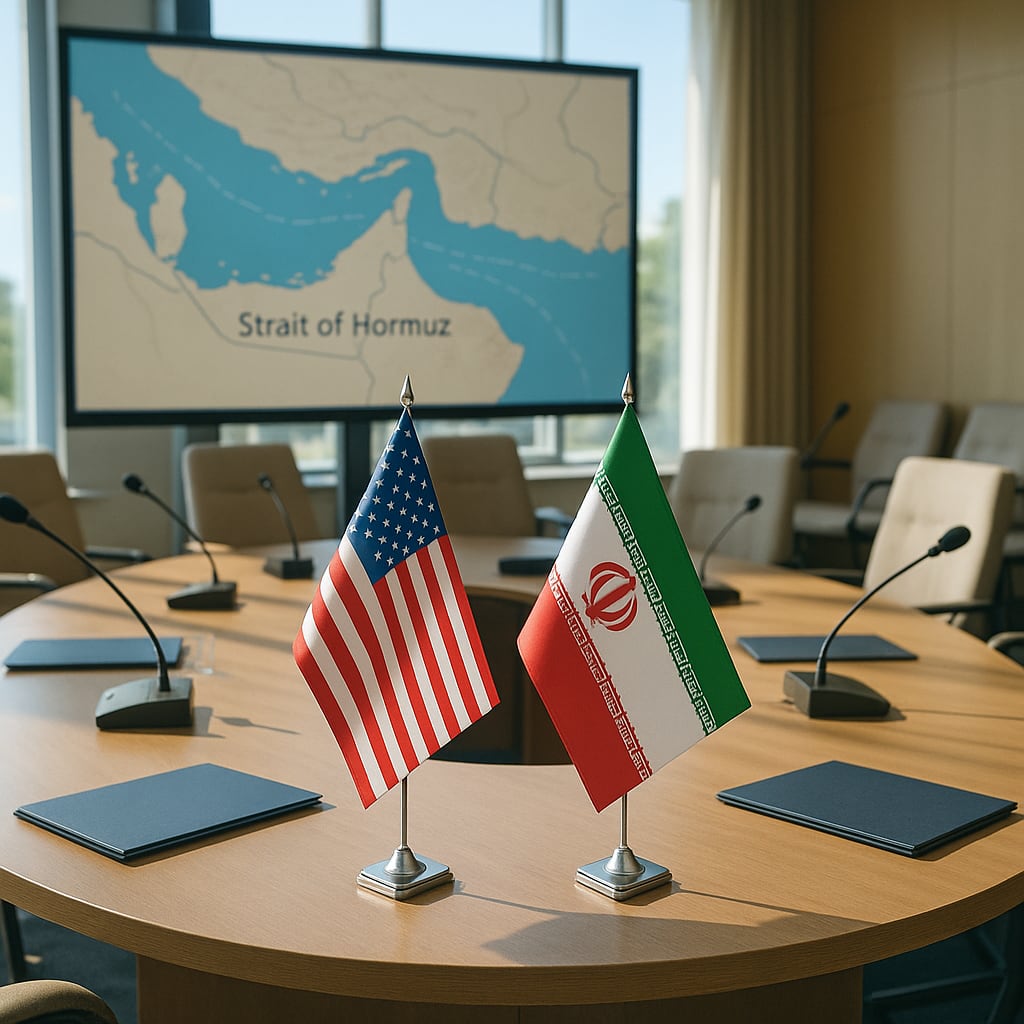
A stop-start push for a US–Iran understanding has moved into its most politically charged phase: Washington is signalling that many elements of a draft framework are already sketched out, while publicly insisting it is “not satisfied” and keeping military pressure on. Tehran, for its part, says message exchanges continue but denies any finalised deal—especially one that would be seen at home as conceding sovereignty over the Strait of Hormuz or capitulating on nuclear demands. The shared picture across international coverage is of negotiations narrowing toward a limited arrangement tied to the blockade and maritime access, even as rhetoric, strikes and regional anxieties keep the region perched between de-escalation and renewed escalation.
What Happened
Across outlets, several facts recur. Talks between the United States and Iran have been under way amid a wider conflict that has disrupted shipping through the Strait of Hormuz and triggered a US-led blockade. Both sides have periodically described negotiations as progressing, but have repeatedly stopped short of declaring an agreement.
In the last week of May, the White House message oscillated. The US president described the United States as not satisfied yet, while also saying he believed Iran wanted a deal. Days earlier, he had spoken more optimistically about the prospect of an imminent agreement, and later indicated he was approaching a “final determination” after consultations with advisers. US officials around him adopted a more encouraging tone: the vice president described “a lot of progress” toward a ceasefire-related deal. That combination—optimism from senior aides, caution from the president—became a feature of the public diplomacy.
Iran’s public stance was more uniform: senior figures reiterated that no final understanding had been reached and that communications continued via message exchanges. Iranian messaging also stressed resistance to “pressure” and “excessive demands,” positioning any negotiation as a defence of rights and sovereignty rather than a retreat.
Meanwhile, events on the ground and at sea continued to intrude. US strikes near Bandar Abbas were reported as part of the ongoing military pressure; Iranian officials said there were no casualties or damage. In parallel, US statements repeatedly returned to Hormuz: Washington framed reopening the strait as non-negotiable, with US officials warning it would open “one way or the other.” Tehran countered with language asserting authority over Hormuz, underscoring that control of the chokepoint remains central to Iran’s leverage and to its domestic narrative.
Several outlets—particularly those focused on diplomatic process and markets—described an emerging framework centred on extending an existing ceasefire and reopening Hormuz. Where the reporting diverged was on how close that framework was to being agreed, and what else it contained: some accounts emphasised additional provisions touching on Iran’s nuclear programme and broader regional posture, while others suggested the nuclear file was not yet fully on the table or remained contested.
Rhetoric also became part of the story. The US president drew international attention for remarks interpreted as threatening Oman over questions related to Hormuz control, a flashpoint that illustrated how negotiations with Iran were entangled with pressure on regional intermediaries and coastal states whose cooperation is critical to any maritime arrangement.
Why It Matters
At stake is not a single issue but a bundle: maritime access through the world’s most strategically important oil chokepoint, the economic impact of disrupted shipping and energy markets, and the political durability of any ceasefire arrangement that could prevent the conflict from widening.
Hormuz and global economics. Coverage that tracked markets highlighted how even the possibility of progress can move prices, while renewed threats and strikes amplify risk. Reopening the strait would be an immediate, tangible outcome with global repercussions—especially for energy prices and supply chains—regardless of whether broader political reconciliation follows. That is why Washington’s repeated insistence that the strait will reopen, and Tehran’s insistence on authority there, are not side issues but the core of the leverage each side wields.
Ceasefire architecture versus “peace.” Much of the reporting suggests the most realistic near-term outcome is a limited framework—an extension or stabilisation of a ceasefire and rules around maritime passage—rather than a comprehensive peace. That distinction matters: a narrow deal could reduce immediate risk without resolving underlying disputes, including those tied to sanctions, regional military posture, and the nuclear programme.
Domestic politics in Washington and Tehran. The US president’s public vacillation—imminence one day, dissatisfaction the next—reflects the constraints of selling any arrangement domestically while also maintaining coercive leverage. Iranian officials, facing their own domestic pressures, have been careful to deny finalisation and to reject portrayals that would make Tehran appear to have yielded under duress. In both capitals, the messaging suggests leaders are preparing their audiences for either an agreement that can be framed as a win, or for continued confrontation.
Regional realignment and ally anxiety. Israeli and Gulf-state concerns run through coverage that focuses on regional security. There are also reports of Washington encouraging Gulf states to join the Abraham Accords, linking the Iran track to a broader US vision for regional alignment. At the same time, the harsh tone directed at Oman—commonly seen as a mediator—signals how fragile the coalition management is around any Hormuz arrangement.
Diverging Narratives
The broad contours align—talks are real, progress is claimed, no deal is final—but the framing differs sharply across outlets and regions.
How close is “close.” Some reporting presents negotiators as nearing a framework, sometimes describing many provisions as already agreed and portraying the remaining obstacles as secondary. Other coverage, especially from Iranian state-linked channels, stresses that nothing is final and that message exchanges continue, implicitly pushing back on any notion that Tehran has accepted US terms. This disagreement is less about whether talks exist than about whether a near-term signature is plausible—and about who would be seen as blinking first.
What the deal is actually about. In several accounts, the centre of gravity is the blockade and Hormuz: reopening shipping lanes, extending a ceasefire, and setting conditions for de-escalation. In others, the emphasis shifts toward the nuclear dimension—claims that Iran’s enriched uranium must be handed over or destroyed, or that nuclear provisions are embedded in the draft. Contrasting reporting also exists on whether nuclear issues have been fully discussed at this stage. The result is two competing public understandings: a maritime/ceasefire package versus a broader strategic bargain that reaches into Iran’s nuclear programme.
Pressure versus diplomacy. Outlets differ on whether US military action and maximalist demands are portrayed as necessary leverage or as destabilising brinkmanship. Coverage that highlights strikes near Bandar Abbas and hardline rhetoric frames negotiations as occurring under threat of escalation, while other accounts foreground the language of progress and final decision-making in Washington.
Regional sovereignty and intermediaries. The Oman episode is framed by some as a dramatic illustration of US coercion even toward partners; in other tellings it is treated as a byproduct of a broader contest over who sets terms for shipping and fees in the strait. Meanwhile, reports involving third-country facilitation—including references to Pakistan’s role in proposals—underscore that this is not purely a bilateral channel, though the prominence of those intermediaries varies by outlet.
The lens of credibility. Some commentary-driven coverage treats any limited deal as vulnerable—an inducement that may not prevent future blockades or crises—casting doubt on durability even if terms are agreed. State-linked Iranian coverage, by contrast, is more focused on contesting the premise that Tehran is desperate or cornered, and on emphasising continued resistance and sovereignty.
Current Situation
As of the end of May, the most consistent, cross-validated status is this: negotiations and indirect communications are continuing; US leaders say significant progress has been made but concede key terms are unsettled; Iran’s Foreign Ministry says no final understanding has been reached. Washington signals it is weighing a “final” decision on a preliminary framework, while Tehran publicly rejects the notion that an agreement is already locked in.
On the ground, military pressure has not ceased, and the Strait of Hormuz remains the central practical issue linking diplomacy to economic risk. The immediate outlook is therefore defined less by grand announcements than by whether both sides can align on a limited framework that addresses maritime access and ceasefire parameters—without either government accepting domestic political costs it cannot absorb.