
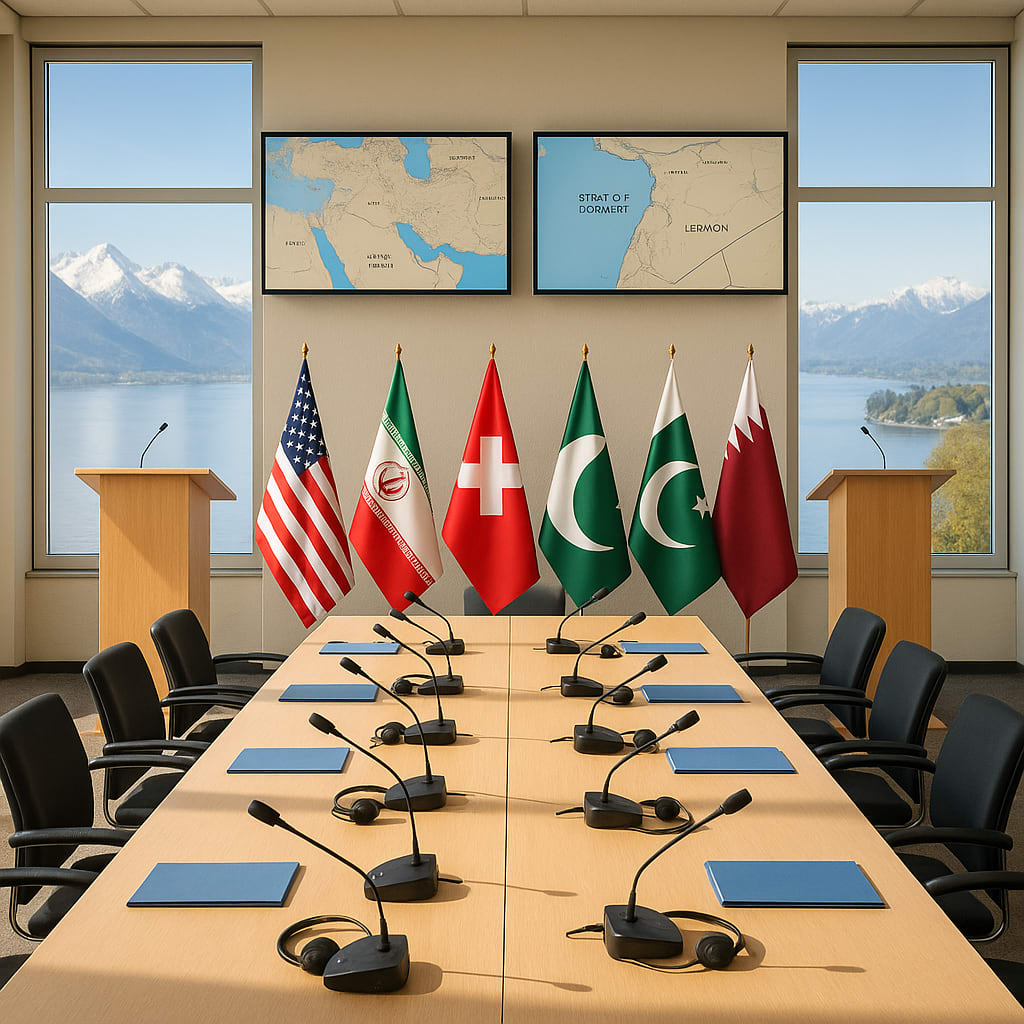
Switzerland cancels first US–Iran implementation talks; envoys pivot as Lebanon front shapes timetable
Narrative Snapshot
- Consensus on cancellation and readiness: Swiss officials said the Friday meeting at Bürgenstock would not take place; the White House framed JD Vance’s delayed departure as logistical and said the US team stood ready to go (The Guardian; The Hindu; Deutsche Welle; Middle East Eye; South China Morning Post).
- Causal framing diverges around Lebanon: US/European lines emphasize logistics, while Israeli and Russian outlets cite Iranian objections tied to Israeli strikes in Lebanon; Tehran publicly warned Israeli attacks or continued occupation in Lebanon would breach the MoU (Times of Israel; TASS; IRNA).
- Modality shift from ceremony to technical talks: Initial expectations of a VP-level signing in Switzerland gave way to reports that Trump envoy Steve Witkoff (and Jared Kushner) and possibly Iran’s FM Abbas Araghchi would handle next steps, with Pakistan and Qatar in a mediating role (TASS; Times of Israel; Deutsche Welle; South China Morning Post; Middle East Eye).
- Stakes flagged as nuclear and economic: Multiple outlets note a 60‑day window to negotiate a permanent nuclear understanding and an initial reopening of oil traffic through the Strait of Hormuz, raising broader implications if the timetable slips (The Guardian; ANSA).
What Happened
Switzerland’s foreign ministry said the first US–Iran talks at the Bürgenstock resort would not occur as planned on Friday, hours after the White House confirmed Vice President JD Vance had postponed his flight, citing logistics (The Hindu; Deutsche Welle; Middle East Eye). The meeting was to open implementation of a 14‑point memorandum of understanding signed earlier in the week, which set a 60‑day window to craft a permanent understanding on Iran’s nuclear program and facilitated resumption of oil traffic through the Strait of Hormuz (The Guardian; ANSA). Initial plans had anticipated a signing ceremony with Vance in Switzerland (TASS; ANSA). After the cancellation, US and Israeli media reported Trump envoy Steve Witkoff was heading to Switzerland and Jared Kushner was already there; Axios-linked reports said Iran’s FM Abbas Araghchi was preparing to travel, with mediators Pakistan and Qatar involved (Times of Israel; South China Morning Post; Deutsche Welle; Middle East Eye).
Why It Matters
The episode underscores how implementation of the US–Iran war MoU is structurally coupled to conflict dynamics in Lebanon. Iranian officials publicly defined Israeli attacks or continued occupation in Lebanon as breaches of the MoU, while several outlets linked the postponement to objections over Israeli strikes, suggesting regional theaters can veto or re-sequence bilateral progress (IRNA; Times of Israel; TASS). Institutionally, Switzerland’s role as host, alongside mediators Pakistan and Qatar, reflects reliance on ad hoc, multi-node diplomacy rather than formal multilateral frameworks (Middle East Eye). The move from a vice-presidential ceremony to envoy-led technical talks signals a recalibration of process and optics. Economically, partial normalization of traffic through Hormuz depends on the MoU’s momentum, making slippage inside the 60‑day window consequential for energy markets (The Guardian; ANSA). Politically, public messaging—from Vance’s claim of “fundamentally changed” dynamics to Trump’s defense of the deal—highlights domestic and allied contestation that could shape negotiating bandwidth (Middle East Eye; Folha de S.Paulo).
Diverging Narratives
- Cause of the stand-down: The White House cited logistical unpredictability; Switzerland confirmed cancellation without attributing cause (Deutsche Welle; Middle East Eye). Israeli and Russian reports, citing US and other sources, pointed to Iranian objections over Israeli strikes in Lebanon; Tehran separately warned that Israeli actions in Lebanon would breach the MoU (Times of Israel; TASS; IRNA).
- Meaning of the cancellation: The New York Times said the announcement raised immediate questions about the MoU’s fate, given unresolved details, whereas several outlets emphasized that US delegations remained ready to depart and that talks would shift to technical channels (New York Times; South China Morning Post; Deutsche Welle).
- Level and locus of diplomacy: Early coverage centered on a public signing with Vance; subsequent reporting pivoted to envoy-led meetings (Witkoff, Kushner) and a possible visit by Araghchi, with Pakistan and Qatar in support—a contrast between high-visibility ceremony and lower‑profile implementation work (TASS; Times of Israel; Middle East Eye).
- Regional inclusion and sequencing: Lebanese officials said they were not informed of the deal’s terms or ceasefire timing, amplifying questions about stakeholder buy‑in even as some coverage linked a Lebanon ceasefire to revived negotiating efforts in Switzerland (Middle East Eye; South China Morning Post).
- Interpretive frame of the deal: Media treatments range from “breakthrough or bluff?” and “success or disaster?” to Iranian and US viewpoints emphasizing, respectively, structural coercion risks and the primacy of diplomacy, reflecting contested assessments of sustainability and leverage (Sky News; Al Jazeera English; Tehran Times).
What Happens Next
- Negotiating format and rank: Watch whether talks resume at envoy level (Witkoff/Kushner) or return to VP‑led sessions. Travel movements reported by Axios-linked outlets for Witkoff and Araghchi, and any updated Swiss scheduling notices, will signal the process lane (Times of Israel; South China Morning Post; Middle East Eye).
- Lebanon linkage: Iranian statements make a Lebanon ceasefire and questions of “continued occupation” determinative for MoU compliance; Israeli media tied the delay to strikes in Lebanon. Indicators include verified ceasefire implementation and changes in Israeli operations (IRNA; Times of Israel; Deutsche Welle; South China Morning Post).
- Technical agenda inside the 60‑day window: Confirmation of “technical talks” at Bürgenstock with Pakistan and Qatar present would indicate movement from optics to implementation. Look for Swiss foreign ministry communiqués and working-group announcements (Middle East Eye).
- Maritime and energy signaling: Reports that Hormuz traffic has resumed set a baseline; sustained stability—or reversals—will reflect progress or friction in negotiations (ANSA; The Guardian).
- Political messaging and constraints: Public statements from the White House and Tehran, and allied reactions, will shape negotiating latitude, especially if criticism intensifies or red lines are reiterated (Folha de S.Paulo; Middle East Eye).