
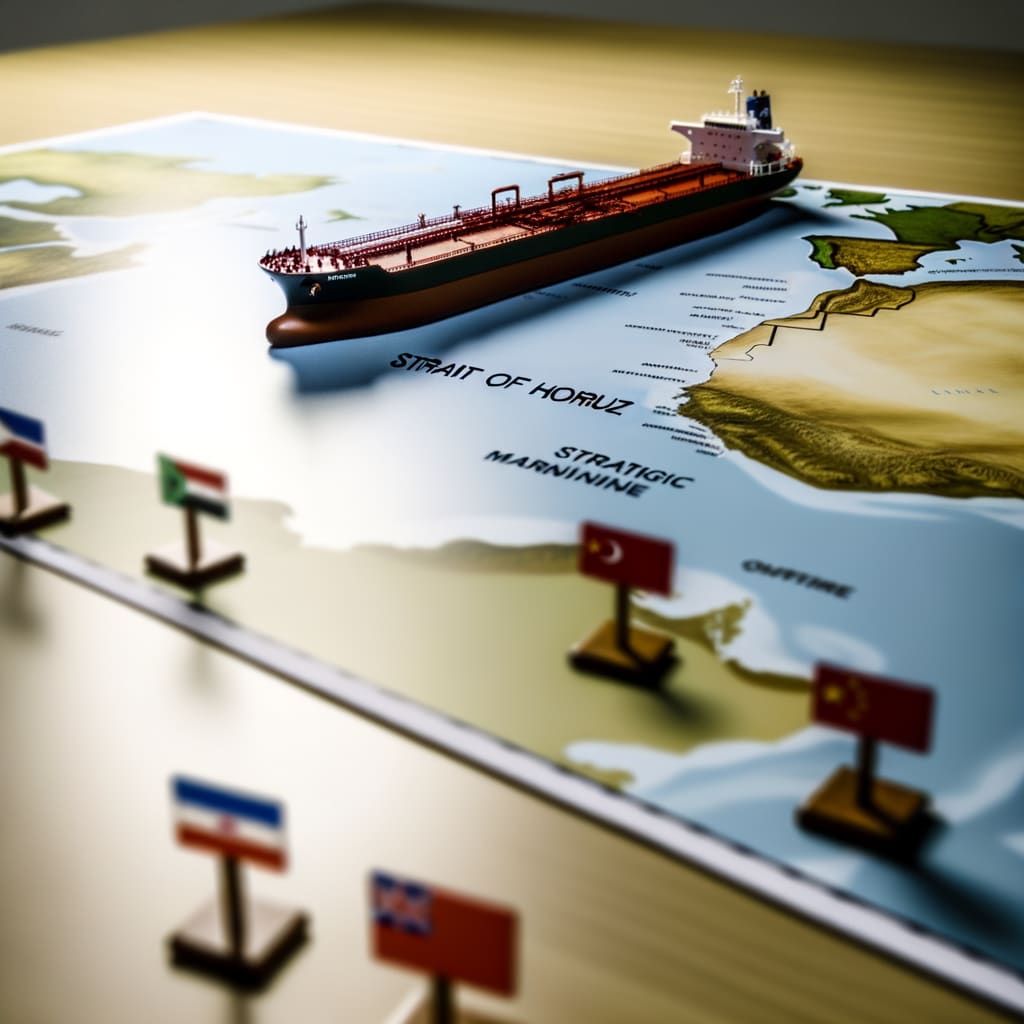
Iran's Closure of Strait of Hormuz Escalates Tensions, Sends Global Economy into Disarray
As the war between Iran, the U.S., and Israel persists, Iran's security chief Ali Larijani asserts that the strategic Strait of Hormuz will remain unsafe, creating global economic disturbance due to its significance in the transport of oil, plastics, fertilizers, and grain. The situation has led to the deployment of French naval forces and a rise in oil prices, with ships attempting to evade Iranian attacks by displaying links to China.
Background and Context
The Strait of Hormuz, a critical route for global oil trade and the transport of other commodities, is currently under the control of Iran's Revolutionary Guard. In an escalating conflict with the U.S. and Israel, Iran has blocked exports to countries it considers enemies or their allies. This blockade has significant implications on the global economy, particularly for nations heavily dependent on these commodities, such as China and Brazil.
Military and Diplomatic Responses
In response to the escalating conflict, French President Emmanuel Macron has taken a proactive stance, proposing a multinational mission to escort tankers through the Strait once the intense phase of the war subsides. Macron stated that the mission would be strictly peaceful and defensive
and may involve both European and non-European countries.
France's plan is to deploy nearly a dozen warships to ensure maritime security and reaffirm its leadership in the European response to the conflict. However, this move by France has also been interpreted as an attempt by Macron to position himself as a mediator of the conflict, amidst internal pressure ahead of the next presidential elections.
Meanwhile, U.S. President Donald Trump has threatened to escalate attacks on Iran if it continues to disrupt global oil supplies. He also expressed his intention to keep the Strait of Hormuz open, describing it as an honor
to do so, particularly to aid China and other nations that depend heavily on the crucial Middle East waterway.
Economic Impact
The closure of the Strait of Hormuz has led to a significant surge in oil prices, the highest since 2022. Moreover, ships anchored in the Gulf or transiting the Strait of Hormuz are altering their tracking data to evade Iranian attacks, with some claiming to have an 'all-Chinese crew' aboard, or changing their destination to 'Chinese.'
Conclusion
The Strait of Hormuz's closure marks a significant escalation in the conflict between Iran, the U.S., and Israel. With Iran's Revolutionary Guard asserting control over the strait, global oil supplies and the economies of various nations hang in the balance. As France and the U.S. prepare different strategies to ensure the continued flow of commodities through the strait, the global community awaits a resolution to the escalating conflict.