
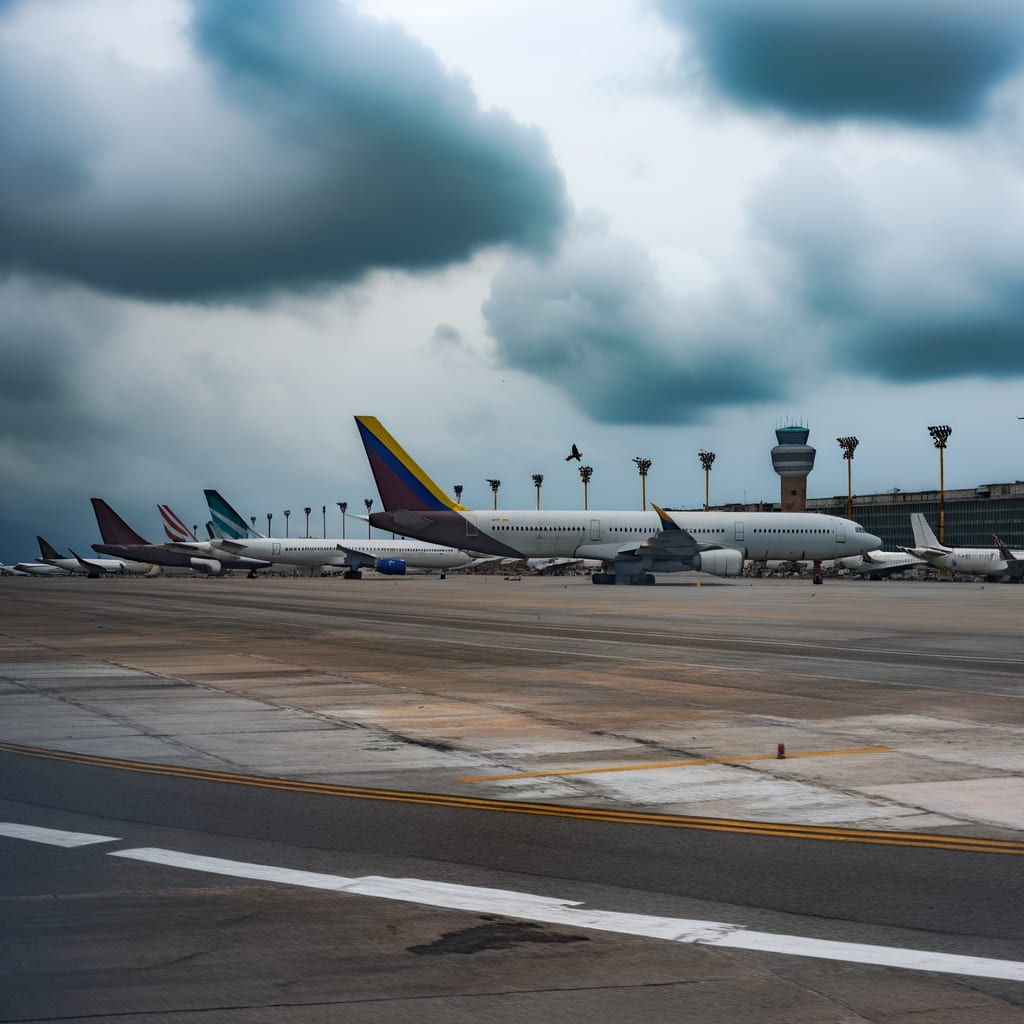
Venezuela Demands Resumption of International Flights Amid US Safety Warnings
In a tense standoff involving safety concerns and political pressure, Venezuela has demanded that international airlines resume their flights within 48 hours or risk losing their clearance to fly there1. This comes after several airlines suspended their Venezuelan flights following a U.S. aviation safety warning23.
Political Pressures and Safety Concerns
The Federal Aviation Administration (FAA) has issued a warning to airlines about flying over Venezuela due to the potentially hazardous situation
in the region45. The FAA notice cited the “worsening security situation and heightened military activity in or around Venezuela” and said threats could pose risks for aircraft at all altitudes5.
The U.S. has significantly increased its military presence across the Caribbean, deploying bombers, warships, and Marines as part of an expanded campaign targeting drug-trafficking and so-called narco-terrorist
networks operating near Venezuela4. President Donald Trump has also authorized the CIA to conduct covert operations inside the Caribbean nation6.
Simultaneously, the U.S. administration has escalated pressure on Venezuelan President Nicolás Maduro2. Trump has warned Maduro that he can do things the easy way … or the hard way,
as the Venezuelan leader vows to defend every inch
of the country7.
Airlines Respond to Warnings
In response to the FAA warning, several major airlines, including Brazil’s Gol, Colombia’s Avianca, and TAP Air Portugal, canceled departures from Caracas2. Other airlines, including Spain's Iberia, Chile and Brazil's LATAM, and Turkish Airlines, have also suspended flights indefinitely38.
TAP stated its flight decision followed U.S. advisories indicating that safety could not be guaranteed2. Iberia announced it would suspend flights to Caracas until further notice
2.
Venezuela's Response and International Reactions
Venezuela responded by revoking the concessions to six international airlines for suspending flights9. The Maduro regime accused them of joining the 'terrorism actions' promoted by Washington9.
In the international arena, Iran has accused the U.S. of 'bullying' Venezuela with its anti-drug campaign10. Meanwhile, the Dominican Republic has allowed the U.S. to use its territory to fight international organized crime11.
Current Status
The standoff continues, as airlines have yet to resume their operations despite Venezuela's ultimatum9. Amid the escalating tensions, President Trump has stated that he wants to speak with President Maduro12. The situation remains volatile as the U.S. plans to keep its military contingent in the Caribbean until November 202813.