
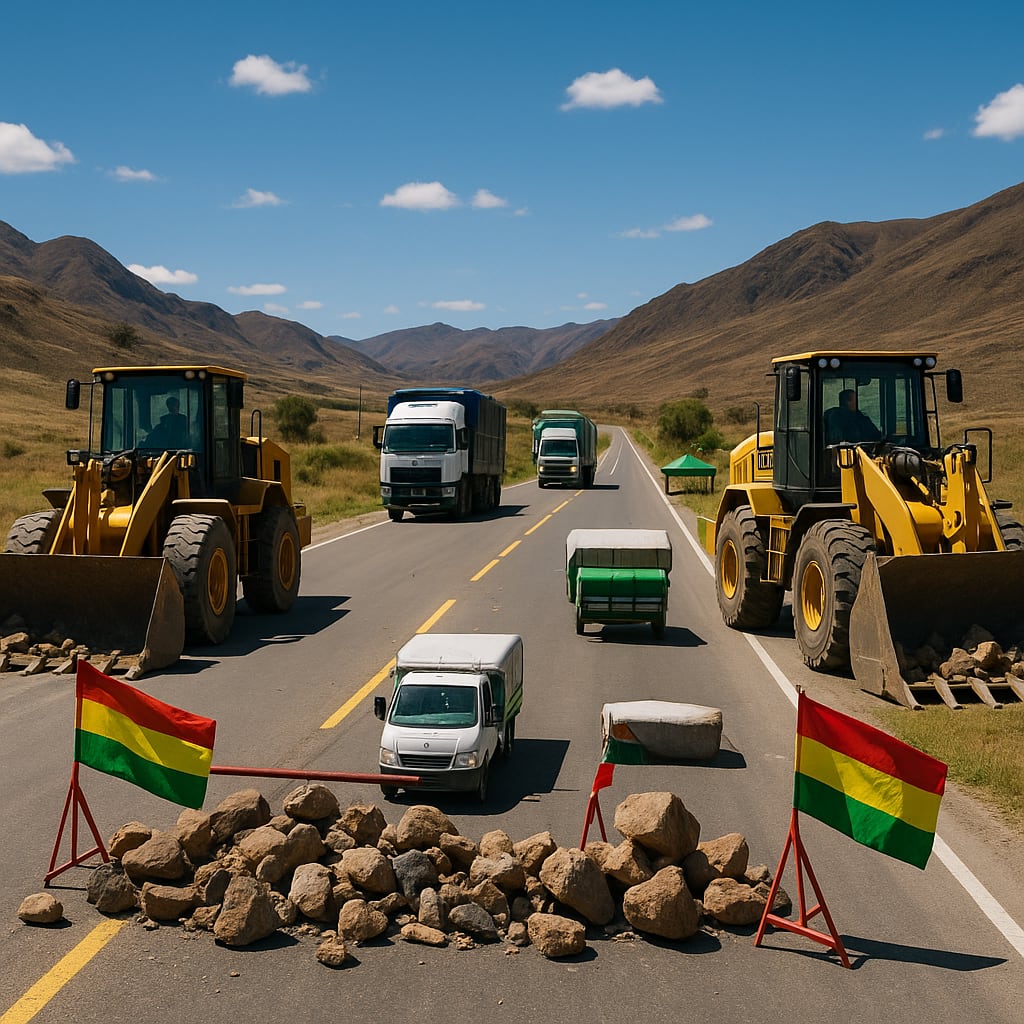
Bolivia declares state of emergency to clear road blockades amid six weeks of unrest
Narrative Snapshot
- Broad agreement: virtually all outlets report the decree enables deployment of security forces to dismantle roadblocks and reopen highways after six weeks (or roughly 50 days) of disruptions that have strained supplies and commerce (SCMP, DW, CBC, BBC, Le Monde).
- Framing diverges on root causes and actors: economic austerity is foregrounded by Al Jazeera, while The Guardian, Clarín, and La Repubblica emphasize a political confrontation with a “conservative” government, protests by unions/Indigenous/coca growers, and links to sectors aligned with former president Evo Morales.
- Institutional emphasis varies: SCMP details constitutional procedures (immediate effect; notification to Congress within 24 hours), while Le Monde (June 21) and The Guardian center on the operational phase—army, police, and bulldozers actively clearing blockades.
- Human impact is covered unevenly: BBC and La Repubblica highlight shortages of basic goods, including food and medicines; Clarín documents thousands of stranded heavy-truck drivers; CBC and The Guardian describe coercive crowd-control and clearance operations.
What Happened
President Rodrigo Paz declared a national state of emergency on Saturday, authorizing wider deployment of the armed forces and police to remove road blockades and “free the country’s roads,” as he put it (SCMP; DW). The move followed a live national address hours after the government announced an agreement with the Bolivian Workers’ Confederation (COB), intended to ease tensions after protracted unrest (The Hindu; Folha, June 19). While the decree took immediate effect, the presidency is required to notify Congress within 24 hours (SCMP). Protests and blockades, launched on May 6 and now six weeks to roughly 50 days old, had paralyzed transport, left thousands of cargo drivers stranded, and produced shortages of basic goods (Clarín; BBC; CBC; La Repubblica). Following the decree, the army and police began clearing roads, including with bulldozers at some sites (Le Monde, June 21; The Guardian).
Why It Matters
The decree tests Bolivia’s constitutional emergency powers and civil-military roles in internal order—authorities cite legal tools to reopen strategic routes, with a prompt-notification requirement to Congress underscoring institutional checks (SCMP). The operation’s outcome bears directly on domestic supply chains: weeks of blockades disrupted flows of food, medicine, and freight, with thousands of truckers immobilized and the economy curtailed (BBC; La Repubblica; Clarín; CBC). Politically, the emergency follows a government-COB accord that may not bind other protest factions, highlighting the fragmented nature of mobilization and the limits of single-channel bargaining (The Hindu; Folha, June 19; Le Monde, June 21). International observers focused on governance and stability will track whether security operations remain bounded and proportional, whether negotiated off-ramps broaden beyond the COB, and whether the government’s framing—order restoration versus political confrontation—reconfigures alignments among unions, Indigenous groups, and movements linked to Evo Morales (Al Jazeera; The Guardian; Clarín; La Repubblica).
Diverging Narratives
- Causal drivers: Al Jazeera anchors the unrest in opposition to austerity measures, while Clarín and La Repubblica report that sectors aligned with Evo Morales joined unions and campesino organizations to demand Paz’s resignation, and The Guardian characterizes the standoff as a broader mobilization by unions, Indigenous groups, and coca farmers against a conservative administration.
- State response and legality: SCMP presents the decree as a constitutional instrument with procedural guardrails (immediate effect; congressional notification within 24 hours), whereas The Guardian and Le Monde (June 21) foreground the coercive mechanics—soldiers and bulldozers clearing barricades—now underway.
- Movement cohesion: Clarín lists the COB among initial organizers of blockades; yet The Hindu and Folha (June 19) highlight a government-COB agreement intended to de-escalate. Le Monde (June 21) reports that, despite that accord, some organizations maintained pressure, prompting the government to order security forces to lift roadblocks—evidence of heterogeneous demands and coordination gaps across protest coalitions.
- Impact emphasis: BBC and La Repubblica stress shortages of food and medicines; CBC and DW foreground the goal of unblocking highways and restoring circulation; Clarín details the plight of more than 5,000 stranded heavy cargo drivers.
What Happens Next
- Congressional interface: The presidency must notify Congress within 24 hours (SCMP). Analysts should watch for legislative reactions—acceptance, questioning of scope/duration, or calls for oversight—as a signal of institutional buy-in or friction.
- Security operations: Le Monde (June 21) and The Guardian report active clearance by army and police, including bulldozers. Key indicators: pace and geographic spread of reopened corridors; whether remaining blockades persist where groups rejected the COB deal.
- Negotiated track: The COB agreement (The Hindu; Folha, June 19) provides a partial channel. Signals to watch: whether the government offers additional talks or adjustments to measures protested as “austerity” (Al Jazeera), and whether other factions enter structured dialogue.
- Socioeconomic stabilization: BBC, La Repubblica, and Clarín document shortages and halted freight. Monitor restoration of food/medicine supplies and release of stranded cargo as a proxy for de-escalation and the decree’s effectiveness in normalizing internal logistics.