
Lead
A fast-moving Ebola outbreak in eastern Democratic Republic of Congo (DRC), driven by the rarer Bundibugyo strain, has begun to reshape politics and public life far beyond the epidemic’s epicentre. As suspected cases climbed toward — and in some accounts past — the 900–1,000 mark, the World Health Organization (WHO) warned that the disease is colliding with armed conflict, displacement and deep mistrust. Neighbouring Uganda reported a growing handful of confirmed infections and shut its border with the DRC, while other African governments moved to harden surveillance and prepare quarantine capacity. In Europe, Italian authorities placed a humanitarian doctor returning from Congo under precautionary isolation, underscoring how quickly a local health crisis can become an international test of readiness, communication and confidence.
What Happened
The outbreak is centred in the DRC’s east, in a region where insecurity and population movement complicate any large-scale public health operation. Across coverage, several core elements recur: the virus involved is the Bundibugyo strain; the case count has been rising rapidly; and response teams face constraints in logistics, security and community acceptance.
By late May, WHO-linked figures circulated widely: more than 900 suspected cases and roughly 220 suspected deaths. Some reporting framed the situation as cases “surpassing 1,000,” reflecting either a later update, differing cut-off times, or the fluidity inherent in suspected-versus-confirmed tallies while testing capacity is scaled up. Multiple outlets stressed that numbers were expected to change as laboratories and field teams expanded verification.
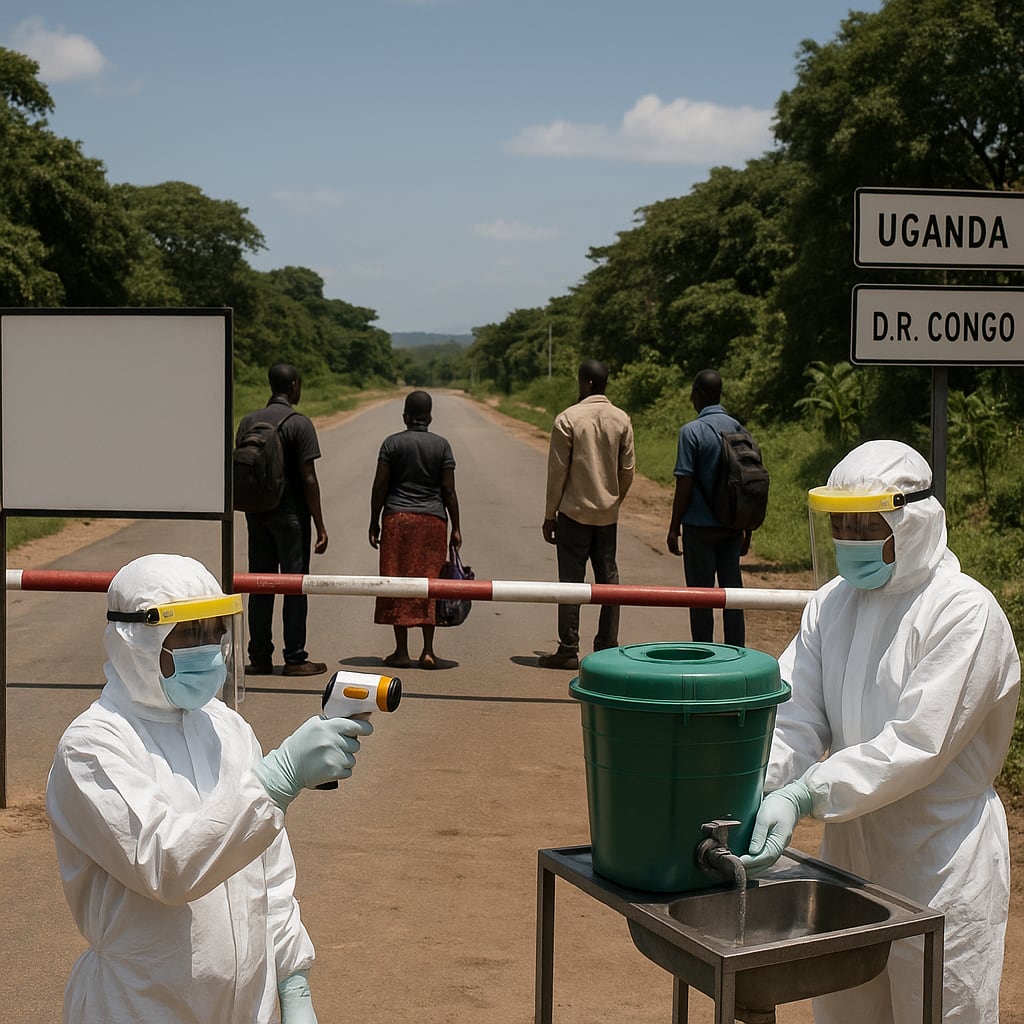
Uganda emerged as the most immediate cross-border concern. It confirmed additional Bundibugyo cases during the same period and announced a temporary border closure with the DRC for several weeks. The closure was presented as a containment measure amid rising infections next door and the reality of intense cross-border movement for trade, work and family ties.
The outbreak’s social dimension has been stark. Accounts from the region described community resistance and volatile interactions around treatment and death management — including an incident in which residents forced entry to a hospital to take the body of a person who had died of Ebola. Such episodes matter epidemiologically because Ebola transmission risk is particularly high through contact with bodily fluids, and risk can intensify around traditional funeral rites and the handling of corpses.
International institutions and governments also moved on two other fronts: medical tools and travel-related risk. Several reports highlighted the absence of an approved vaccine or specific treatment for Bundibugyo comparable to countermeasures used for other Ebola variants, prompting efforts to access experimental antibodies and to convene experts to assess candidate treatments and vaccine approaches. Meanwhile, African states outside the immediate outbreak zone issued alerts and activated preparedness steps, from enhanced screening to contingency planning.
The ripple effects reached Europe. Italian reporting described a doctor affiliated with Médecins Sans Frontières returning from Congo after contact with Ebola patients and being placed under quarantine at Rome’s Spallanzani hospital as a precaution. Coverage in Italy emphasised that the clinician was asymptomatic at the time of isolation, framing the measure as preventive and protocol-driven rather than a sign of domestic transmission.
Why It Matters
This outbreak is being treated as more than a medical emergency: it is a stress test for governance in conflict settings, for regional diplomacy in the Great Lakes, and for the credibility of global health leadership.
First, the security environment is not a backdrop but a driver of operational limits. WHO leadership publicly pressed for a ceasefire to allow health teams to reach communities, isolate cases and conduct contact tracing. The argument is straightforward and repeated across international coverage: you cannot run a containment strategy — transport specimens, staff clinics, protect responders, establish safe burial teams — when fighting disrupts roads, communications and trust, and when civilians are displaced repeatedly.
Second, the outbreak has triggered immediate policy decisions at borders. Uganda’s closure is a high-impact signal: it acknowledges a cross-border threat but also risks disrupting livelihoods in one of Africa’s busiest informal trade corridors. Such measures can deter movement through official crossings while pushing it toward informal routes, complicating surveillance — a tension that hangs over the region’s public health strategy even when not stated directly.
Third, the Bundibugyo strain’s tool gap is shaping the international response. Multiple outlets converged on a central point: there is no widely available, specifically approved vaccine or treatment for this strain. That reality forces reliance on classic containment — detection, isolation, contact tracing, community engagement — while accelerating deliberations on experimental antibodies and on whether and how to adapt existing vaccine platforms. The scientific uncertainty feeds political pressure: authorities must act decisively without the reassurance of a proven pharmaceutical backstop.
Fourth, the outbreak is exposing fault lines in global health capacity and politics. Some commentary framed the crisis as an early test of a world in which the United States plays a reduced role in global health, shifting more burden to WHO, regional bodies and national governments. Whether or not one accepts that thesis, the coverage broadly agrees that the response is strained — by speed of spread, insecurity, and limited supplies — and that choices made now will set precedents for how future epidemics are financed and managed.
Finally, events around death management — including the seizure of a body from a hospital — underscore that Ebola control is inseparable from community trust. The virus’s lethality may be described as “below 25%” in WHO messaging carried in some reporting, yet fear remains high. Even a lower case-fatality ratio does not prevent social disruption when rumours, stigma, and contested authority drive families to resist medical protocols.
Diverging Narratives
The broad facts overlap, but outlets diverge sharply in emphasis and in the causal story they tell.
Security-first framing vs health-system framing. International coverage anchored in WHO messaging foregrounded war and armed group activity as the main accelerant: the “collision” of disease and conflict. Other reporting leaned more toward health-system strain and tool scarcity — shortages of protective equipment, limited testing, and the lack of approved Bundibugyo-specific countermeasures — portraying the outbreak as outpacing institutional capacity even without attributing primary blame to combatants.
The meaning of the numbers. The most visible discrepancy is the case count: “more than 900 suspected” versus “surpassing 1,000.” The disagreement is less about contradiction than about measurement. Some outlets treated suspected cases as the headline indicator; others presented a higher figure that appears to reflect either later situational updates or different aggregation methods. Several sources also stressed that figures would change as testing scales up, implicitly warning readers not to treat any single day’s numbers as final.
How contagiousness and risk are communicated. Explanatory pieces tended to focus on transmission mechanics — direct contact, heightened risk from corpses, and the role of funeral practices — framing public behaviour as a central variable. Political and diplomatic coverage emphasised border closures, ceasefire appeals and international coordination. European coverage, exemplified by Italy’s quarantine decision, focused on protocol, reassurance and containment competence, with prominent attention to the asymptomatic status of the returning clinician.
International responsibility and geopolitics. Some narratives widened the lens to global power: reduced US engagement, debates over where to quarantine citizens abroad, and how international aviation and travel guidance should be managed. Others kept the focus local, highlighting community incidents, deaths of health workers, and the day-to-day dangers faced by responders — a human-security framing that casts the epidemic as a lived crisis rather than a policy test.
Current Situation
As of the latest reports in this cycle, the outbreak remained concentrated in eastern DRC but was no longer a purely national emergency: Uganda had confirmed multiple cases and enacted a time-bound border closure, and a range of African countries had moved to heightened alert and preparedness measures.
WHO’s public posture combined urgency with conditional optimism: the outbreak can be stopped, but only if access improves and communities cooperate — conditions that hinge on security, logistics and trust. Expert consultations were under way to evaluate candidate treatments and vaccines for Bundibugyo, while some reporting highlighted efforts to obtain experimental antibody therapies as case numbers climbed.
Outside Africa, responses have focused on risk management rather than widespread alarm. Italy’s precautionary quarantine of an asymptomatic doctor returning from Congo illustrates a pattern likely to repeat elsewhere: vigilant monitoring of known exposures, isolation when appropriate, and public messaging designed to prevent panic while reinforcing that Ebola transmission requires close contact.
The immediate outlook is defined by three moving targets: the reliability of surveillance and testing (which affects the case count itself), the effectiveness of community engagement around care and burials, and the security situation that determines whether responders can reach hotspots consistently.