
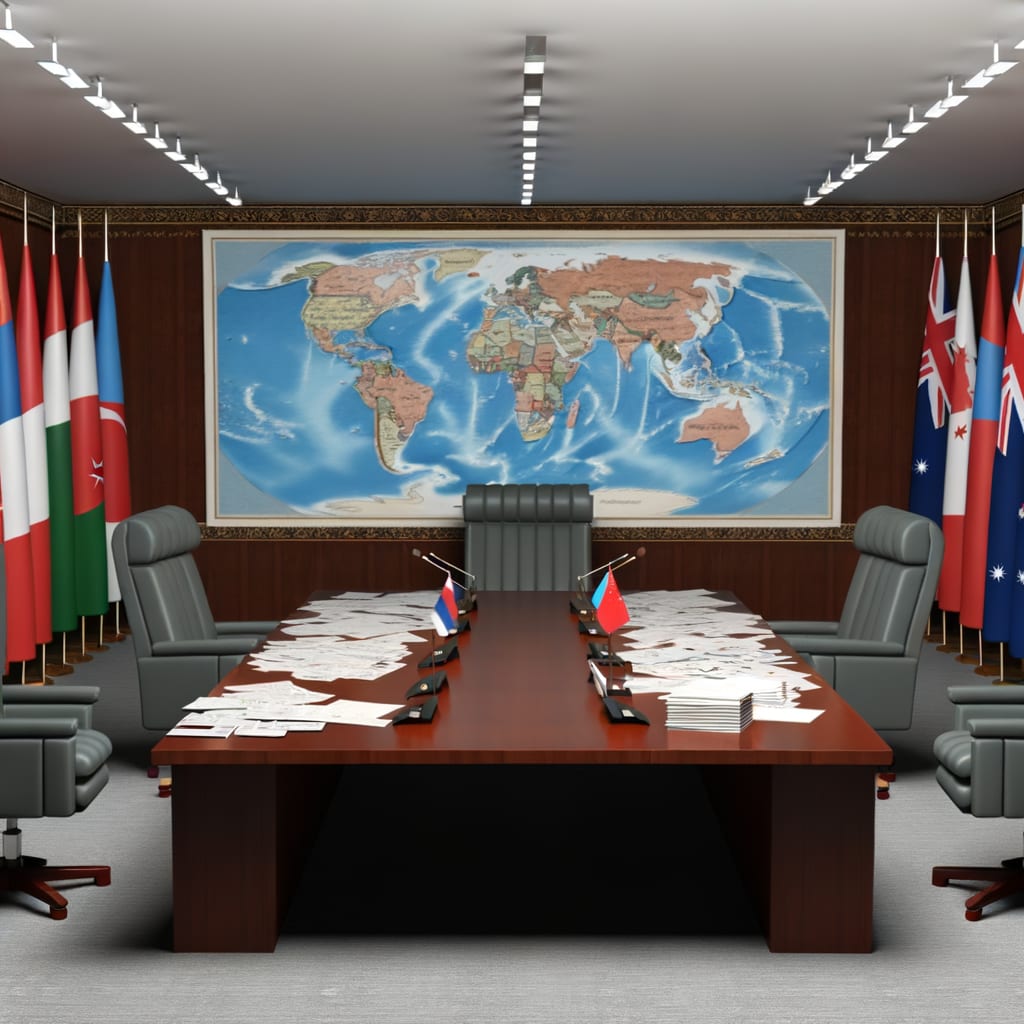
US-Iran Talks: A Saga of Contrasting Claims Amid Intense Military Conflict
As the conflict between the United States and Iran continues, a haze of contrasting claims, denials, and threats swirl around the question of ongoing negotiations. While the US claims that conversations with Iran are underway and progressing positively, Iran resolutely rejects the assertion, adding that it demands a complete cessation of hostilities across the region.
Background and Context
The conflict, now in its fifth week, has seen the US carry out continuous strikes against Iran, with Israel also executing a wave of attacks on Tehran. Iran's President Masoud Pezeshkian argues these actions showcase the US's disbelief in diplomacy. Simultaneously, the Trump administration maintains that the talks are ongoing, with the US president even claiming that emissaries are involved in these discussions.
Diverging Narratives
Contrarily, Iran's ambassador to Russia, Kazem Jalali, dismissed Trump's claims of negotiations as completely false
, stating that Iranian officials have repeatedly denied any talks. Iran’s Foreign Minister Abbas Araghchi concurred, confirming that while messages have been exchanged with Washington, directly or via regional intermediaries, this does not amount to negotiations.
US Secretary of State Marco Rubio, however, hinted that Washington was in contact with a new
and more reasonable
regime in Iran, while declining to elaborate further.
Threats and Counter-Threats
Amid these conflicting narratives, both sides have issued threats. The White House warned Iran to accept a military defeat, or the US would hit harder than before. Trump even went further to issue a stark warning to Iran, saying the US will “keep blowing them away” if a deal is not reached, and that Iran should negotiate or he will become their nightmare
.
In response, Iran has warned of executions and asset seizures for spying or aiding 'hostile states'. Iran's judiciary spokesman added that even sharing photos or videos that could aid enemy targeting may be treated as providing intel.
Current Status
As tension escalates, the situation inside Iran seems to be fracturing, with officials advocating for negotiations with the US being labeled as traitors, risking elimination.
Despite the threats and internal fractures, Trump appears hopeful about the resolution of the conflict, claiming that the US could end the war in two or three weeks. However, this assertion seems to contrast with his earlier threat to Iran to make a deal or face continuous attacks.
The ongoing conflict and its potential resolution, therefore, remain shrouded in uncertainty, with contrasting claims from either side and the continued threat of military action.
In the midst of this ambiguity, it is clear that the international community is closely watching the developments in this conflict, waiting for a resolution that would bring peace to the region.