
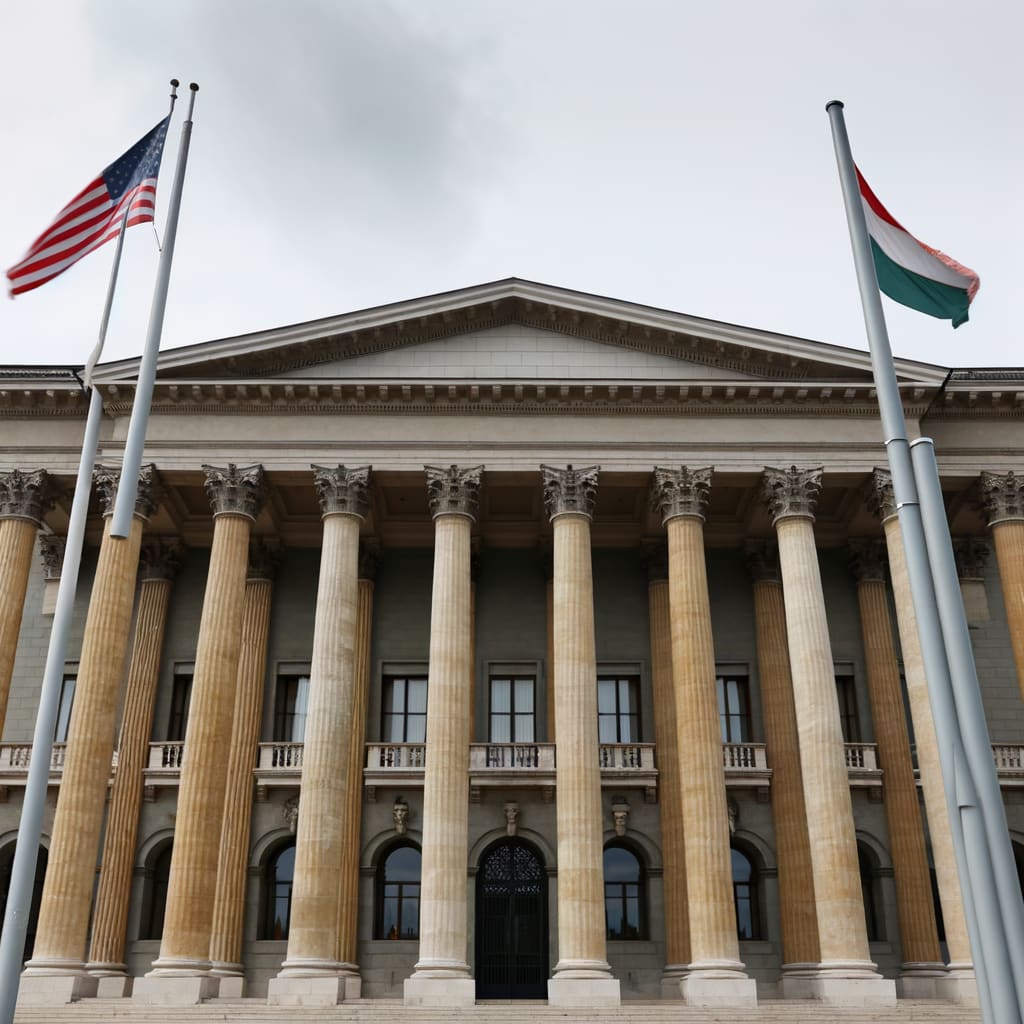
US Vice President JD Vance Visits Hungary to Support Prime Minister Viktor Orban's Re-Election Bid
In the lead-up to Hungary's pivotal parliamentary election this Sunday, US Vice President JD Vance made a high-profile visit to Budapest to lend support to incumbent Prime Minister Viktor Orban.
Background and Context
Orban, a Eurosceptic nationalist who has held power since 2010, is facing the most challenging re-election bid of his career. The Prime Minister's Fidesz party is trailing behind the center-right Tisza party, led by Peter Magyar, according to several independent polls. Orban, a symbol of the global far-right and an inspiration for former US President Donald Trump, has been accused by critics of eroding democratic norms in Hungary.
Key Developments
During his two-day visit, Vance held a joint press conference with Orban and lavished praise on the Hungarian Prime Minister. Vance's visit, the highest-level diplomatic trip by an American official to Budapest since 2006, was seen as a clear signal of the US' support for Orban.
In his remarks, Vance criticized what he termed as shameful electoral interferences
by the European Union and Ukrainian spies, echoing Orban's campaign messaging. The US Vice President also condemned recent comments by Ukraine's Volodymyr Zelensky, labeling them as outrageous and unacceptable.
Adding to the spectacle, US President Donald Trump joined the rally via a phone call, declaring his support for Orban. Victor is a fantastic man,
Trump declared in the call held up by Vance to the crowd.
Implications and Reactions
The visit has drawn a mixed response from both international and local observers. While Hungary's Foreign Minister Peter Szijjarto hailed the event as a new golden age
in U.S.-Hungarian relations, others have noted that the US support may not guarantee Orban gains in the election. Some critics argue that Vance's intervention could even have a counterproductive effect among Hungarian voters.
The visit also highlights the broader geopolitical implications, with ex-Austrian Foreign Minister Karin Kneissl suggesting that the US and EU are engaged in a political proxy war
in Hungary. The US and Russia have both accused the EU of interfering in the Hungarian election.
Conclusion
As Hungary's election draws near, the political stakes remain high. With Orban facing a significant challenge to his decade-long rule, the outcome of this weekend's election could have far-reaching implications for both Hungarian politics and the country's relationship with the US and the EU. Despite the high-profile support from the US, it is ultimately up to the Hungarian voters to decide their country's political future.