
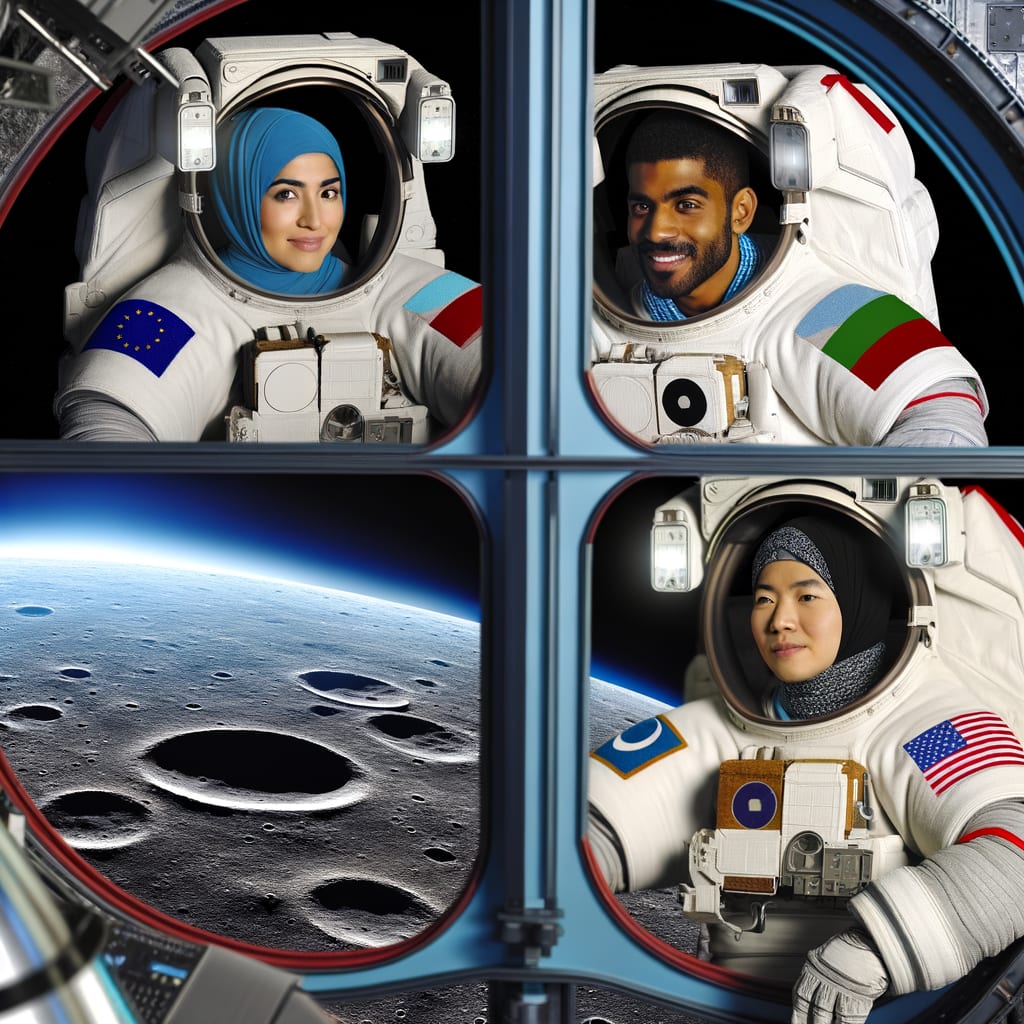
Artemis II Astronauts Set New Distance Record in Historic Lunar Flyby
In a historic achievement, the four astronauts aboard NASA's Artemis II mission have ventured farther from Earth than any humans before them, shattering the distance record set by the ill-fated Apollo 13 mission in 1970. The Artemis II crew, comprising NASA astronauts Reid Wiseman, Victor Glover, Christina Koch, and Canadian Space Agency astronaut Jeremy Hansen, traveled a staggering 406,771 kilometers from Earth during their lunar flyby.
The Journey Begins
The ambitious Artemis II mission began with the launch of the Orion spacecraft, marking a critical phase in lunar exploration. It marked the first crewed lunar journey since the Apollo 17 mission in 1972. However, unlike the Apollo missions, Artemis II was not destined to land on the lunar surface but to flyby the moon and return to Earth.
After four days of travel, the Orion spacecraft entered the moon's gravitational sphere of influence, setting the stage for the record-breaking flyby. The spacecraft came within roughly 6,550 kilometers of the lunar surface, performing a flyby around the moon.
Record-Breaking Flyby Amid Communication Loss
The momentous flyby was not without its tense moments. As anticipated, there was a 40-minute communication blackout as the moon's body blocked radio and laser signals between Earth and the Orion spacecraft. During this time, the four astronauts were more isolated than any humans in deep space history.
Despite the loss of communication, the astronauts continued with their scientific objectives, observing and photographing the lunar far side. The signal was restored as Earth reemerged on the other side of the moon’s horizon, a moment known as Earthrise
.
Making History
In surpassing the distance record set by Apollo 13, the Artemis II astronauts have become the farthest emissaries of our planet. They reached a record distance of 252,756 miles (406,771 kilometers) from Earth, sailing about 5,000 miles further than the Moon.
The historic flyby marks the first time in more than fifty years that humans have traveled this far from Earth. This remarkable achievement has been hailed as a breakthrough in human space exploration and a testament to the capabilities of modern space technology.
The Journey Home
Following the lunar flyby, the Artemis II mission is now Earth-bound. The crew spent a little less than seven hours flying over the moon before commencing their return journey.
As the mission continues, the world awaits the return of these farthest-traveled astronauts. Unseen photos of the far side of the moon taken by the crew during the celestial flyby have been revealed by NASA, capturing the awe and wonderment of this historic mission.
The Legacy of Artemis II
The Artemis II mission, despite being a test flight, has achieved more than its initial objective. It has set a new record for human space travel, paving the way for future lunar exploration missions and taking a significant step toward the goal of establishing a sustainable human presence on the moon.
While the crew prepares for their return, the world celebrates this milestone in human space exploration. The success of this mission is a testament to human innovation and the relentless pursuit of knowledge, pushing the boundaries of our capabilities in space.