
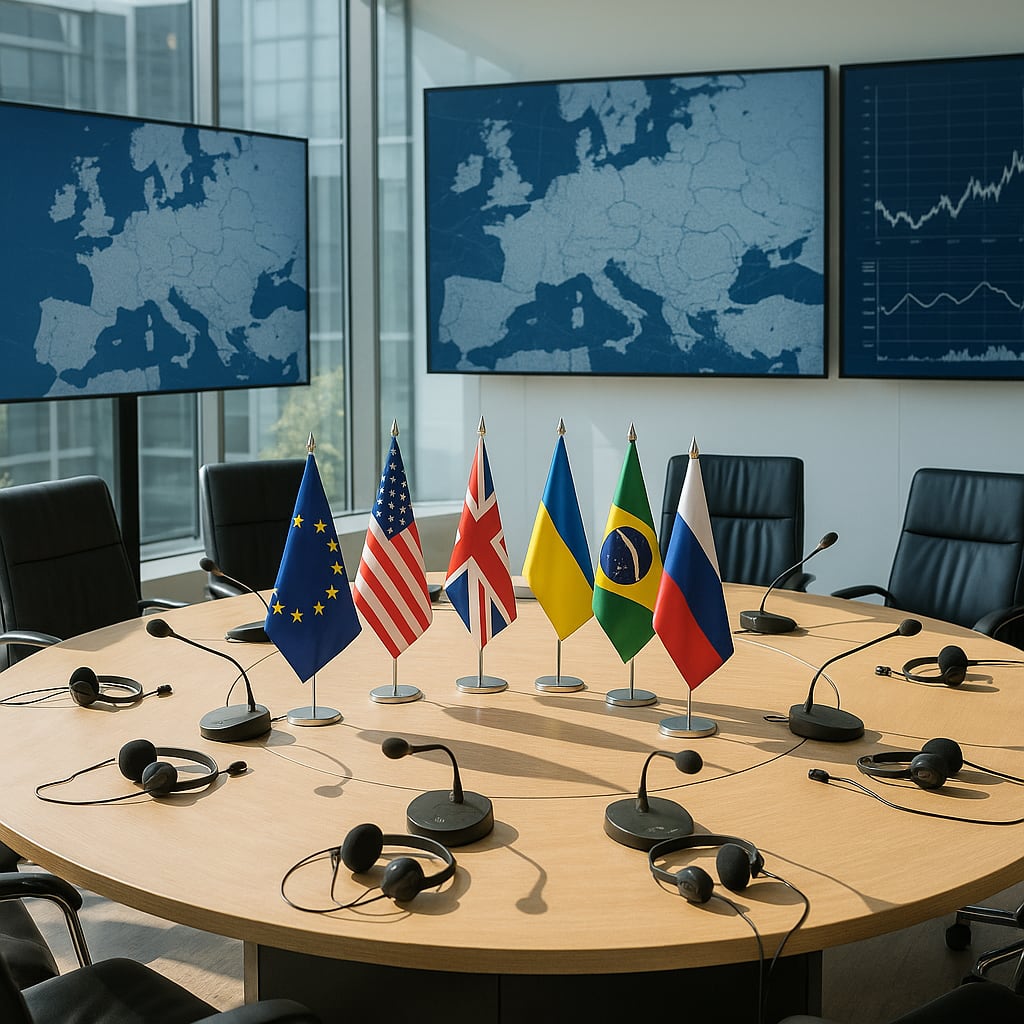
At the G7 in Evian, leaders pressed for a sharper U.S. role on Ukraine as Trump shifted tone and the Kremlin pushed back
Narrative Snapshot
- Western outlets broadly register a tonal shift from Donald Trump toward ending the war, coupled with European efforts to harness it: Le Monde details how Europeans amplified his Iran “deal” and offered maritime support in Hormuz to keep him engaged on Ukraine, while La Repubblica highlights talk of tougher oil sanctions and EU pressure to raise aid. Kyiv Independent stresses alignment gains but “actions still pending.”
- Russian official and pro-Kremlin narratives reject that a shift occurred. TASS relays claims that Europeans “pumped” Trump with “harmful ideas” and that assumptions of a tide turning toward Kyiv are “incorrect,” while its press review spotlights commentary accusing the EU of derailing talks.
- A Global South strand is visible: Folha de S.Paulo reports Lula’s “best” meeting yet with Zelensky and a renewed Brazilian push for peace, with TASS quoting Lula’s readout of donor fatigue.
- Coverage keeps the battlefield in view (Le Monde reports multiple Ukrainian civilian casualties from Russian strikes) alongside economic levers: new UK sanctions (Le Monde) and discussions of limiting Russian oil revenue (La Repubblica).
What Happened
At Evian, G7 leaders convened a session on “security for Ukraine and Europe” with Volodymyr Zelensky present, followed by Trump-Zelensky bilaterals and a planned further meeting (Le Monde, June 16–17). Trump said “Russia should make a deal,” called the conflict’s losses—“notably Russian”—a reason to end it, and characterized Moscow as the offensive party (Le Monde, Japan Times). He declined to detail any expansion of U.S. weapons supplies, though he described contacts with both Zelensky and Vladimir Putin favorably and said both sides want peace (TASS, Japan Times). Europeans reinforced his Iran achievement and offered support in the Strait of Hormuz to sustain U.S. focus on Ukraine (Le Monde). The UK announced new sanctions on Russia (Le Monde), while European leaders pressed for increased aid and constraints on Russian oil revenues (La Repubblica). Zelensky held a joint post-G7 call with Trump and Emmanuel Macron, saying it “could make a big difference” (Kyiv Independent). The Kremlin dismissed talk of a pro-Ukraine shift and said Europeans had influenced Trump; Moscow also publicly invited Zelensky to meet Putin in Moscow (The Hindu, ANSA).
Why It Matters
The episode tests whether G7 diplomacy can translate a U.S. tonal shift into policy outputs—aid, sanctions, and political guarantees—amid constraints flagged within the U.S. system. TASS cites Vice President Vance’s argument that Washington’s capacity to support Kyiv is limited, underscoring European debates over burden-sharing and the feasibility of oil-revenue curbs (TASS; La Repubblica). Le Monde’s account of an EU “give” on Iran/Hormuz to secure a “get” on Ukraine speaks to transactional linkages that may now shape transatlantic coordination. Brazilian engagement, which Folha frames as newly constructive, signals potential Global South roles in de-escalation even as Russia rejects any narrative of momentum shifting to Ukraine (The Hindu; TASS). The mix of battlefield casualties (Le Monde) and stalled concreteness (Kyiv Independent) highlights a policy gap: rhetoric outpacing commitments, with implications for NATO planning cycles, EU budgetary decisions, and sanctions enforcement architectures.
Diverging Narratives
Western-European reporting emphasizes movement in Trump’s posture and intentional European choreography to sustain it. Le Monde details the diplomatic inducements around Iran/Hormuz; La Repubblica spotlights calls to escalate economic pressure on Russian oil and EU pressure for more aid; the Japan Times notes Trump’s public framing that Russia is the aggressor. Yet Kyiv Independent underlines the absence of new, specific U.S. measures despite the improved tone and Zelensky’s assertion that follow-on calls “could make a big difference.”
Russian official channels push the opposite reading. The Kremlin labels claims of a shift “incorrect,” asserting Europeans want the war to continue and “pumped” Trump with harmful ideas (TASS; The Hindu). TASS’s press review amplifies commentary that the EU is derailing talks and juxtaposes this with market expectations tied to Middle East developments. Meanwhile, Corriere della Sera reports a sharp Russian media/political backlash portraying Trump as ambiguous and intent on offloading Ukraine costs onto Europe.
A third line comes from Brazil: Folha’s account has Lula valuing his Zelensky meeting and pledging renewed mediation, while TASS quotes him sensing Western fatigue and desire to end the war—framing that differs from both European escalation-of-support arguments and Moscow’s denial of any shift.
What Happens Next
- U.S. policy specificity: Trump avoided detailing expanded weapons aid (TASS). Indicators to watch include any Pentagon or White House announcements on systems, munitions flows, or policy constraints; explicit U.S. backing for tighter oil measures referenced by European leaders (La Repubblica); and follow-up readouts from Trump–Zelensky contacts (Kyiv Independent).
- Transatlantic trade-offs: European “give-and-take” linking Iran/Hormuz contributions to Ukraine engagement (Le Monde; Corriere della Sera) could solidify in G7 or EU communiqués, maritime deployments, or sanctions packages. Signals include EU Council budgetary moves on Ukraine aid and UK/EU sanctions expansions (Le Monde).
- Russia’s response channel: The Kremlin’s invitation to Zelensky to meet in Moscow (ANSA) and its denial of any pro-Ukraine momentum (TASS; The Hindu) set markers. Watch for Russian openness to third-party facilitation (e.g., Brazil) versus tighter red lines in public statements.
- Political bandwidth and legitimacy: TASS’s citation of U.S. capacity limits (Vance) and a Ukrainian poll showing most expect leadership change after the war (Kyiv Independent) bear on endurance and negotiating space. Monitor U.S. congressional dynamics, EU burden-sharing debates, and Ukrainian domestic opinion as constraints on settlement options.