
Lead
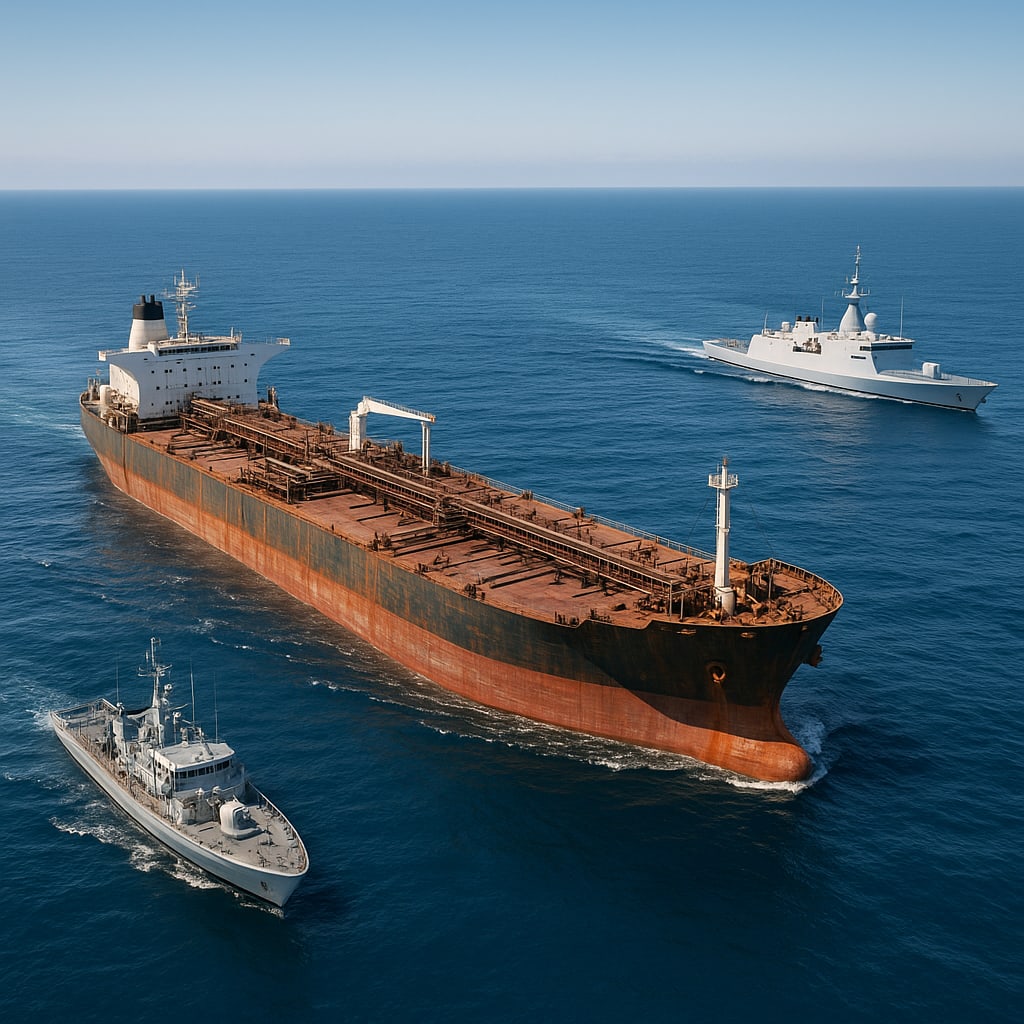
French naval forces boarded and diverted the oil tanker Tagor in the Atlantic Ocean, casting the incident as a high-seas enforcement action against Russia’s “shadow fleet” and the circumvention of international sanctions. Paris says the ship—described as sanctioned and sailing under a false flag—was intercepted far west of Brittany and is being escorted toward a mooring point off western France. Moscow has answered with unusually blunt language, calling the move illegal and akin to piracy, while London has confirmed it helped track and monitor the vessel. The episode has quickly become more than a single boarding: it is a test of how far European states are willing to go to police sanctions on the water, and how Russia will contest those actions diplomatically.
What Happened
The operation took place on Sunday in the Atlantic, on the high seas, at a distance reported by French authorities as more than 400 nautical miles (roughly 740km) west of the tip of Brittany. France’s president publicly announced the boarding and argued that it was “unacceptable” for ships to evade sanctions. Multiple outlets describe the target as the tanker Tagor, linked to Russian oil exports and placed under sanctions by Western governments; Ukrainian coverage further stresses that the ship is sanctioned not only by the EU and the UK but also by Ukraine.
French officials framed the action as an interception and escort rather than a seizure at sea, saying the vessel was being routed toward a designated anchorage or mooring point on France’s western seaboard. Subsequent reporting converges on the same immediate logistical outcome: the ship was to be held at anchor under French oversight, with additional security measures around the site. One recurring detail is that authorities planned restrictions in the area—reported as including a no-flight zone—suggesting heightened concern about safety, interference, or the sensitivity of the operation.
British involvement was publicly acknowledged. London confirmed it supported the French effort by helping monitor and track the vessel, a detail that appears repeatedly in French- and English-language coverage and is also cited in Russian state media. Paris similarly highlighted “several partners,” with the UK named among them—an emphasis that appears designed to show the action was not a unilateral French impulse but part of coordinated sanctions enforcement.
Russia responded on several tracks. The Kremlin condemned the detention as illegal and “bordering on piracy,” language echoed across Russian official statements. Russian diplomatic channels in Paris also focused on the crew: preliminary information circulated that the captain was a Russian citizen, and Moscow said its embassy was working to protect Russians aboard. Russian officials rejected the legal premise of forcibly rerouting a vessel from the high seas, arguing that such measures are not provided for by international treaties—an effort to move the argument from political outrage to claimed legal principle.
Across the broader news cycle, the Tagor incident was also used to spotlight a wider maritime problem: the growth of an opaque “shadow” or “dark” fleet transporting Russian oil and petroleum products under complex ownership structures and frequently shifting flags, registrations, and insurers. Environmental risk—especially from older or poorly insured tankers—featured prominently in parallel coverage, portraying the sanctions-evasion system as not only a geopolitical challenge but a potential ecological hazard.
Why It Matters
At its core, the Tagor boarding signals a shift from tracking and sanctioning ships on paper to physically enforcing restrictions at sea. European governments have tightened measures against Russia’s oil revenue since the invasion of Ukraine, but the ability of tankers to reroute, reflag, and operate through intermediaries has blunted the impact. By physically intercepting and diverting a ship described as part of that ecosystem, France is advertising a willingness to impose costs and disruption, not just list names and entities.
The political significance is equally clear. France’s president chose to announce the operation himself, turning a maritime enforcement action into a public message: sanctions will be defended and, in Paris’s view, evasion will be confronted directly. The UK’s acknowledged support adds weight, suggesting a coordinated European posture in the Atlantic and indicating that sanctions enforcement is becoming a shared operational task rather than a purely administrative one.
For Russia, the stakes run beyond a single tanker. Moscow’s “piracy” accusation serves a dual purpose: it delegitimizes the action internationally and warns of escalation if such boardings become routine. Casting the incident as illegal also opens space for diplomatic countermeasures—through protests, legal arguments, or reciprocal actions—without conceding that sanctions have lawful reach on the high seas.
There is also an economic and global dimension. Separate reporting on Asia’s continued appetite for discounted Russian crude underscores a central tension: even as European states tighten enforcement near their waters, demand elsewhere can keep the shadow fleet profitable. That gap—between Western sanctions policy and non-Western purchasing decisions—helps explain why enforcement is increasingly focused on logistics: shipping, insurance, flags, and routes. The implication is that maritime enforcement is becoming one of the few levers available to disrupt flows without direct military confrontation.
Finally, the environmental frame matters because it broadens the coalition for action. By highlighting the risks of poorly maintained or ambiguously insured tankers, enforcement can be presented not just as a geopolitical tool against Russia but as a safety measure to prevent spills and maritime disasters—especially in busy sea lanes and near sensitive coastlines.
Diverging Narratives
The broad facts align across outlets: a French-led boarding in the Atlantic, a tanker identified as Tagor, an escort toward anchorage in western France, British support, and a sharp Russian denunciation. The differences lie in how the same elements are packaged and what is treated as the central issue.
Legality versus legitimacy. Russian official messaging concentrates on the legality of the action on the high seas, portraying it as an unlawful detention and an example of Western “legal nihilism.” This framing aims to shift the debate away from sanctions evasion—where Russia is on the defensive—and toward maritime law and freedom of navigation. Western coverage, by contrast, tends to treat the legitimacy of sanctions enforcement as the main point, emphasizing that the ship was sanctioned and allegedly engaged in circumvention.
“Intercepted,” “seized,” or “detained.” Language varies in ways that matter. Some coverage uses terms equivalent to “intercepted” and “escorted,” implying a controlled diversion under legal authority. Other headlines lean toward “seized,” a word that suggests a more forceful taking of possession. The underlying event may be the same, but the vocabulary signals different judgments about proportionality and legal footing—and it influences whether audiences interpret the action as policing or as escalation.
False flag and the “shadow fleet.” European reporting gives significant prominence to the claim that the vessel sailed under a false flag and that it is part of Russia’s shadow fleet. Russian responses repeat the “allegedly” qualifier around the false-flag claim and put greater emphasis on consular protection and the status of crew members, a move that personalizes the story and can help portray Russia as defending citizens rather than defending sanctions evasion.
Environmental danger as a parallel headline. Ukrainian and some international business-oriented angles elevate the “ticking time bomb” narrative: the shadow fleet as a looming environmental disaster. That emphasis broadens the story beyond the immediate confrontation and presents enforcement as preventative safety policy. Other outlets foreground the diplomatic clash—Paris’s announcement and Moscow’s retaliation—making the environmental theme secondary.
Partner role and coalition signaling. British confirmation is widely cited, but its portrayal differs. In Western coverage it reinforces allied cooperation; in Russian state media it functions as evidence of a coordinated Western campaign, potentially bolstering Moscow’s argument that the action is political rather than legal.
Current Situation
As of the latest reporting, the Tagor is being escorted toward a designated anchorage or mooring area off western France, with additional security measures reported around the site. French authorities continue to present the incident as sanctions enforcement against a vessel accused of attempting to skirt restrictions, while Russia maintains that the detention is illegal and has mobilized diplomatic channels to safeguard its nationals aboard.
The immediate outlook is defined by procedure rather than drama: administrative and legal steps around the ship’s status, scrutiny of documents and flagging, and continued diplomatic sparring over the right to stop and reroute a tanker on the high seas. The broader trajectory is clearer: the confrontation is likely to be treated, on both sides, as a precedent—either for more assertive European action against the shadow fleet, or for a sustained Russian campaign to challenge the legitimacy and legality of such operations.