
Lead
The Trump administration is moving on two parallel tracks to restore and expand its tariff agenda after the U.S. Supreme Court struck down a large tranche of earlier duties in February. On one front, it is fighting in court over whether importers must be reimbursed for tariffs already collected—an issue affecting more than 300,000 importers. On the other, it is unveiling a new, broad set of proposed levies—generally in the 10% to 12.5% range—aimed at roughly 60 economies, including the European Union and major U.S. partners across Asia, Europe and the Americas. The stated rationale this time is forced labour: U.S. trade officials argue the targeted governments have failed to adequately bar goods produced with forced labour from entering their markets, indirectly enabling such goods to flow into U.S. supply chains.
Across the coverage, the shared picture is of a White House searching for a more durable legal hook for tariffs while maintaining political momentum for “tariff wall” policies—an approach already drawing swift diplomatic pushback from Beijing and Brussels and unsettling partners in ongoing trade negotiations.
What Happened
In February, the U.S. Supreme Court invalidated many of the Trump-era surtaxes on imports. That ruling set off a high-stakes administrative and legal aftershock: how far the decision reaches, what authorities the executive branch can still use to impose trade penalties, and whether the government must repay duties already collected. French coverage emphasizes that the administration has appealed a court decision requiring reimbursement, underscoring the scale of the affected importing community—more than 300,000 importers—an unusually concrete measure of how widely the earlier tariffs had penetrated the U.S. economy.
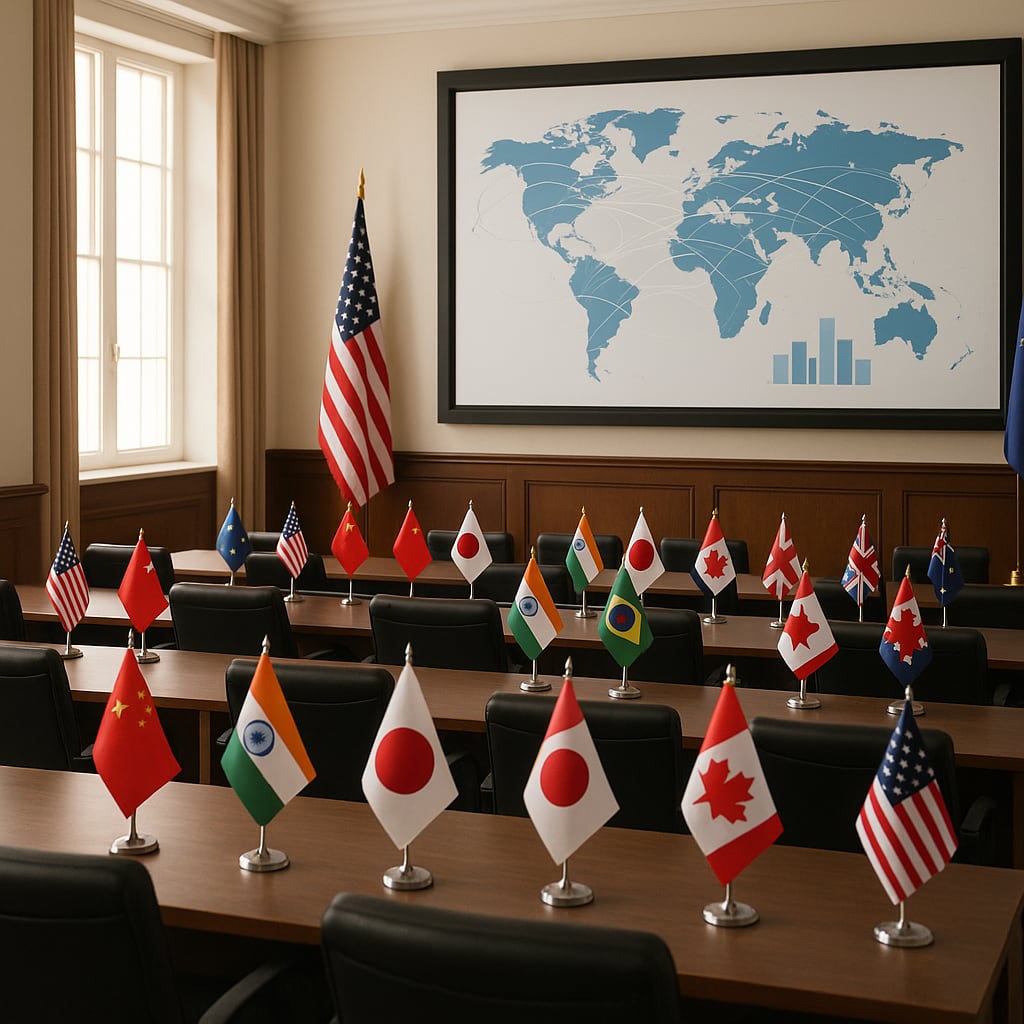
This week, the administration pivoted from defending old tariffs to proposing new ones. Multiple outlets describe U.S. trade officials concluding investigations under Section 301—an instrument used to address “unfair trade practices”—and presenting a plan to impose additional duties on imports from dozens of countries. The proposed tariff structure appears to be tiered: a baseline of at least 10%, with many major economies facing a 12.5% levy. The list of economies cited across reports includes China, India, Japan, South Korea, Brazil and Switzerland, as well as the European Union and U.S. partners such as Canada, the U.K., Taiwan and Australia.
The administration’s stated justification is distinct from earlier national-security or broad trade-deficit arguments: the new duties are framed as a response to failures to “crack down” on goods made with forced labour. The U.S. case, as described in several accounts, is that if other governments do not effectively ban such imports—or do not enforce those bans—forced-labour-tainted goods can move through global supply chains and ultimately reach U.S. consumers. That claim is already being challenged by some of the targeted governments. Coverage from Asia highlights that China and the EU have rejected the allegations and criticized the proposed measures.
Several reports also stress process: the proposal is not described as instantly effective across all products. Public consultation and further steps are mentioned before final decisions are taken, suggesting a formal rulemaking or administrative period rather than an immediate overnight imposition.
In parallel, national and regional angles show how the same U.S. action lands differently. India-focused reporting notes that the proposed additional 12.5% tariff could complicate ongoing trade talks, while the Indian government is portrayed as maintaining engagement. In Australia, the emphasis is on a specific allegation—that Australia imports goods made with slave or forced labour—met by a sharp rebuttal from Canberra pointing to what it describes as robust modern slavery and forced-labour legislation. In Brazil, coverage goes deeper into how multiple U.S. investigations and tariff proposals may stack, including discussion of a separate proposed 25% tariff tied to a different Section 301 track, alongside the forced-labour-related duties.
Why It Matters
At stake is more than a new set of import taxes. The administration is effectively testing whether it can rebuild a sweeping tariff architecture—one that affects allies as well as rivals—under a rationale likely to be more defensible politically and legally than earlier approaches. Forced labour sits at the intersection of human rights, trade enforcement and supply-chain security; it is a banner that can resonate across party lines in Washington while also allowing the executive branch to argue it is responding to a concrete transnational harm rather than simply seeking protectionism.
But the breadth of the target list—spanning strategic competitors and close partners—raises the risk of retaliation, trade diversion and diplomatic spillover. Major economies named across coverage are deeply embedded in U.S. supply chains and consumer markets. Even modest ad valorem duties of 10% to 12.5% can cascade through prices, sourcing decisions and contract negotiations, particularly in sectors where margins are thin and substitutes are limited. For exporters, the threat is not only the tariff level but the uncertainty: a proposed measure tied to broad country findings can make planning difficult for firms and investors.
The move also carries immediate diplomatic consequences. By framing tariffs as a response to other governments’ alleged laxity on forced labour, Washington is implicitly questioning partners’ enforcement capacity and regulatory credibility. For the EU and China—both highlighted as rejecting the premise—this becomes a matter of sovereignty and reputational defense, not merely commerce.
Domestically, the reimbursement appeal matters because it speaks to the durability of trade policy and the costs of reversals. If the government must repay large amounts of duties, it could become a budgetary and administrative burden while also energizing importer lobbies and business groups that have long argued tariffs function as a tax on U.S. firms and consumers. The importers figure—over 300,000—suggests the constituency affected is far broader than a handful of large multinationals.
Diverging Narratives
A striking commonality is agreement on the pivot: after February’s Supreme Court setback, the administration is seeking a fresh legal and political route to impose tariffs. Where coverage diverges is in the moral and strategic interpretation of that pivot, and in which consequences are foregrounded.
Human-rights enforcement vs. legal workaround. Some reporting treats forced labour primarily as the substantive trigger—an enforcement action designed to pressure governments to block suspect goods. Other coverage, particularly in European outlets, leans more heavily on the idea that forced labour is the “latest maneuver” to circumvent the Supreme Court’s limits, presenting the policy less as a human-rights initiative and more as a method to restore a previously curtailed tariff program. U.S.-based business coverage similarly highlights the legal durability question, noting criticism that the forced-labour focus could be a pretext for protectionism. These frames share the same factual core—the use of forced-labour findings to justify tariffs—but differ in assigning the primary motive.
Who is the main target. In Asia, the emphasis falls on China and the EU pushing back, framing the proposal within broader geopolitical competition and transatlantic friction. In India, the focus is on trade talks and the practical complication of negotiations. In Australia, the coverage narrows onto the reputational sting of being accused—directly or indirectly—of importing goods produced with slave labour, and the government’s insistence its legislation is “world-leading.” Latin American coverage gives Brazil an outsized share of attention, emphasizing how it may be hit by overlapping U.S. tariff initiatives and investigations, and exploring which products might be exempt.
Scale and mechanics. Outlets vary in how they describe the structure. Some highlight “at least 10%” as a baseline; others emphasize 12.5% as the hallmark figure for many major economies. The count of targeted jurisdictions is also rendered slightly differently across coverage—often 60, sometimes framed as 59 countries plus the European Union—reflecting a technical distinction about whether the EU is counted as a single economy or alongside its member states in the tally. The underlying point remains consistent: the net is wide and includes many of America’s biggest trading partners.
Moral language and tone. Opinionated commentary—particularly in some Brazilian coverage—casts the tariff approach as coercive, describing a doctrine of tariffing opponents and extracting concessions from those dependent on the U.S. market. Straight news reporting in other outlets is more procedural, centering on investigations, consultation periods, and the administration’s stated intent.
Current Situation
As of early June, the administration’s immediate posture is dual: it is appealing the judicial decision that would compel reimbursements of previously collected duties, while also advancing a new package of proposed tariffs tied to Section 301 forced-labour investigations. The proposed measures cover roughly 60 economies, with duties commonly described in the 10% to 12.5% range and major economies frequently placed at 12.5%. Public consultation and further administrative steps are expected before any final imposition.
Internationally, early responses are already hardening. China and the European Union are publicly rejecting the forced-labour allegations and criticizing the proposal. In other capitals—such as Canberra and New Delhi—the immediate emphasis is on rebutting implications about enforcement and minimizing disruption to trade talks. In Brazil, industry and policymakers are portrayed as mobilizing to reduce exposure and to understand how exemptions and overlapping U.S. investigations might affect specific sectors.
The near-term outlook is therefore defined less by a single tariff start date than by a convergence of legal risk, diplomatic backlash and commercial uncertainty. The reimbursement appeal keeps the Supreme Court ruling’s consequences alive at home, while the forced-labour tariff proposal opens a new front abroad—one that pits Washington’s chosen enforcement rationale against partners’ insistence that the policy is either misdirected, disproportionate, or, in the harshest framing, a repackaged protectionist instrument.