
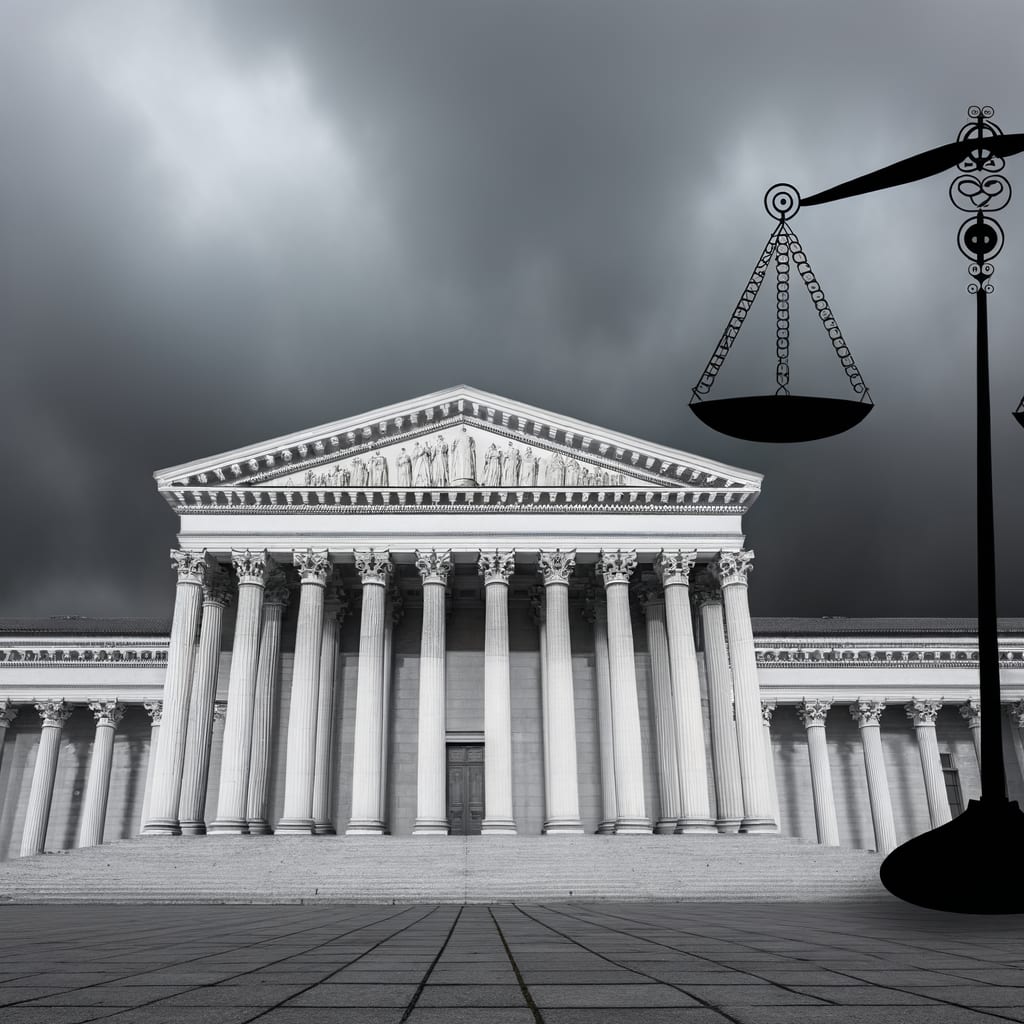
US Supreme Court Rejects Trump's 'Liberation Day' Tariffs, Opens the Door to Legal Uncertainty
In a pivotal ruling, the US Supreme Court has declared President Trump's sweeping global tariffs unconstitutional, arguing that the power to impose such tariffs lies with Congress, not the President. However, a myriad of other legal avenues could potentially restore Trump's aggressive trade powers, leading to a state of uncertainty.
Background and Context
According to a 6-3 decision led by Chief Justice John Roberts, the court ruled that the framers gave [tariff] power to Congress alone, notwithstanding the obvious foreign affairs implications of tariffs.
This ruling challenges President Trump's use of the International Emergency Economic Powers Act (IEEPA) to impose his Liberation Day
tariffs on most countries.
Key Developments
Following the Supreme Court's ruling, President Trump quickly announced a new 10% global tariff, using the Trade Act of 1974. This was later raised to 15%, leading to further legal and economic uncertainty.
Justice Brett Kavanaugh, who voted with the minority, wrote a fiery dissent that called the high court’s decision illogical.
Trump lauded the dissenting justices on his Truth Social platform, declaring Kavanaugh, along with Justices Clarence Thomas and Samuel Alito, to be his new heroes.
Reactions and Implications
The ruling has elicited strong reactions both domestically and internationally. China, for instance, has urged the US to cancel the tariffs, arguing they now violate even US domestic law. Meanwhile, Democrats applauded the Supreme Court’s decision, calling the tariffs an unfair tax on Americans.
On the home front, the Supreme Court ruling has also been met with mixed reactions from the Republican party. Some Republicans have privately celebrated the court's decision, seeing it as a preservation of Congress' power over tariffs and the separation of powers. Meanwhile, Trump withdrew his endorsement from Republican Rep. Jeff Hurd, accusing him of lacking support for his tariff policies.
Current Status
Following the Supreme Court's decision, the world now watches President Trump's next move in the global trade arena. The ruling has left Asian trading partners, as well as other nations such as Australia and Taiwan, seeking clarity about the future of their trade deals with Washington.
The tariff ruling has also sparked a debate on the implications for the balance of power between the President and Congress, with some arguing it could be one of the most important Supreme Court cases of the century.
In light of these developments, the future of global trade under the Trump administration remains uncertain as nations grapple with the ramifications of the Supreme Court's decision.