
Lead
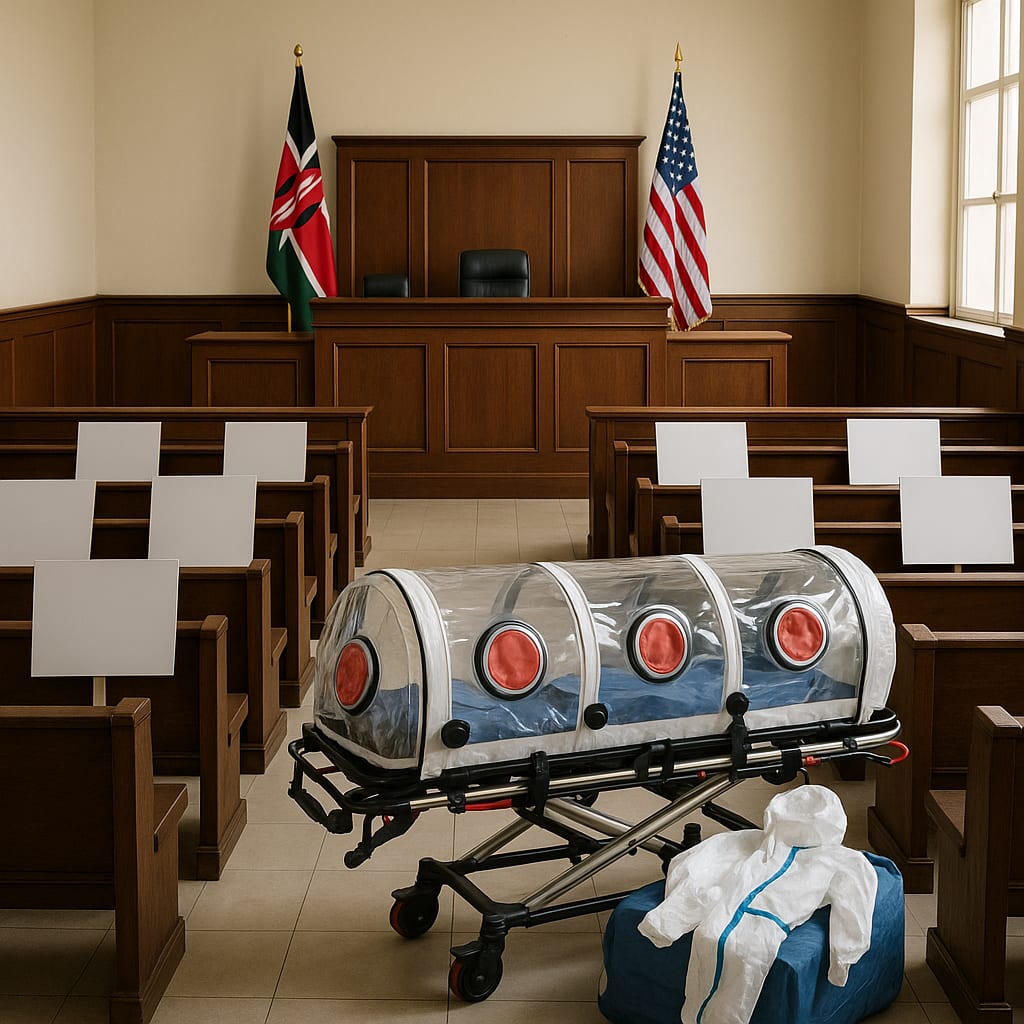
A proposed US-backed Ebola quarantine and isolation facility at Kenya’s Laikipia Air Base has triggered a rare convergence of medical alarm, legal pushback, street protest and diplomatic discomfort—despite Kenyan authorities insisting there are no Ebola cases in the country. Across outlets, the shared picture is of a plan intended for US nationals potentially exposed to Ebola colliding with Kenyan concerns about sovereignty, transparency and public safety, and spiralling into court orders, clashes with police, and escalating political pressure on Nairobi to explain what was agreed, when, and under whose authority.
What Happened
The core facts recur across local Kenyan reporting and international coverage: the United States sought— and Kenya’s government approved in principle—an arrangement to establish a quarantine/isolation capability in Kenya linked to Ebola exposure. The proposed site is consistently identified as Laikipia Air Base near Nanyuki in central Kenya. The facility is described as intended for US citizens (and, in some accounts, other US-linked personnel) who may have been exposed to Ebola amid a wider regional outbreak concern. Kenyan officials, including the health ministry, have defended the initiative as a preparedness measure that would strengthen surveillance and emergency response.
The plan, however, became public in a way that appeared to outpace public consultation and parliamentary scrutiny. Kenyan medical workers, represented by the doctors’ union, demanded full disclosure of the agreement and a clear plan for how Kenyans would be protected from any risk associated with bringing exposed individuals into the country. Civil society groups moved to court seeking to block the facility and associated transfers, arguing the arrangement raised constitutional and public-interest questions.
Courts then became a central arena. A High Court issued conservatory orders temporarily halting the establishment or operation of Ebola-related quarantine, isolation, or treatment facilities linked to the US plan, and barring the admission or transfer into Kenya of persons exposed to or infected with Ebola under the contested arrangement. That legal intervention did not cool tensions on the ground. Residents in and around Nanyuki mobilised demonstrations near the air base; multiple outlets depict hundreds of mostly young protesters marching and then confronting police. The protest began peacefully and deteriorated into running battles as anti-riot police moved to disperse crowds and secure the base perimeter.
Amid the political storm, the government sought to reassure the public on two fronts: that Kenya was taking general border and outbreak-preparedness steps, and that there was no Ebola outbreak inside Kenya. Health authorities reported that suspected cases had been tested and found negative—an assurance echoed in regional reporting—reinforcing the paradox at the heart of the controversy: the fiercest domestic backlash has erupted in a country being told it has no confirmed Ebola.
At the same time, Kenyan reporting traced the proposed facility to earlier Kenya–US understandings, with references to a pact dating back years. This deepened the transparency dispute: critics argued that the public was being presented with a fait accompli rooted in older, opaque agreements, while government voices portrayed the plan as a lawful, technical measure consistent with preparedness and international cooperation.
Why It Matters
Public health vs public trust. The dispute is not only about Ebola; it is a referendum on how health emergencies are governed. Several Kenyan commentaries press the argument that outbreaks cannot be treated as hospital matters alone—implying a national security approach that integrates border controls, intelligence-style risk assessment, and whole-of-government preparedness. Yet the same security logic can collide with democratic expectations of disclosure: secrecy justified as “preparedness” can corrode compliance and trust, which are themselves essential in outbreak response.
Sovereignty and the optics of unequal risk. The facility’s stated purpose—quarantining US citizens in Kenya—has proven politically combustible. Even with assurances about safety protocols, the arrangement is widely perceived domestically as externalising risk from the US to Kenya. That perception carries diplomatic weight: it can harden public scepticism toward security and health cooperation with Washington, especially when hosted on a military base, which symbolically fuses health policy with defence infrastructure.
Economic stakes beyond the air base. Kenya’s tourism industry has injected an additional pressure point. Business stakeholders fear that branding Kenya as a destination for Ebola quarantine—however limited the facility’s purpose—could trigger reputational damage, cancellations, and renewed travel anxieties. In this framing, the threat is not only epidemiological but economic: a single policy decision could impose costs on regions far from Laikipia.
Rule of law as a stress test. The legal orders halting the facility have become a litmus test for how institutions respond when executive decision-making meets public backlash. Kenyan coverage highlighting claims of continued work or government defiance of court directions elevates the story from a health-policy dispute to a governance confrontation—one that can reverberate across other contentious infrastructure and security decisions.
Diverging Narratives
Preparedness infrastructure vs “Ebola dumping ground”. Kenyan government-aligned explanations stress capability-building: improved disease surveillance, faster emergency response, and structured quarantine protocols. In contrast, much Kenyan civil society, union, and opinion framing centres on moral hazard and unequal power: Kenya as a holding zone for foreigners exposed to a deadly pathogen. International outlets largely retain the US-citizens angle as the defining feature, but tend to present the facility as a US plan meeting Kenyan resistance, rather than an initiative co-owned by both governments.
Security lens vs rights-and-process lens. Some Kenyan commentary argues for treating deadly diseases as security threats—an appeal to urgency, coordination and deterrence. Rights groups and legal petitioners emphasise process: constitutional compliance, lawful authority for foreign agreements, and public participation. These are not mutually exclusive, but the emphasis changes the implied remedy: strengthen command-and-control systems, or strengthen oversight and transparency.
Scale and character of unrest. Across sources, the protest is consistently described as involving hundreds and occurring at or near Laikipia Air Base, with police deploying to cordon off the area. Where coverage diverges is in tone: international reporting often foregrounds the spectacle—young protesters, chants, confrontation—while local reporting places greater weight on the escalation mechanics (from peaceful march to clashes) and the local political temperature. The emphasis shapes causality: unrest as spontaneous youth anger, versus unrest as the predictable outcome of a contested process.
Legal compliance and government conduct. Kenyan reporting gives prominent attention to court orders and the allegation that authorities pressed on regardless. Some external coverage focuses more narrowly on the court blocking the plan, treating the judiciary as a decisive brake. The difference matters: one framing suggests an institutional check functioning; the other suggests a deeper rule-of-law contest with uncertain enforcement.
Risk inside Kenya. Authorities have repeatedly stressed that suspected Ebola cases tested negative, and that there are no confirmed cases. This reassurance is central in regional reporting, yet it can function differently across narratives: for government, it supports the claim that Kenya is responsibly managing vigilance; for critics, it sharpens the question of why Kenya should accept any additional risk at all when it has no outbreak.
Current Situation
The latest reporting converges on four immediate realities:
- No confirmed Ebola cases have been reported in Kenya, with tested suspected cases returning negative results as communicated by government-linked channels.
- A court-ordered pause is in place against establishing or operating the contested Ebola quarantine/isolation facilities and against transferring exposed or infected persons into Kenya under the disputed plan.
- Public opposition has moved from elite critique to street mobilisation, with protests in Nanyuki drawing hundreds and leading to police clashes and tightened security around the air base.
- Political pressure for disclosure is intensifying, led by medical professionals and civil society, alongside economic actors worried about tourism fallout.
The immediate outlook is defined less by epidemiology than by governance: whether the government provides full documentation and a credible public-health risk framework; whether court orders are obeyed and enforced; and whether dialogue can defuse local tensions around Laikipia Air Base. Until those questions are resolved, the facility—regardless of its technical design—remains a symbol of contested authority at the intersection of health security, foreign partnership, and public consent.