
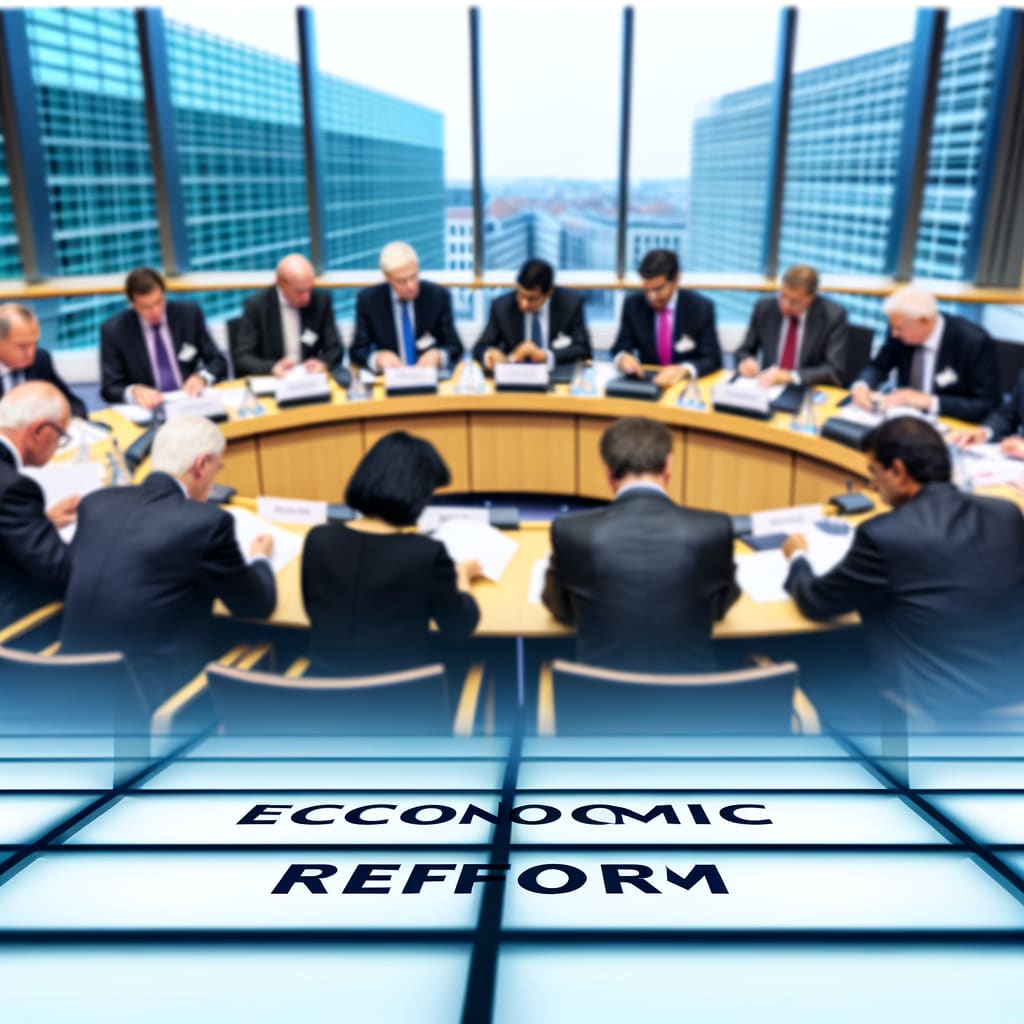
EU Leaders Debate Economic Reform Amidst Calls for Autonomy and Competitiveness
European Commission President Ursula von der Leyen has proposed a controversial plan to increase the bloc's competitiveness and autonomy by breaking down key unanimity requirements. Von der Leyen's move is seen as an attempt to sidestep opposition from some EU member states, allowing like-minded nations to work on economic matters in small groups.
Background and Context
As highlighted by multiple sources, the European Union has been grappling with economic challenges, including falling behind global giants like China and the United States. In a bid to turn the tide, von der Leyen has advocated for a tear down
of economic barriers, arguing that the EU is driving with the handbrake on,
according to The Guardian.
Key Developments
Von der Leyen's agenda involves a focus on trade, the single market, and simplification, as reported by Corriere della Sera. She has suggested that the EU should further dilute the unanimity requirement, a pillar of the bloc, according to Russia Today. This would enable groups of member states to pass economic reforms without the consent of the entire bloc, a move that some countries, including Hungary and Slovakia, have criticized as an overreach.
Alongside this, the EU leaders are debating the contentious Buy European
policy, which favors European companies in an attempt to regain economic competitiveness. However, opinions on this policy are diverging, with some leaders arguing that it could further strain the EU's economic fortunes, as reported by The Guardian.
Implications and Reactions
These proposed economic reforms are expected to provoke significant debate among EU leaders. While some agree with von der Leyen's push for increased EU autonomy and competitiveness, others have raised concerns over sovereignty and the potential risk of creating a two-tier EU system.
Von der Leyen's approach has been met with criticism from some quarters. Former European Commissioner Thierry Breton, who is preparing a project for the EU to regain its sovereignty
from 2027, has been critical of von der Leyen, as per Le Monde. Furthermore, French President Emmanuel Macron has suggested that common EU debt could be used to finance defense and artificial intelligence, indicating alternative approaches to bolstering the EU's economic standing, as reported by ANSA.
Conclusion
As EU leaders gather in Belgium for intensive discussions on the bloc’s economy, the battle for the soul of the EU economy is unfolding. The question of whether to follow a path of free trade or protection, integration, or sovereignty is at the heart of this debate. How these discussions are resolved could redefine the future of the EU's economic landscape, with significant implications for member states and, indeed, the global economy.