
Lead
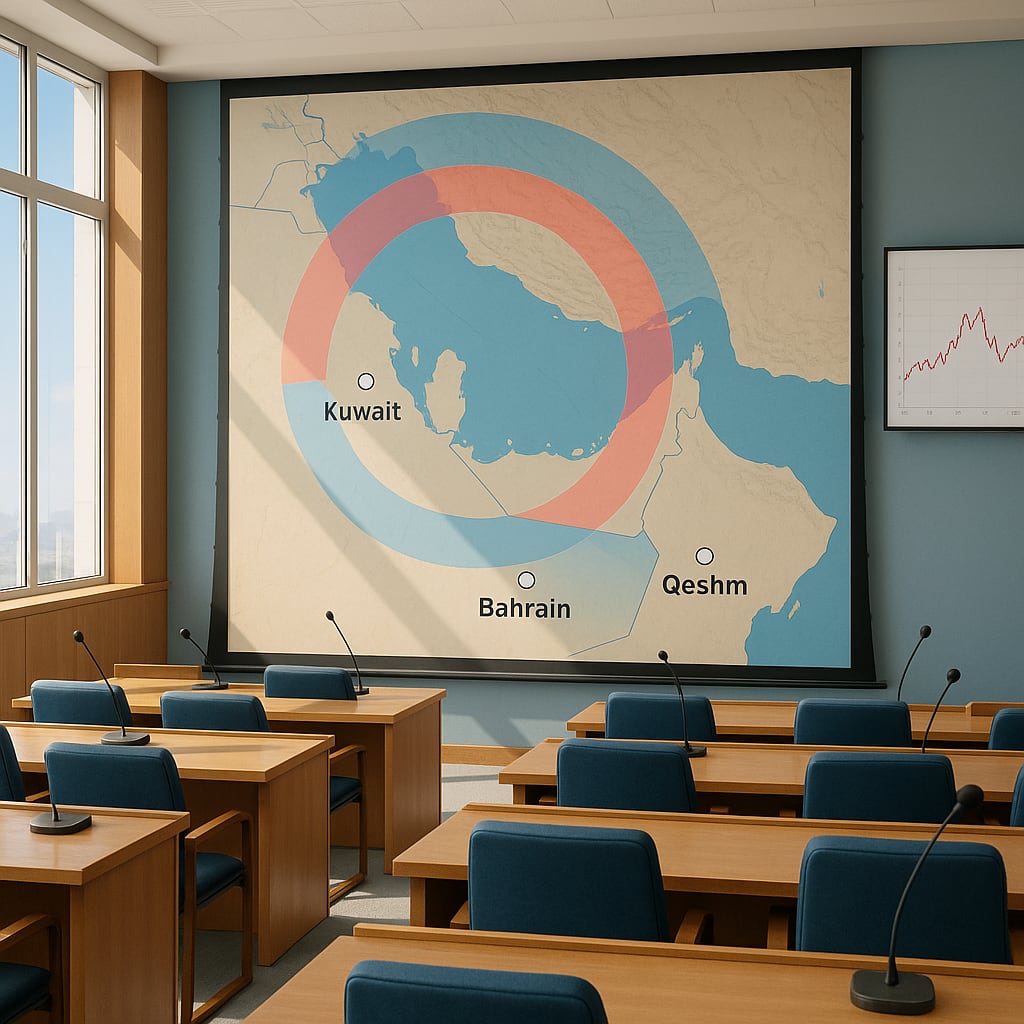
A widening US–Iran confrontation has spilled into the Gulf’s frontline states, with Kuwait reporting repeated missile and drone attacks and the United States confirming strikes on Iranian military targets, including Qeshm Island. Across multiple accounts, the same outline emerges: Washington says it is acting in self-defence during a maritime standoff, while Tehran and its allied messaging depicts retaliation against US military assets and the regional states that host them. The most consequential turn is the apparent shift from primarily military-to-military exchanges toward impacts on civilian infrastructure—most notably at Kuwait’s international airport—raising the stakes for Gulf governments trying to avoid being pulled deeper into a conflict they did not choose.
What Happened
The episode sits within a broader pattern of tit-for-tat activity in the Gulf that intensified as the US military enforced a naval blockade posture against Iran. In the days leading into June, official US messaging described a campaign of maritime interdiction and redirection of commercial shipping. Iranian political messaging, meanwhile, stressed that the blockade would end either through talks or force—language that set the stage for escalation without confirming an imminent plan.
By June 1, the confrontation moved sharply upward. US statements reported strikes on Iranian military sites, and multiple outlets treated these as a major inflection point in the cycle. Almost immediately, Kuwait reported coming under aerial attack involving missiles and drones, and Iranian Revolutionary Guard messaging claimed it had struck a US base in response. The basic sequence—US strikes followed by Iranian-linked retaliation toward Gulf targets—appears consistently across coverage.
Over the following 48 hours, attacks and alerts around Kuwait and neighbouring Gulf states broadened. Kuwait publicly stated that its air defences were engaging “hostile” missiles and drones, while Bahrain issued warnings amid reported aerial threats. Gulf political reaction also hardened: regional states condemned the attack on Kuwait, and Kuwait’s foreign ministry framed the incident as a direct assault on the country’s security and stability, explicitly reserving the right to retaliate.
By June 3, the operational picture presented in much of the reporting converged on three points:
- Iran launched missiles and drones toward Kuwait and Bahrain. US military statements said multiple projectiles either broke apart, fell short, or were intercepted, and that defences in the region had engaged the threats.
- The US conducted further strikes on Iranian territory, prominently including Qeshm Island. Washington described these as self-defence actions.
- Kuwait’s airport became a focal point. Kuwait said its passenger terminal was hit by Iranian drones and missiles, reporting injuries and serious material damage. Kuwaiti authorities subsequently suspended airport operations, describing casualties and damage to facilities.
Alongside these claims, Iranian messaging continued to emphasise retaliation against US military assets and to place responsibility on Gulf hosts. One prominent point of contention was an Iranian claim of a strike on the headquarters of the US Fifth Fleet—an assertion the US side denied.
Why It Matters
The immediate military significance lies in the conflict’s geography. Kuwait and Bahrain host critical US military facilities and are positioned near the maritime arteries of the Gulf. When attacks are directed at or near these states, they are not merely local security incidents; they become tests of US regional defence, the credibility of deterrence, and the cohesion of Gulf security arrangements.
The political stakes for Gulf governments are equally stark. Kuwait’s decision to publicly reserve the right to retaliate signals a shift from quiet crisis management toward explicit deterrence language. Even if Gulf leaders seek de-escalation, domestic expectations of sovereignty and security rise sharply when civilian sites are hit and airports disrupted.
The episode also matters because it intersects with a wider maritime and economic confrontation. The naval blockade posture—and reports of commercial vessels being redirected—links the crisis to global shipping confidence. That connection is reinforced by market coverage noting oil’s sensitivity to Gulf instability, with Brent prices nearing the psychologically important $100 level as the situation rattled markets. Even without long-term supply disruption confirmed, the combination of aerial attacks, maritime enforcement, and uncertainty can price risk into energy and insurance markets quickly.
Diplomatically, the clash underscores how difficult it is to stabilise US–Iran relations through limited, managed exchanges. Broader analysis in international coverage has emphasised that neither side appears eager for all-out war, yet the pattern of retaliatory steps makes miscalculation more likely—particularly when attacks spread toward allied territory and civilian infrastructure.
Diverging Narratives
Despite broad agreement on the outline—US strikes on Iranian sites followed by Iranian missiles and drones toward Gulf targets—the framing varies sharply by outlet and by the political vantage point implied in the reporting.
1) Self-defence versus retaliation—and who started what.
US-facing and many international reports foreground Washington’s claim of “self-defence” strikes, presenting Iranian launches as the escalation that had to be met. Iranian and Iran-aligned messaging instead treats the US strikes—and the wider blockade posture—as the initiating aggression, with missile and drone launches framed as justified retaliation. The difference is less about the sequence (which most coverage treats similarly) than about causal responsibility.
2) The status of Gulf states: victims, hosts, or parties to the conflict.
A Gulf-centric framing emphasises Kuwait as a sovereign state under attack—hence condemnations and Kuwait’s right-to-retaliate language. Iranian messaging shifts the emphasis toward Kuwait and Bahrain as facilitators of US operations, arguing they “bear responsibility” for allowing US attacks to be conducted from their territory. These frames point to a strategic contest over legitimacy: whether Gulf states are being attacked unjustly, or whether they are implicated through military hosting arrangements.
3) Civilian infrastructure: central fact or secondary detail.
Some coverage places the Kuwait airport strike at the centre, highlighting injuries, terminal damage, and the suspension of operations—elements that make the crisis feel less like a remote military exchange and more like a direct threat to daily life and national functioning. Other accounts keep the focus on military targets and air-defence performance, treating civilian impacts as consequential but not the main lens. The divergence affects how escalation is interpreted: as a worsening of battlefield tempo, or as a potential crossing of a threshold into broader harm.
4) Disputed claims: what was hit, and what was stopped.
There is recurring tension between claims of successful strikes and claims of successful interception. US military statements emphasise downing drones, intercepting missiles, and preventing damage to American personnel and assets. Kuwaiti authorities confirm damage and injuries at the airport. Iranian claims about striking specific high-value US targets—such as the Fifth Fleet headquarters—are explicitly denied by the US side. The pattern is familiar in fast-moving conflicts: each side highlights effectiveness while minimising vulnerability, and neutral outlets differ in how prominently they display those competing assertions.
5) Scope of threats across the region.
Some reporting points to a broader arc of danger—suggesting additional Gulf states may be under threat—while other accounts narrow the focus to Kuwait and Bahrain as the principal targets in this round. The result is different perceptions of regional contagion: contained confrontation versus an expanding theatre.
Current Situation
As of the latest reporting, Kuwait has suspended operations at its international airport following reported strikes that authorities say caused injuries and serious damage. Kuwait and Bahrain publicly attribute attacks on civilian infrastructure to Iran, while US Central Command says its forces and regional air defences have intercepted multiple Iranian threats toward allied territory and protected US assets.
The United States confirms it has carried out strikes on Iranian targets, including Qeshm Island, characterising the actions as self-defence. Iran’s messaging continues to cast its launches as retaliation and to argue that Gulf hosts share responsibility for enabling US operations, while at least one high-profile Iranian claim—striking the Fifth Fleet headquarters—has been denied by the US.
The immediate outlook is defined by two competing realities presented across coverage: active defensive operations that appear to be limiting some attacks, and a conflict dynamic that is expanding in political cost as civilian infrastructure is hit and Gulf states harden their public posture. With energy markets reacting and Gulf capitals issuing warnings and condemnations, the crisis is no longer confined to a bilateral US–Iran exchange; it is now a regional security event with direct consequences for civilian movement, economic confidence, and the diplomatic room to step back.