
Lead
A fragile diplomatic track between Washington and Tehran has broken down amid a widening regional crisis that now links the war around Iran, a mounting confrontation over maritime chokepoints, and renewed Israeli strikes in Lebanon. Across outlets with sharply different political lenses, several points recur: Iran has at least paused or halted talks with the United States; Iranian military and political figures are escalating warnings tied to Lebanon’s fighting and to what Tehran calls a naval “blockade”; and the Strait of Hormuz—through which a major share of global oil and other trade moves—has become the central pressure point, with knock-on effects reaching energy markets, shipping, and commodity supply chains.
At the same time, the coverage is marked by a key tension: while some reporting describes an Iranian “closure” or “blockade” of Hormuz (and even threats to extend restrictions to the Red Sea), Iranian state-linked messaging highlights controlled, permit-based passage that suggests regulation and coercion rather than a total shutdown.
What Happened
The immediate catalyst in much of the reporting is Iran’s announcement—carried by multiple outlets—that it has halted or is no longer continuing talks with the United States. The halt is framed as part of a broader escalation tied to two connected arenas: the maritime confrontation around Hormuz and the intensifying Israeli campaign in Lebanon, including strikes on Beirut.
Iranian officials and advisers have issued increasingly blunt warnings. Senior voices close to Iran’s leadership have signaled that Tehran will not accept a continued maritime squeeze and that its “patience” is limited, linking this stance to the fighting in Lebanon and to what they depict as external attempts to restrict Iran’s access and leverage at sea.
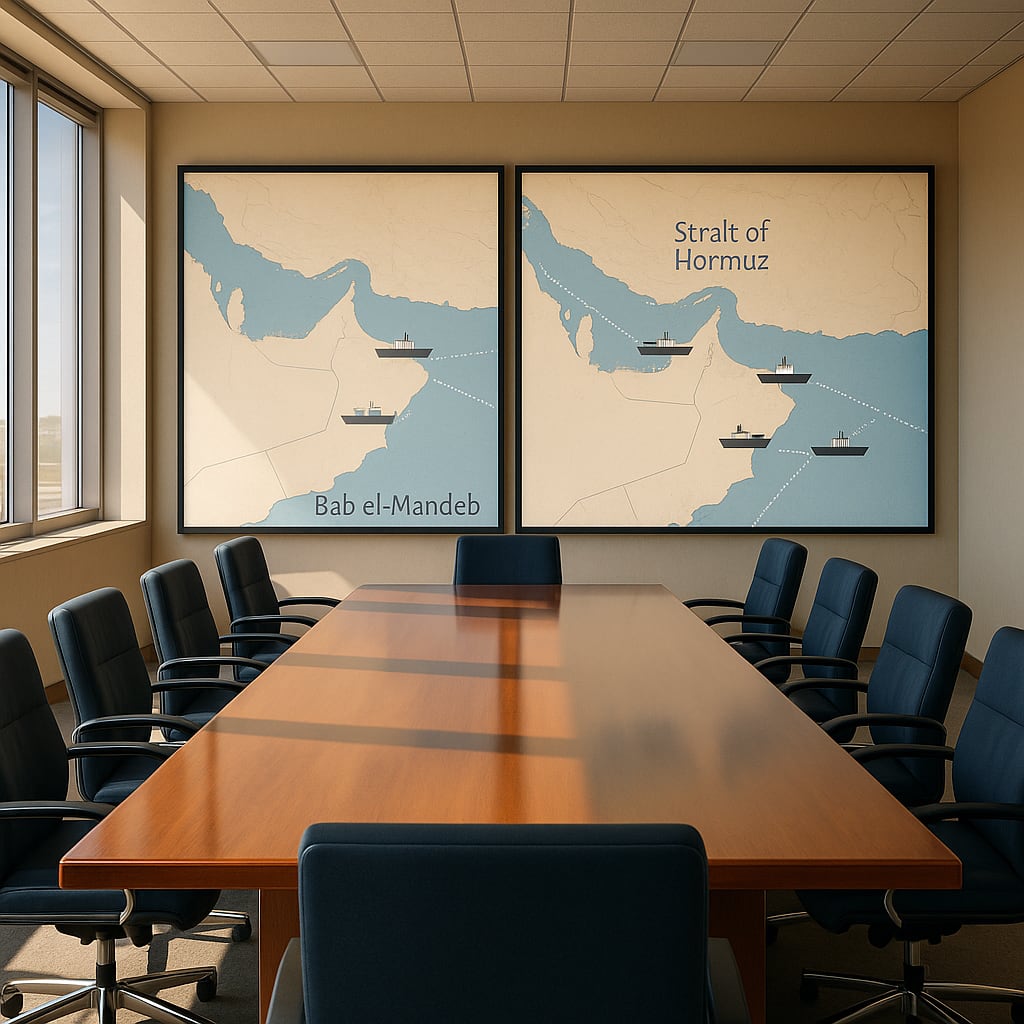
On the water, the most consistently reported operational detail is not a blanket stoppage of shipping but a shift toward Iranian control mechanisms. Iran’s Revolutionary Guard Navy has publicly said it is allowing commercial vessels through Hormuz with Iranian authorization, citing dozens of ships permitted over a 24-hour period and describing a round-the-clock permit process. This aligns with parallel reporting about the concept of a “toll” or regulated transit—an arrangement that has drawn a U.S. warning against any pay-to-pass regime and threats of sanctions on parties that would facilitate it.
The maritime confrontation is also described from the U.S. military angle: reports cite U.S. Central Command figures indicating that U.S. forces have redirected a large number of commercial vessels and disabled several during the period described as a naval blockade. Separately, U.S. strikes near Bandar Abbas are reported in late May amid “day 90” war coverage, with Iranian statements of no casualties or damage. Together, these strands portray a contested operating environment where both sides are using limited, demonstrative force and maritime control to shape negotiations and deter escalation—until the diplomatic track itself appears to stall.
A further escalation is reflected in reporting that Tehran is considering formalizing its leverage: an Iranian lawmaker is cited discussing the “nationalization” of the Strait of Hormuz—presented as a political-legal move that echoes past nationalizations in Iran’s modern history. While it is unclear how actionable such a concept would be under international maritime law, its appearance in official discourse underscores how central Hormuz has become to Iran’s strategy.
Alongside Hormuz, some coverage says Iran is threatening to widen pressure to other chokepoints. There are claims that Tehran has ordered the Strait of Hormuz blocked and that it intends to close the Bab el-Mandeb Strait at the southern end of the Red Sea—an expansion that would put additional global shipping lanes under strain. These assertions appear in regional and state-linked reporting but are not uniformly corroborated by the operational updates emphasizing permitted transits through Hormuz.
Finally, the broader regional battlefield remains active. Iranian messaging through the IRGC’s Quds Force warns the United States and Israel against further escalation in Lebanon and Gaza. Separate live reporting from Israel describes missile launches toward Gulf states following U.S. actions against a vessel allegedly attempting to breach a blockade, illustrating how quickly the maritime standoff can intersect with wider military exchanges.
Why It Matters
The significance of the current moment is less about a single announcement than about the convergence of three levers: diplomacy, maritime chokepoints, and regional war.
First, diplomacy. The halting of U.S.-Iran talks matters because the negotiations have been treated—especially in late-May coverage—as a potential path to de-escalation and a mechanism to restore freer navigation. The breakdown signals that the maritime situation is no longer merely a negotiating chip; it is now a driver of instability in its own right.
Second, the chokepoints. Hormuz is uniquely consequential: even partial disruption, uncertainty, or added transaction costs can ripple through global energy pricing, insurance, and shipping schedules. The impact is already visible in market-oriented reporting that places Brent crude near $100 amid conflict jitters. The story also extends beyond oil: Brazil’s press focuses on fertilizer imports rising to the top of the foreign minister’s agenda, a reminder that shipping disruptions in the Gulf can hit agricultural inputs and food systems far from the Middle East.
Third, the human and operational toll. British coverage foregrounds the lived reality for seafarers—thousands described as trapped for months amid exhaustion and stress—bringing attention to the labor and safety implications that are often secondary to geopolitical narratives. This dimension underscores that “blockade” conditions, even if porous or variably enforced, can produce prolonged hardship for crews caught in a risk zone with unclear rules and shifting permissions.
Fourth, the risk of regional spillover. By tying maritime escalation to Israeli operations in Lebanon and by issuing broader warnings through elite military channels, Tehran is signaling that pressure points are connected. If restrictions are extended beyond Hormuz—or even credibly threatened—global trade routes through the Red Sea could face compounded disruption.
Diverging Narratives
The coverage diverges less on the central fact of heightened confrontation than on how to describe it, who is driving it, and what is actually happening on the water.
“Closure” versus “controlled passage.” Some outlets frame Hormuz in maximal terms—blocked, closed, or ordered shut—pairing this with claims of expanding the “naval blockade” to Bab el-Mandeb and the Red Sea. Iranian state-linked reporting, by contrast, emphasizes that ships are transiting with permits granted by Iranian authorities, implying not an absolute closure but a regime of conditional access. This distinction matters: a permit-based system is still coercive and destabilizing, but it describes a different operational reality than a complete stoppage.
Who is imposing a blockade? Russian state media and Iran’s state channels highlight the notion of a U.S.-led naval blockade or interdiction campaign, reinforced by figures attributed to U.S. Central Command about redirected and disabled vessels. Western coverage tends to focus on Iran’s threats and capabilities regarding closure, or on U.S. miscalculation of Iran’s ability to disrupt traffic, emphasizing deterrence failures and strategic warning signs. The underlying disagreement is about agency and legitimacy: whether maritime disruption is primarily a defensive response to U.S. actions or an Iranian escalation aimed at leverage.
The Lebanon linkage. European and regional outlets place stronger weight on Iran’s warning to Washington to restrain Israel in Lebanon—presenting the talks’ collapse and maritime threats as contingent on Beirut’s bombardment and the broader Israel-Lebanon front. Other coverage treats Lebanon as part of a general escalation environment but keeps Hormuz and U.S.-Iran dynamics at the center. This difference changes the implied solution set: constrain Israel to stabilize talks, versus negotiate maritime terms directly.
Economic framing versus security framing. Market-focused and global-supply reporting centers on oil prices, commodities, and national economic exposure (notably fertilizers). Anglo-American security and politics coverage gives more attention to war-gaming, deterrence, and the internal debates of U.S. decision-making. Regional outlets emphasize sovereignty, resistance, and the right to impose tolls or regulate passage, while also highlighting potential third-party adaptations—such as shipping interests expressing willingness to pay for transit—suggesting a drift toward transactional navigation under duress.
Current Situation
As of early June, the clearest shared picture is of a stalled diplomatic channel, heightened rhetoric linked to Lebanon, and an unsettled maritime environment in which traffic continues but under intensified interference and uncertainty. Iran’s forces are publicly portraying themselves as gatekeepers granting passage through Hormuz, while U.S. military reporting portrays active countermeasures affecting commercial vessels. The economic consequences are already propagating through energy prices and trade planning far beyond the region, while the human cost for crews in the zone is becoming harder to ignore.
The immediate outlook, based strictly on the reported status, is one of continued volatility: talks are halted, warnings are escalating, and both sides are operating in close proximity around a chokepoint where miscalculation can carry outsized global consequences—even absent a formally declared, fully airtight closure.