
Lead
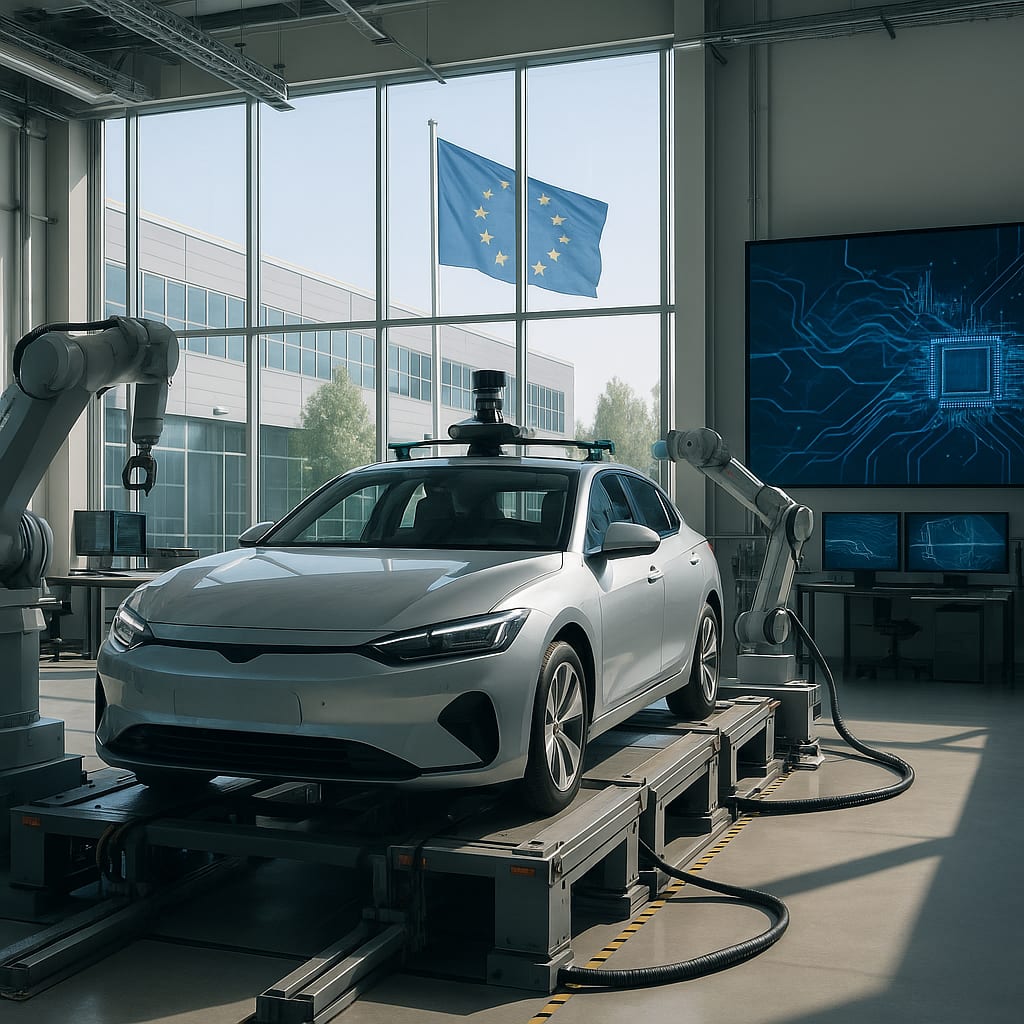
China’s electric-vehicle industry is emerging from another month of bruising domestic competition with a clearer—if still precarious—direction: sell more technology, not just cheaper cars. May brought a rebound in EV sales momentum in the world’s largest auto market, helped by fresh model launches and increasingly sophisticated driver-assistance features. But the same forces powering that recovery—rapid product cycles, heavy investment in batteries and software, and relentless capacity buildout—are sharpening tensions abroad. In Europe, policymakers are preparing a tougher trade posture toward a perceived “China shock” in manufactured goods, even as Chinese automakers push deeper into the continent, highlighted by plans for SAIC Motor’s first EU production facility in Spain.
Taken together, the coverage sketches a single story playing out on two stages: at home, Chinese carmakers search for profitability and differentiation beyond price cuts; abroad, Europe is reassessing how to respond to a wave of Chinese competitiveness that is no longer confined to consumer electronics and solar panels, but now extends into the heart of industrial employment—automobiles.
What Happened
In China, EV makers saw sales recover in May after a period of strain that has been widely associated with aggressive discounting and weakening demand. The improvement is described as being supported by new models and features that consumers can perceive as tangible upgrades—higher-performance batteries and more advanced driver-assistance systems. The implication across the reporting is consistent: product differentiation is becoming more central to winning orders than simply cutting sticker prices.
That shift is reinforced by a parallel theme: the competitive battleground is moving toward artificial intelligence and software-defined vehicles. Coverage points to a reorientation in industry strategy—from price wars toward AI capability—as firms respond to tighter regulatory scrutiny and softer demand signals. Rather than trying to win solely on affordability, companies are investing in driver-assistance, autonomous-driving stacks, and AI-enabled in-car experiences as the next axis of competition.
Several datapoints in the reporting illustrate how companies are trying to stake claims in that new landscape. BYD, positioned as the world’s largest EV maker, is described as promoting a self-developed autonomous driving system branded “God’s Eye,” with an explicit safety narrative: a stated aim of “zero accidents,” paired with an assurance tied to crash-cost coverage. Meanwhile, other industry developments referenced include progress in robotaxi-style offerings and the rollout of advanced driver-assistance features by foreign competitors in China—signs that the race is not only domestic, but increasingly global in technology and branding.
Alongside corporate strategy, policy is moving. China is presented as rolling out a broad regulatory blueprint intended to set standards across EVs, AI-enabled vehicles, batteries, semiconductors, and vehicle chips—an effort framed as expanding influence over the global auto industry’s technological direction. The emphasis here is not merely on industrial promotion, but on codifying standards in the core layers of future vehicles, where interoperability and compliance can shape markets.
On the European front, the reporting describes a hardening stance toward Chinese imports, with EU officials preparing a tougher response to what is characterized as a second “China shock”—a flood of low-cost competition seen as undermining local industries. That policy shift is coupled with a broader political readout: a view circulating in Brussels that the era of treating China primarily as a partner has ended, replaced by an assessment of China as a sophisticated competitor.
Yet, even as the mood in Brussels darkens, European regions and Chinese firms are still pursuing investment. SAIC’s plan to establish a manufacturing plant in Spain’s Galicia is presented as its first production facility in the European Union, and it comes via engagement with a regional government eager to host industrial capacity. The move sits at the intersection of two trends: Europe’s defensive trade posture and Chinese automakers’ push to localize production and reduce exposure to trade barriers and political risk.
Why It Matters
The immediate business story—Chinese EV sales recovering in May—matters less for the headline number than for what it signals about the industry’s next phase. China’s EV market has been defined by scale, speed, and intense rivalry. When growth softens, the same capacity that once looked like an advantage becomes a pressure point, feeding overcapacity concerns and intensifying competition. The reporting repeatedly returns to this structural issue: too many producers, too much output, and too thin a margin for error.
In that environment, the pivot toward premium models and AI capability is more than marketing. It is an attempt to reprice the product—moving from commoditized hardware to differentiated systems—while preserving volume. Premiumization offers one route to margins; AI and advanced driver assistance offer another, by creating feature bundles that can command higher prices and strengthen customer lock-in through software ecosystems.
Policy and standard-setting raise the stakes further. If China is indeed formalizing standards around chips, batteries, and AI vehicles, it is positioning itself not just as a producer, but as a rule-shaper. Standards can advantage domestic supply chains, accelerate adoption of homegrown technologies, and complicate foreign firms’ access unless they comply. In an industry where semiconductors and battery supply chains are strategic, this becomes industrial policy by another name—one with international spillovers.
Europe’s response matters because autos are politically sensitive: they anchor employment, regional supply chains, and trade balances. The framing of “China shock 2.0” signals anxiety that the competitive dynamic seen in other manufacturing sectors could repeat in automobiles, compressing European producers’ market share and pushing governments toward protective measures. At the same time, SAIC’s Spain plan illustrates the countermove: if exports are politically contested, local production can be both a commercial strategy and a diplomatic one—creating jobs on the ground while embedding Chinese firms inside European industrial geography.
Diverging Narratives
Across the coverage, the facts align on several pillars—fierce competition in China, a move toward AI-driven differentiation, and Europe’s increasingly defensive posture—but the storytelling diverges sharply in emphasis.
Technology optimism vs. market stress. Business-focused framing highlights May’s recovery and consumer draw to better batteries and driver-assistance features, portraying innovation as a stabilizer. Other angles foreground the fragility beneath the rebound: weakening demand, regulatory tightening, and persistent overcapacity. The same market signals are thus read either as a turning point powered by innovation or as a temporary lift that does not resolve structural excess.
Safety-led autonomy vs. competitive signaling. The presentation of BYD’s “zero accidents” ambition and crash-cost coverage can be read in two ways depending on emphasis: either as a serious safety commitment meant to build consumer trust, or as a competitive messaging strategy in a crowded field where branding around autonomy is becoming a differentiator. The reporting does not unify around a single interpretation; instead it reveals an industry trying to turn advanced driver assistance into both a technical and reputational moat.
Standards as governance vs. standards as influence. Policy coverage frames China’s blueprint as a comprehensive standards push that reaches batteries, AI vehicles, and semiconductors. The divergence lies in implication: some framing treats it as domestic governance for a fast-moving sector; other framing stresses international influence—standards as a lever to shape the global industry’s technical foundations. Both interpretations can coexist, but they lead to different readings of intent and consequence.
Europe as protector vs. Europe as host. European-focused coverage leans toward strategic defensiveness, underscoring a tougher line on Chinese imports and a shift away from partnership. Yet the SAIC factory plan in Spain introduces a different European storyline: subnational actors competing for investment and jobs even while Brussels debates a firmer trade stance. This tension—between EU-level trade politics and local industrial development priorities—runs through the combined reporting without being resolved.
What is notably downplayed across the set is any single, agreed-upon endpoint: the coverage does not converge on whether price wars are definitively ending, only that the competitive center of gravity is shifting toward AI and premium features. Likewise, while Europe’s tougher posture is highlighted, the precise measures and their enforcement trajectory are not consistently detailed, leaving the overall direction clearer than the mechanics.
Current Situation
As of early June, China’s EV market is described as having regained footing in May, propelled by new model launches and a race to bundle higher-performance batteries and increasingly advanced driver-assistance systems. Competition remains intense and structurally constrained by overcapacity concerns, pushing manufacturers to seek relief through premium segments and software-led differentiation rather than pure price cuts.
Policy is moving in parallel: China is advancing a standards-oriented blueprint covering EVs, AI vehicles, batteries, and semiconductors—an approach that signals tighter governance at home and potential influence abroad.
In Europe, the political climate is tightening around Chinese industrial competition, with indications that Brussels is preparing a firmer response to rising import pressures. At the same time, Chinese automakers are pursuing deeper European footprints that could partially reframe the trade dispute—from an export-driven confrontation to a more complex negotiation over investment, local production, and the distribution of jobs and value chains within Europe.
The immediate outlook, as depicted across the coverage, is one of simultaneous acceleration and friction: faster technological competition inside China, and a more contested market access environment in Europe—both shaping where Chinese EV makers build, sell, and define the next generation of vehicles.