
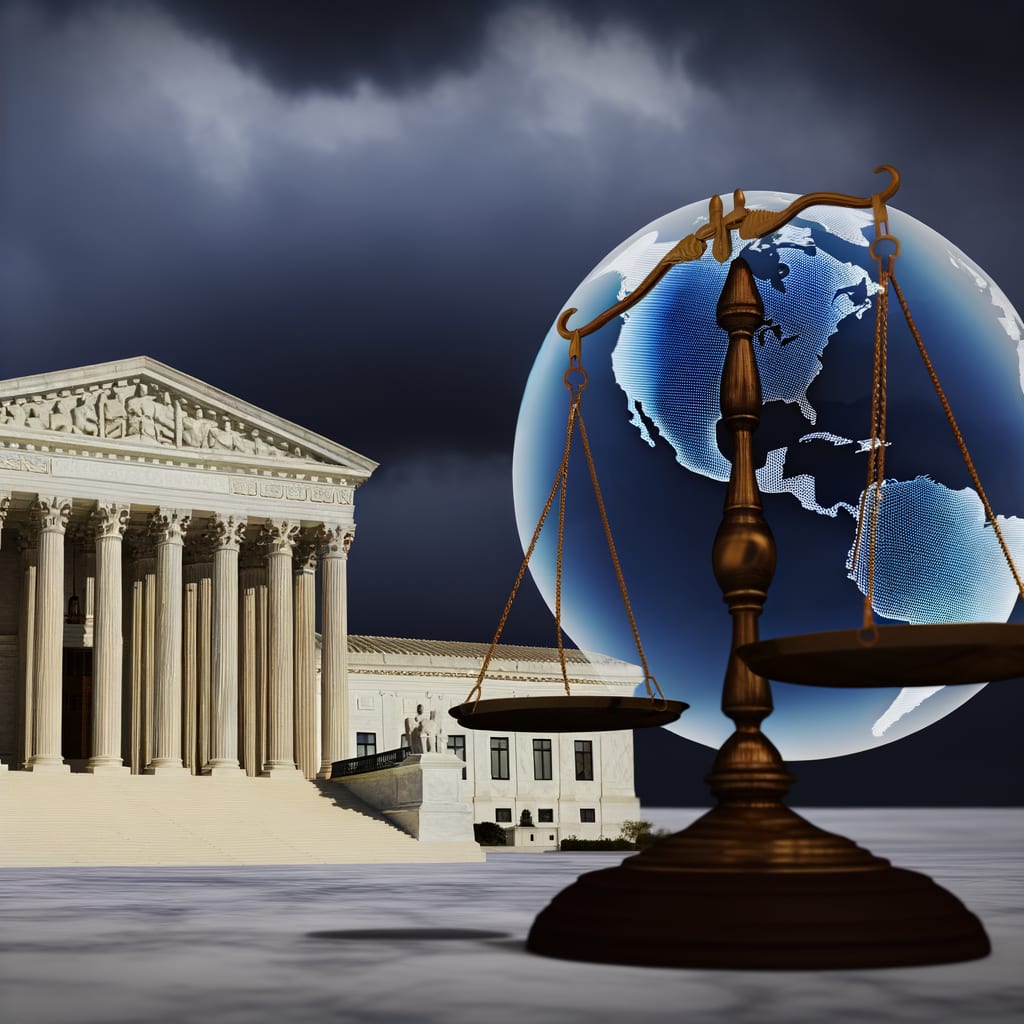
US Supreme Court Blocks Trump's Tariff Powers, Global Trade in Question
In a significant move, the US Supreme Court has ruled against President Donald Trump's sweeping tariff regime, declaring it unconstitutional and causing a ripple effect on global trade relations. This decision primarily benefits countries that have faced severe criticism from the American government, including China and Brazil.
Background and Context
The Supreme Court's 6-3 decision invalidated Trump's use of the International Emergency Economic Powers Act (IEEPA) to impose tariffs on most US trading partners. The justices ruled that the Constitution grants Congress, not the president, authority over tariffs123.
President Trump had imposed tariffs on many trading partners early last year, accusing them of unfair trade practices4. Most faced a universal 10% baseline tariff, with additional surcharges for large trade imbalances4. In response to the Supreme Court ruling, President Trump invoked a separate statute – Section 122 of the US Trade Act of 1974 – to impose a 15% global tariff5.
Key Developments
The Supreme Court ruling has stirred confusion and uncertainty among US trading partners in Asia6. Taiwan has sought clarification from Washington in light of the legal reset5. Similarly, Australia is examining all options to avoid the new 15% tariffs announced by Trump7.
Chinese Commerce Ministry urged Washington to lift the tariffs, arguing they now violate even US domestic law4. The ruling has also impacted China's sprawling export sector, which now eyes a brief window of opportunity to front-load shipments to the US89.
According to a study, Brazil is one of the countries most benefited by the Supreme Court's decision10. The ruling also adds uncertainty for the US partners in East Asia, including Japan, South Korea, and Taiwan11.
Implications and Reactions
Analysts suggest that the legal setback has shifted trade tensions into a phase of cautious stability rather than escalation, strengthening China’s negotiating position12. The ruling has also been interpreted as a win for Chinese exporters9.
However, not all reactions have been positive. The Supreme Court's decision has been met with applause by Democrats, who criticized Trump's tariff strategy as an unfair tax on Americans13.
Current Status
Amidst this international turmoil, all eyes are now on the upcoming Beijing summit, where President Trump is set to meet President Xi Jinping. The outcome of this meeting could prove decisive for the future of bilateral trade8. In the meantime, countries around the globe are left to navigate the 'murky waters' of global businesses following Trump's tariff loss14.