
Lead
Eastern Democratic Republic of Congo is confronting a double emergency that health officials describe as mutually reinforcing: a fast-growing Ebola outbreak caused by the Bundibugyo strain, and persistent armed conflict that is restricting access, displacing civilians, and undermining basic public health measures. The World Health Organization’s director-general, Tedros Adhanom Ghebreyesus, has warned of a “catastrophic collision” of disease and violence and has publicly appealed for a halt to fighting to enable humanitarian operations. As neighbouring states tighten border controls and raise alerts, the outbreak is increasingly being treated not only as a Congolese health crisis but as a regional stability test.
What Happened
The outbreak—described as Congo’s 17th—has been centred on Ituri province in the country’s east. Across coverage, the core picture is consistent: infections and deaths are rising quickly, and containment efforts are struggling to keep pace because health teams cannot reliably reach communities, trace contacts, or operate safely in areas affected by fighting.
The most widely repeated warning from WHO leadership is that insecurity is hampering the response. Tedros has linked the spread to mass displacement and overcrowding, with people moving through or living in camps where transmission risks grow and routine surveillance breaks down. He has also framed access as the decisive variable: stopping transmission depends on humanitarian corridors, sustained presence of health workers, and the ability to carry out standard outbreak control measures—testing, isolation, safe burials, contact tracing, and community engagement.
The scale of the outbreak is conveyed through two parallel sets of figures that often appear side by side: a high suspected-case count nearing 900 and a lower confirmed-case tally in the low hundreds. Outlets broadly agree that suspected cases have surged rapidly and that suspected deaths are counted in the hundreds, while confirmed infections and confirmed deaths are much lower. This split reflects the realities of operating in conflict zones where laboratory confirmation can lag and where health authorities may treat probable cases as Ebola for containment purposes even when testing is delayed or impossible.
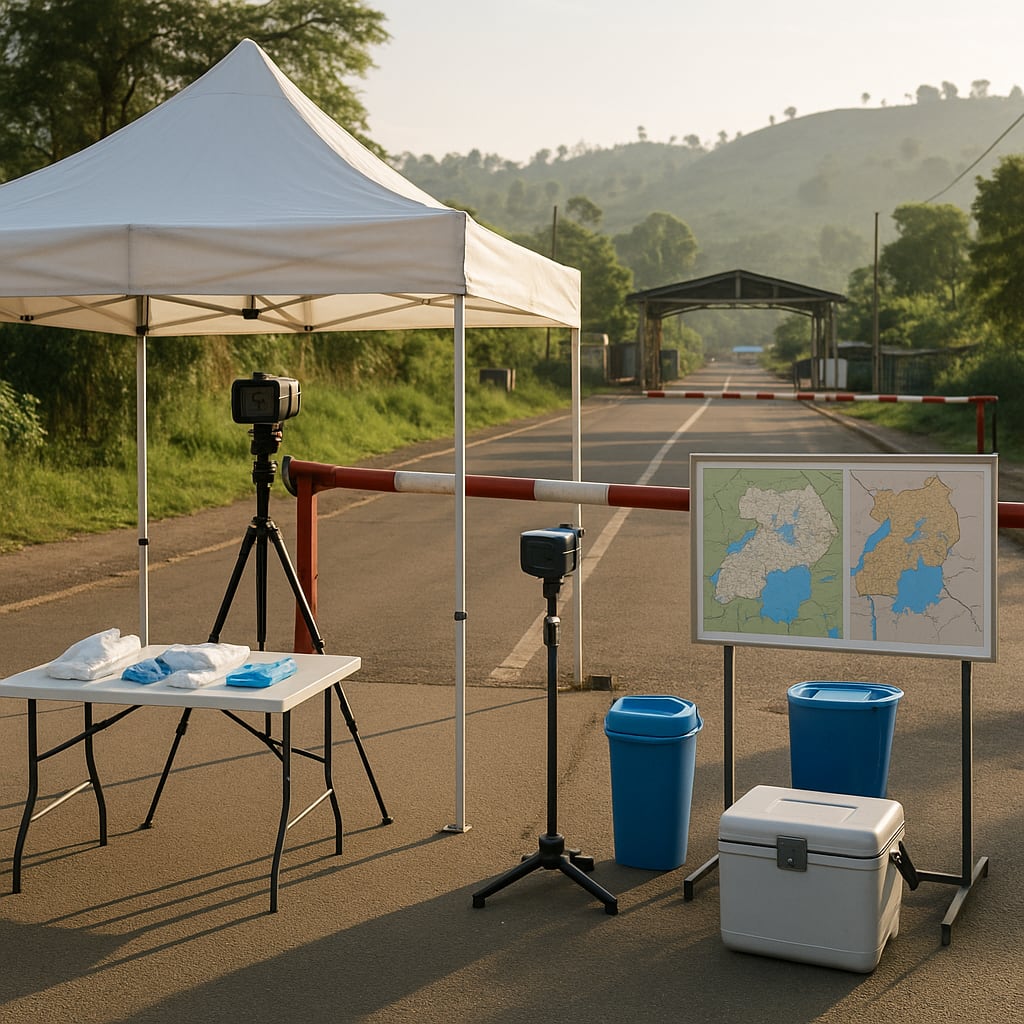
The crisis has also spilled across borders. Uganda has recorded cases of the same Bundibugyo strain and, amid regional alarm, announced the closure of its border with DR Congo “with immediate effect.” Other countries have moved to strengthen preparedness: Kenya has announced emergency measures along its borders, and Nigeria’s public health authorities have raised alerts about the risk of importation.
Against this backdrop, Tedros travelled to DR Congo, heading to Ituri—described as the hardest-hit area—while reiterating that the outbreak “can be stopped” if responders can reach affected populations and operate without interference.
Why It Matters
This is not only a story of epidemiology; it is a story about governance and security. The phrase “catastrophic collision” has resonated because it captures how conflict reshapes an outbreak’s trajectory. In settings where armed groups, mistrust, and displacement are persistent, the tools that usually break chains of transmission—rapid diagnosis, stable treatment centres, and safe, culturally acceptable burials—become harder to deliver and easier to disrupt.
The Bundibugyo strain adds another layer of challenge. Multiple outlets underscore that there is no widely deployed, strain-specific vaccine or approved targeted treatment, increasing reliance on supportive care and experimental or adapted medical countermeasures. Scientific and health reporting has highlighted the difficulty of developing and trialling vaccines against this strain quickly, especially when insecurity limits clinical research and routine delivery systems.
Regionally, the outbreak is testing the balance between disease control and economic/social continuity. Border closures and heightened screening can slow cross-border spread, but they also risk impeding trade, labour movement, and humanitarian logistics. Uganda’s decision to shut its border signals how quickly neighbours may shift to restrictive measures when local cases appear and when the epicentre is perceived as unstable. Meanwhile, alerts in countries farther afield, such as Nigeria, reflect the fear of silent importation via travel routes that are difficult to police completely.
The crisis also exposes the fragility of health infrastructure in parts of eastern Congo. Reports of community actions around treatment facilities—including incidents involving access to bodies—have underscored the importance of trust, communication, and safe burial practices, all of which become harder when health workers are viewed through the lens of conflict, coercion, or misinformation.
Diplomatically, WHO’s appeal for a ceasefire is a significant escalation in tone: it positions outbreak control as dependent on political and military decisions, not simply on funding or technical capacity. That framing implicitly calls on armed actors and their backers—domestic and external—to weigh the public health consequences of continued fighting.
Diverging Narratives
While the central facts align, outlets differ in emphasis, framing, and the practical implications they draw.
Health emergency vs security emergency. Some coverage treats the outbreak primarily as a public health story that is being obstructed by violence; others treat it as a security-and-governance story in which Ebola becomes another destabilising force. In the former framing, the focus is on operational requirements—humanitarian access, contact tracing, safe burials, laboratory confirmation. In the latter, the emphasis shifts to displacement, camps, and the inability of state authority to guarantee safe conditions for responders.
Ceasefire plea vs border defence. Another split appears in what is foregrounded as the “next step.” A number of reports centre WHO’s ceasefire appeal as the pivotal intervention—an attempt to open space for health operations. Others give greater weight to neighbouring countries’ protective measures, especially Uganda’s border closure, effectively reframing the outbreak as a regional containment problem where national borders become the key line of defence.
How the numbers are presented. The most consequential divergence is not the direction of the trend—nearly all reporting agrees cases are rising fast—but the way figures are narrated. Some reports lead with suspected cases approaching 900 and suspected deaths in the hundreds, conveying an outbreak that is already vast. Others highlight the confirmed counts (for example, confirmed cases around 121 and confirmed deaths in the teens), producing a less apocalyptic but still urgent picture. The gap is rarely described as a contradiction; instead it reflects different editorial choices about whether to prioritise confirmed laboratory data or the broader suspected/probable caseload used for field response.
Science and preparedness vs immediate crisis imagery. International health and science-oriented coverage has devoted attention to the challenges of vaccine development for Bundibugyo and to the limits of existing tools. Other reporting prioritises vivid indicators of social strain—overrun facilities, community confrontations, and the day-to-day hazards facing responders. Both are part of the same reality, but the choice of lens affects the implied solutions: research and medical countermeasures on one hand; security, access negotiations, and community trust-building on the other.
Domestic political spillovers in neighbouring states. In regional African coverage, preparedness measures and legal or political pushback receive more attention—such as court actions affecting quarantine plans or government steps to establish holding centres—highlighting how Ebola fears can ripple into domestic policy debates well beyond the epicentre. International outlets more often compress these complexities into a single theme: heightened regional alert.
Current Situation
The latest reporting places Tedros in DR Congo, travelling toward Ituri while reiterating that the outbreak is containable if access improves and if insecurity does not block response teams. The outbreak continues to be described as fast-spreading, with suspected cases near 900 and suspected deaths in the hundreds, alongside a smaller confirmed-case and confirmed-death tally reflecting the constraints on testing and verification in conflict-affected areas.
Neighbouring countries are acting on the assumption of ongoing cross-border risk. Uganda has closed its border with DR Congo, and other states have announced heightened preparedness steps, including border measures and national alerts about importation.
The immediate outlook, as presented across outlets, hinges less on medical uncertainty than on operational reality: whether health teams can safely reach affected communities, whether population movement can be monitored, and whether trusted systems for isolation and burial can function amid violence and displacement. Without improved humanitarian access and security conditions, the central warning—of a collision between war and disease—remains the defining feature of the crisis.