
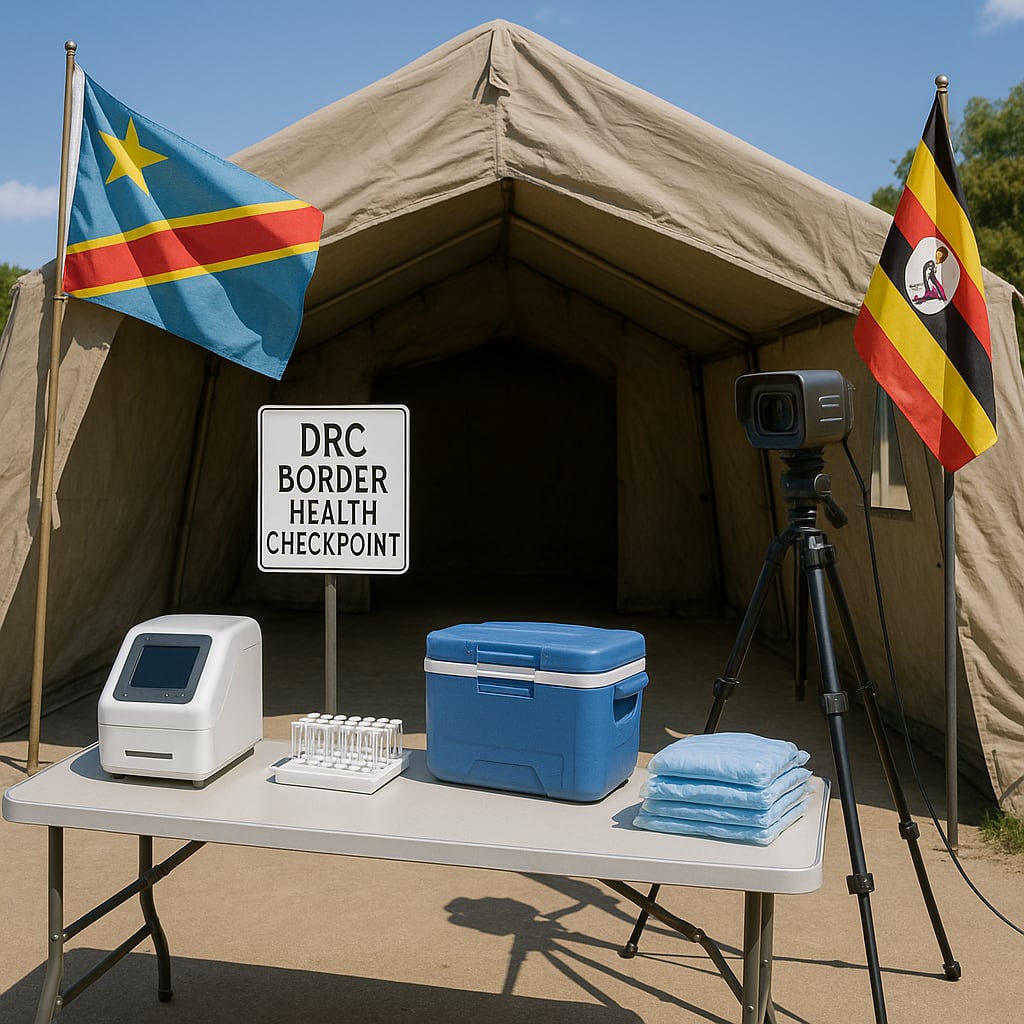
Ebola in DRC exposes operational gaps, prompts regional deployments, and rekindles debates on borders and vaccines
Narrative Snapshot
- Reporting converges on two operational constraints in the Democratic Republic of the Congo (DRC): deep community mistrust in affected areas and critical shortages of basic protective gear for front-line staff (Japan Times). Analysts tie both to conflict dynamics and fragile trust that complicate containment (Nigeria Health Watch).
- East African commentary emphasizes risk communication and public confidence: calls for transparency and calm messaging in Kenya sit alongside arguments that Ebola’s transmissibility is often overstated (Daily Nation; Mail & Guardian).
- Coverage splits on the locus of control measures. Ugandan officials project regional solidarity and readiness, including deploying treatment capacity into the DRC (Nile Post; Independent/Kampala), while U.S. political pressure on Europe highlights renewed reliance on travel measures (The Hindu). Asian outlets focus on airport defenses (South China Morning Post).
- Policy commentary tests the R&D pipeline: why, despite two decades of knowledge, no vaccine existed for the Bundibugyo strain when this outbreak began (IPS), with broader lessons drawn from the COVID-19 era on early mobilization (Folha de S.Paulo).
What Happened
Health authorities and international partners are responding to an expanding Ebola outbreak centered in the DRC. Japan Times reports nearly 600 confirmed cases, with mistrust and resistance—including attacks on burial teams and treatment centers—hampering the response, and medics facing shortages of boots and masks despite rising donor contributions constrained by aid cuts and logistics. TASS cites DRC authorities reporting 115 deaths and 297 patients hospitalized. Regional governments are positioning: Uganda’s president assured the WHO of readiness and called for stronger regional coordination (Nile Post), while Ugandan teams prepared to set up Ebola treatment centers and a laboratory inside the DRC (Independent/Kampala). In Kenya, commentary highlighted the politics around a reported case and urged calibrated public messaging (Mail & Guardian; Daily Nation). Beyond Africa, the U.S. urged the EU to tighten travel measures (The Hindu), and Asian media asked whether the virus could transit regional airports (South China Morning Post).
Why It Matters
This episode tests multiple layers of global health governance at once. First, it spotlights the interface of outbreak control with conflict and social trust—conditions Nigeria Health Watch underscores as central to containment in the DRC—where PPE shortfalls and security risks disrupt core interventions (Japan Times). Second, it probes regional cooperation models: Uganda’s forward deployment of treatment and lab capacity into the DRC operationalizes cross-border assistance (Nile Post; Independent/Kampala). Third, it reopens policy debates on mobility controls—Washington’s push for European travel measures (The Hindu) and Asia’s scrutiny of airport defenses (South China Morning Post)—and their alignment with community-focused control. Finally, it exposes gaps in the countermeasure pipeline: IPS questions the absence of a Bundibugyo-specific vaccine despite long-standing knowledge, even as other pathogens attract investment, such as a €15m multi-country chikungunya vaccine trial launched in Kigali (New Times via AllAfrica), amid broader concern over vector-borne threats (CBC News).
Diverging Narratives
- Transmission risk vs. public fear: East African commentary urges precision—that Ebola is highly infectious but not easily transmitted person-to-person without contact with bodily fluids (Daily Nation)—to avoid panic and stigma, a concern echoed in analysis of Kenya’s politicized discourse around a reported case (Mail & Guardian).
- Community engagement vs. coercive controls: Nigeria Health Watch emphasizes that insecurity, displacement, and fragile trust are central obstacles. Japan Times details attacks on responders and shortages of basic kit, pointing to operational fixes and community relations. In contrast, The Hindu highlights a U.S. call for European travel measures, and the South China Morning Post asks if Asia’s airport defenses could be bypassed—re-centering borders rather than neighborhoods as the frontline.
- Capacity signaling vs. on-the-ground constraints: Uganda projects readiness and regional assistance (Nile Post; Independent/Kampala). Simultaneously, Japan Times reports medics in the DRC “with no boots” and dwindling masks due to aid cuts and logistics, suggesting that declared readiness and real-time resourcing may not align across the response chain.
- R&D readiness: IPS argues that the lack of a Bundibugyo vaccine after two decades reflects systemic lags, while Folha de S.Paulo frames COVID-19’s lesson that distant outbreaks demand swift, anticipatory investment—an expectation the current Ebola episode is testing.
What Happens Next
- Supply stabilization for front-line responders: Japan Times notes donor contributions alongside shortages tied to aid cuts and logistics. Watch for procurement surges of PPE, restoration of supply lines into insecure zones, and whether attacks on teams abate—signals of operational traction.
- Cross-border deployment by Uganda: Independent/Kampala reports imminent establishment of treatment centers and a lab in the DRC. Indicators include site activation, staffing, and data-sharing protocols with Congolese authorities—benchmarks for effective regional assistance.
- Travel and border policy recalibration: Following the U.S. call to the European Commission (The Hindu), monitor EU guidance on travel measures and airport health protocols. In Asia, SCMP’s focus suggests tracking civil aviation advisories and screening practices for alignment with WHO guidance and regional risk assessments.
- Countermeasure pipeline: IPS’s critique on Bundibugyo vaccines puts funders and research coalitions on the spot. Watch for targeted R&D announcements or trial initiations specific to Ebola variants, alongside the Kigali-launched chikungunya trial (New Times via AllAfrica) as a barometer of regional clinical trial capacity building.