
Lead
A luxury resort plan in Albania tied to Jared Kushner has become a flashpoint where environmental protections, allegations of political favoritism, and Albania’s EU ambitions collide. In recent days, street protests have swelled and turned tense in places, while anti-corruption prosecutors have opened an investigation into how protected land statuses were altered to enable development on sensitive coastline. The government, led by Prime Minister Edi Rama, is defending the project as a jobs-and-investment engine; opponents argue it is an emblem of state capture and a direct threat to rare coastal ecosystems.
What Happened
The immediate trigger for the unrest is a set of proposed high-end tourism developments linked to a Kushner-connected investment vehicle. The projects have been associated in public debate with two emblematic Albanian sites: Sazan Island—an ex-military outpost that has long carried strategic and symbolic weight—and the Narta Lagoon area on the Adriatic coast, widely described as protected or environmentally sensitive.
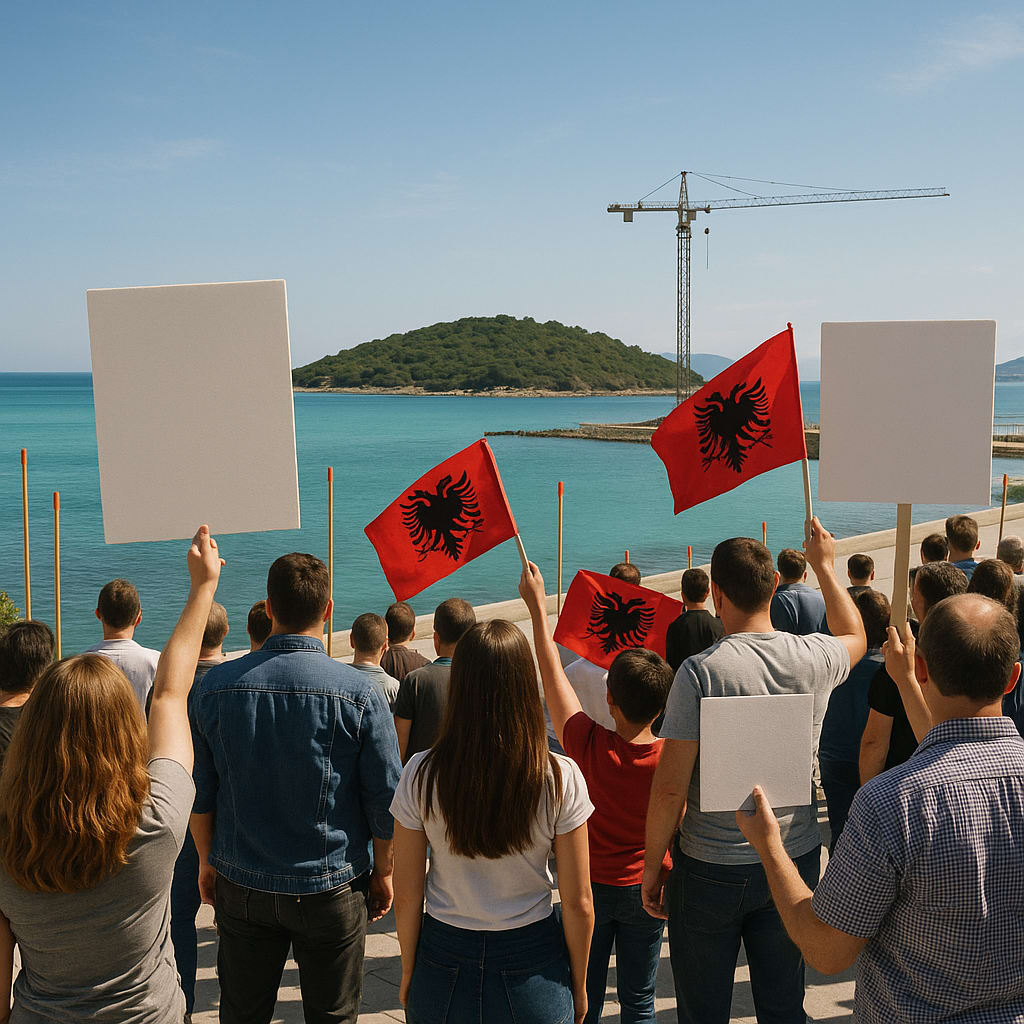
Across coverage, several facts align: a Kushner-linked venture is associated with plans for a luxury resort; the plan requires or benefits from changes in land designation or regulatory treatment; and Albanian civil society groups and opposition voices have mobilized against it, staging demonstrations that have grown in size over successive days. Protest slogans have explicitly targeted the Trump family, and the demonstrations have featured a strong anti-corruption theme alongside environmental demands.
Authorities have now been pulled into the story in two ways. First, anti-corruption prosecutors have opened an inquiry focused on the legal and administrative process behind changes to the protected status of coastal wetlands connected to the development footprint. Second, the government has publicly leaned into its defense of the investment, presenting it as a national opportunity and rejecting claims that the process has been bent for politically connected investors.
The protests have varied in intensity. Some reporting highlights clashes and violence at demonstrations, while other accounts foreground peaceful rallies and the breadth of civic participation. But the arc is consistent: what began as a localized fight over planning permissions has escalated into a national controversy with international reverberations because of the Trump-family linkage and Albania’s long-running tensions over development, transparency, and environmental enforcement.
Why It Matters
This controversy lands on a fault line in Albanian politics: the government’s push to attract foreign capital—especially in tourism—versus a persistent domestic narrative that major projects are too often driven by insider access, weak safeguards, and opaque decision-making.
Environmental stakes. The sites at issue are repeatedly described as protected coastal areas and wetlands—ecosystems that environmental groups argue are among the most vulnerable to large-scale construction. The dispute is not only about a single project footprint but about the precedent: whether formally protected areas can be reclassified or exceptions engineered when sufficient political and financial weight is applied.
Governance and rule-of-law stakes. The opening of an anti-corruption investigation shifts the story from advocacy into the realm of institutional accountability. It tests whether Albania’s anti-corruption bodies can investigate high-profile decisions that sit close to the political center, especially where international investors are involved and where government messaging has been strongly supportive. The investigation also makes the paper trail—who signed what, under which legal authority, and with what justification—central to the public debate.
EU trajectory and external scrutiny. Albania’s European aspirations form an important backdrop. A project framed domestically as a development win can, from a European governance perspective, become a liability if it reinforces concerns about transparency, conflicts of interest, or the integrity of environmental protections. The controversy has also drawn attention to how major investments are vetted and how public land is allocated or reclassified—issues that intersect with broader European concerns about corruption and regulatory capture in accession countries.
Political symbolism. The Trump-family connection changes the global resonance. For supporters, a marquee name signals confidence and could be presented as validation of Albania’s investment pitch. For opponents, it becomes a shorthand for elite deal-making and for a perceived blending of politics and private business—especially sensitive given Jared Kushner’s family ties to the current U.S. president and the charged symbolism that brings in both Albanian and international media ecosystems.
Diverging Narratives
Although the core facts are shared—Kushner-linked luxury development, protected coastal land, protests, and prosecutorial scrutiny—coverage diverges sharply in what it treats as the central issue.
1) Corruption probe vs. civic mobilization.
Some outlets place the anti-corruption investigation at the heart of the story, treating protests and public anger as consequences of alleged procedural manipulation—specifically, changes to protected status in a coastal wetland area. Others lead with the street demonstrations themselves, emphasizing the scale of turnout, the slogans directed at the Trump family, and the social movement character of the opposition. The difference is not merely stylistic: one framing suggests the dispute is primarily institutional and legal; the other suggests a broader crisis of legitimacy and public consent.
2) Environment-first vs. geopolitics-and-branding.
European-facing coverage tends to foreground protected habitats, regulatory standards, and how such projects sit alongside EU expectations. In that framing, the key audience is Brussels as much as Tirana, and the project is evaluated as a governance test. By contrast, some international coverage makes the Trump-family tie the main headline, implicitly treating the development as an extension of U.S. political branding abroad and emphasizing the reputational stakes for Albania.
3) “Investment opportunity” vs. “state capture.”
Government-aligned arguments are consistently presented as economic: jobs, investment inflows, and the idea that luxury tourism can reposition Albania internationally. Opposing narratives focus on process and ownership: whether protected lands are being converted for private gain, whether decision-making has been insulated from public scrutiny, and whether well-connected networks—local and international—are shaping outcomes behind the scenes. In the most skeptical renderings, Kushner’s role is less a business detail than a spotlight that makes ordinary Albanian concerns about opaque development feel internationally legible.
4) The geography of the dispute.
A significant point of complexity is that public discussion and media emphasis do not always align on a single site. Sazan Island appears as a vivid symbol—an island with a militarized past now slated for luxury redevelopment—while the Narta Lagoon area is emphasized as an environmentally protected wetland where land-status changes are central to the legal controversy. This dual-site emphasis can make the story appear inconsistent to casual readers, even as it reflects a broader phenomenon: multiple high-end tourism proposals, tied by theme and political dispute, being debated as part of one national argument over how Albania develops its coastline.
5) Protest intensity and policing.
There is also a difference in how unrest is characterized. Some reporting highlights violent episodes and confrontation; others stress the peaceful nature and civic breadth of the demonstrations. The underlying agreement is that protests are growing and politically salient, but the tone affects perceived legitimacy—either as a public order challenge or as a grassroots democratic response.
Current Situation
As of early June 2026, protests continue and appear to be expanding, with demonstrators demanding that the government halt or block the development plans and preserve protected areas. The Albanian prime minister remains publicly committed to the project’s economic rationale, signaling that the government does not intend to reverse course simply due to street pressure.
The anti-corruption investigation is the most concrete institutional development. Its direction—whether it focuses narrowly on procedural compliance, or broadens into questions about influence and conflicts—will likely shape the next phase. In the near term, the dispute is set to play out on three parallel stages: in the streets through continued mobilization; in administrative and legal channels through scrutiny of land reclassification and permitting; and in Albania’s international relationships, where the combination of EU governance expectations and the Trump-linked branding of the project ensures sustained attention.
Whether construction has begun on the contested sites is presented differently across coverage, but the political reality is already fixed: the project has become a proxy battle over Albania’s development model, and a test of how resilient environmental protections and anti-corruption institutions are when a megaproject arrives with global names attached.