
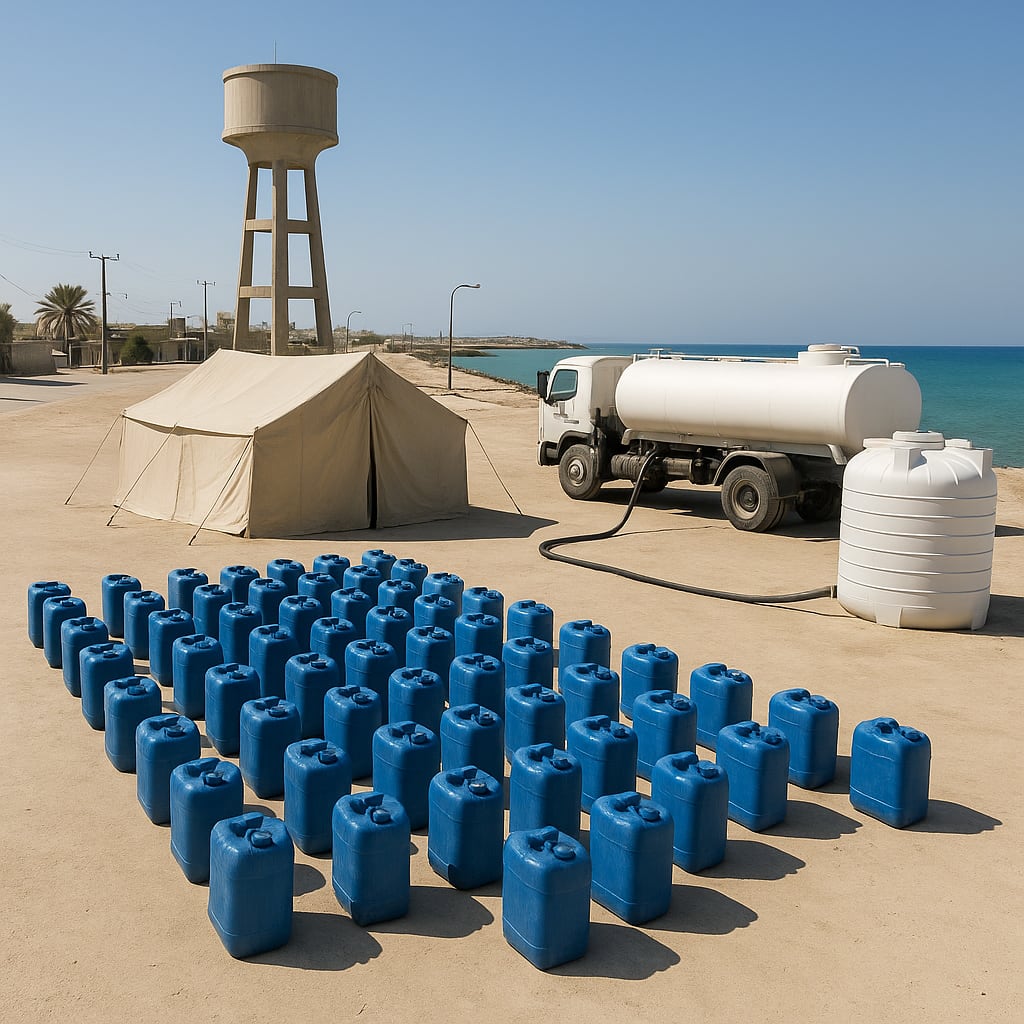
Reported U.S. strikes damage Iranian water reservoirs in Sirik, cutting supplies for thousands amid wider U.S.–Iran exchanges
Narrative Snapshot
- Multiple outlets converge on the core fact: two reservoirs near Sirik, Hormozgan, were hit and drinking water was disrupted for civilians; The Hindu reports 20,000 residents affected, while SCMP and Middle East Eye (MEE) cite “thousands.” Al Jazeera situates the facilities as protected civilian infrastructure.
- Legal framing diverges. The New York Times’ satellite analysis indicates precision strikes on a water facility but says intent is unclear; it notes that deliberately targeting civilian infrastructure could constitute a war crime, a point echoed by Corriere della Sera. Iranian state outlets (IRNA, Tehran Times) characterize the attack as deliberate and barbaric.
- Motive and sequence are framed through retaliation claims: Al Jazeera reports the U.S. cited the downing of a U.S. helicopter; TASS states an Iranian drone hit the helicopter but says intent is unknown.
- Regionally, MEE reports reciprocal U.S.–Iran strikes and strain on a ceasefire, while Deutsche Welle highlights systemic energy and logistics vulnerabilities around the Strait of Hormuz. The Guardian underscores contested U.S. domestic messaging around the conflict.
What Happened
Explosions were reported in Iran’s southern Hormozgan province on June 9–10, including near the Strait of Hormuz (MEE). Iranian state media and international outlets say U.S. strikes hit two water reservoirs serving Sirik; The Hindu reports the Bemani and Kouhestak areas lost safe drinking water for roughly 20,000 residents, with SCMP describing “thousands” affected. IRNA quoted Foreign Ministry spokesperson Esmaeil Baqaei condemning an attack on the nation’s “pulse of life,” while Tehran Times detailed the destroyed tanks’ capacities (500 and 2,000 cubic meters). The New York Times’ analysis of satellite imagery and videos suggests precision strikes on a water facility but says it is unclear whether it was intentionally targeted. Al Jazeera reports the U.S. cited retaliation for a downed helicopter; TASS notes it was hit by an Iranian drone, with unclear intent. MEE reports Iran struck U.S.-linked sites across the region as exchanges continued.
Why It Matters
The incident sits at the intersection of humanitarian protection norms and military escalation. Al Jazeera emphasizes that water systems are civilian infrastructure with special protection under international humanitarian law; the New York Times and Corriere note that deliberate targeting could constitute a war crime, raising accountability questions for states and potential roles for multilateral scrutiny. MEE’s reporting of renewed tit-for-tat strikes and a strained ceasefire signals risks of entrenchment beyond the immediate episode. Deutsche Welle warns that even a de-escalation would not swiftly resolve energy and supply chain fragility linked to the Strait of Hormuz and damaged infrastructure. Concurrently, Al Jazeera describes a dual track of U.S.–Iran talks and force signaling, while the Guardian highlights domestic political headwinds in Washington—factors that may constrain crisis management, transparency on targeting decisions, and pathways to a durable settlement.
Diverging Narratives
Iranian outlets and officials present the strikes as a deliberate attack on civilian life. IRNA quotes the Foreign Ministry labeling the hits on Sirik’s water structures an assault on the country’s “pulse of life,” and Tehran Times frames the damage in moral and humanitarian terms, emphasizing tank capacities and civilian dependence. By contrast, the New York Times, after geolocating and analyzing imagery, concludes the facility was precisely struck but stresses that it is unclear whether the U.S. knew it was a water site; it underscores that deliberate targeting of such infrastructure could amount to a war crime, leaving the legal assessment contingent on intent and knowledge. Al Jazeera highlights the broader legal significance of striking water systems while noting the U.S. cast its actions as retaliation for a helicopter downing; TASS reports that an Iranian drone was involved but that intent remains unknown. MEE’s coverage embeds the incident within ongoing reciprocal strikes and a stressed ceasefire, while casualty figures and outage scope vary across outlets (e.g., The Hindu’s estimate versus SCMP’s “thousands”).
What Happens Next
- U.S. targeting transparency and legal posture: The NYT flags legal exposure if the facility was deliberately targeted. Watch for any CENTCOM/Pentagon clarification on target identification, decision processes, or internal reviews; the presence or absence of such detail will shape legal and diplomatic fallout (NYT; Corriere).
- Iranian response calibration: Iran’s foreign minister vowed to answer any U.S. attack, and senior figures signaled firmness (MEE). Indicators include additional strikes on U.S.-linked sites (as MEE already reported) or messaging that reopens diplomatic channels highlighted by Al Jazeera’s “deal vs. war” framing.
- Humanitarian restoration and risk to critical infrastructure: Follow Iranian state updates for repair timelines and water service restoration in Sirik (IRNA; The Hindu; SCMP). Additional hits on utilities would signal escalation in methods with broader civilian impact (Al Jazeera).
- Regional stability and energy flows: MEE notes a strained ceasefire amid exchanges; DW underscores that shipping and infrastructure constraints at Hormuz persist irrespective of a deal. Monitor disruptions to maritime traffic, infrastructure repair capacity, and any third-party mediation efforts referenced in broader regional reporting.