
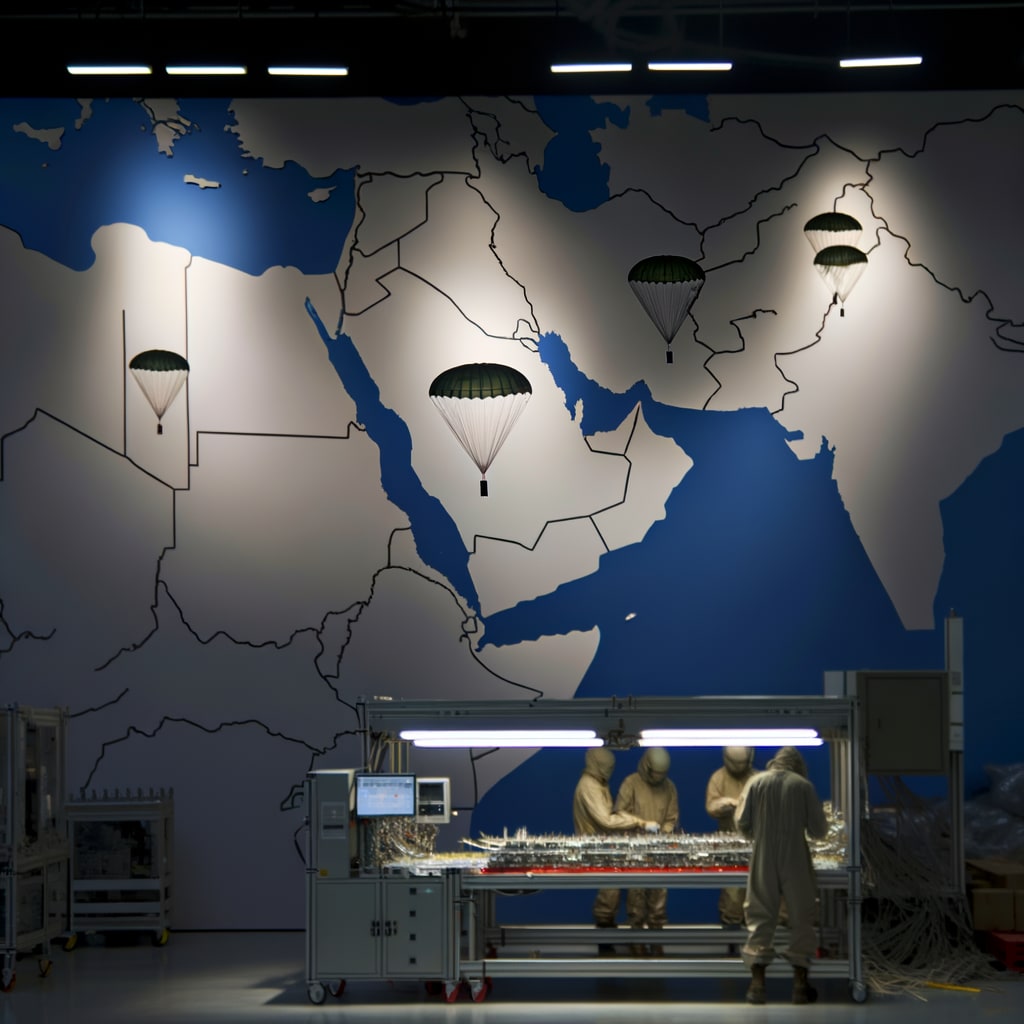
US Targets Iranian Drone Production, Contemplates Troop Deployment Amid Rising Tensions
The US military has confirmed strikes on an Iranian turbine engine production facility in Qom province, linked to the Islamic Revolutionary Guards Corps (IRGC). Meanwhile, the Pentagon is reportedly contemplating the deployment of airborne troops to Iran, as tensions continue to escalate in the Middle East.
Background and Context
The Qom Turbine Engine Production Plant has been producing gas turbine engines for attack drones and aircraft components used by IRGC, according to a statement by US Central Command (Centcom) reported by Middle East Eye. Despite these strikes, experts maintain that Iran retains its drone production capacity, although its ability to produce larger, longer-range ballistic missiles has been cast in doubt.
The US has reportedly hit more than 9,000 targets in Iran, damaging or destroying over 140 Iranian vessels, as reported by TASS. Flight data suggests possible movement of US military personnel towards the Middle East, indicating a potential escalation of US involvement in the region, as reported by Middle East Eye.
Key Developments
Senior US military officials are also considering the deployment of approximately 3,000 airborne troops to capture Kharg Island, responsible for 90% of Iran's crude oil exports, according to a report from the New York Times and RT. Kharg Island was targeted by US strikes in mid-March, though its energy infrastructure was spared.
The US is also ramping up its military arsenal, with Donald Trump ordering 22 B-2 strategic bombers for use in the operation against Iran, as reported by TASS.
Implications and Reactions
Iran, in response to these developments, has threatened to mine the Persian Gulf and coastal zones if its coasts or islands are attacked, as reported by Le Monde. The country has also warned of striking energy sites across the region if its power plants are targeted, as reported by Al Jazeera English.
President Trump has issued an ultimatum for Iran to reopen the Strait of Hormuz within 48 hours or face strikes on its energy infrastructure, according to ANSA and Folha de S.Paulo. Iran has retorted with threats of missile attacks on US infrastructure.
Despite this escalating rhetoric, a ceasefire seems unlikely. TASS has reported that there have been no proposals from Iran for ending the war or ceasing fire.
Conclusion
The situation remains volatile with the US continuing to target Iranian military objectives and contemplating further troop deployment. Iran has responded with threats of its own, escalating the potential for further military conflict in the region. While negotiations and ceasefire remain uncertain, the global community watches on, awaiting the next developments in this escalating crisis.