
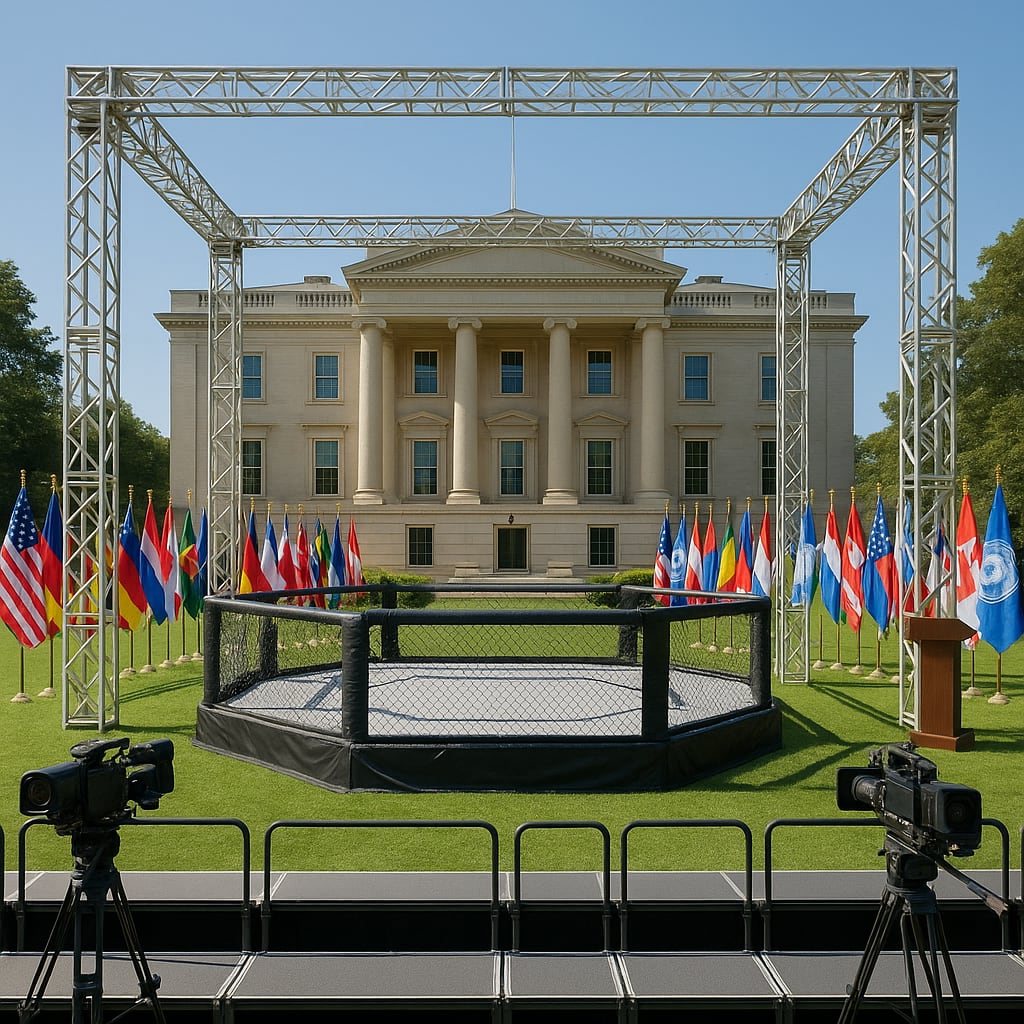
Trump’s 80th: White House UFC spectacle coincides with announced US–Iran peace terms
Narrative Snapshot
- European and global outlets foreground context: the show’s optics alongside the Iran war and the administration’s peace claims (DW; Le Monde; Sky News), while US conservative outlets frame it as patriotic pageantry tied to semiquincentennial themes and family presence (Fox News).
- Coverage diverges on propriety and financing: The Guardian characterizes the event as an unprecedented private, for‑profit use of the White House; Fox News repeatedly cites UFC assurances it would not profit and reports costs “upwards of $60m.”
- International vantage points emphasize symbolism and cost (SCMP; CBC), diplomatic timing (Le Monde; Middle East Eye), and global political greetings (ANSA; Times of Israel), while Latin and European press spotlight a fighter’s slur against Michelle Obama as an escalation of culture‑war rhetoric (Clarin; Corriere della Sera).
- Regional reporting around the peace announcement underscores unanswered implementation details, including nuclear commitments and third‑country financial channels, with officials denying money movements and neighboring states not briefed (Middle East Eye; UAE denial).
What Happened
On Sunday, a mixed martial arts event branded “UFC Freedom 250” unfolded on the White House South Lawn under a 28‑metre‑tall, 600‑ton steel structure dubbed “The Claw,” marking President Donald Trump’s 80th birthday (CBC; SCMP). About 4,000–4,300 attendees, including roughly 1,200 active‑duty service members, watched seven bouts, a military flyover, fireworks, and ceremonial elements led by Trump and UFC chief Dana White; Melania and Ivanka Trump appeared, and celebrities and tech leaders were present (DW; Fox News; The Hindu; Corriere della Sera). The New York Times noted the event’s heavy use of White House trappings. Outside, protesters rallied (The Guardian). Hours around the event, Trump and media outlets highlighted an initial US–Iran agreement to end the 108‑day war, with Middle East Eye reporting plans to sign in Geneva and Trump saying Iran agreed not to develop or acquire nuclear weapons (Le Monde; Sky News; MEE).
Why It Matters
- Institutional norms: Staging a commercial‑scale combat‑sports spectacle on White House grounds tests long‑standing conventions about the executive mansion’s use for political theater and private events. Disputed claims over profit and public resources (The Guardian vs. Fox News) elevate questions likely to draw congressional and watchdog scrutiny in future administrations.
- Diplomacy by spectacle: The tight coupling of a high‑octane show with peace‑process messaging underscores a personalization of statecraft and the use of mass entertainment as a signaling tool (Le Monde; DW; BBC analysis of mixed Iran messaging). This has implications for how allies, adversaries, and domestic constituencies assess US commitments.
- Regional implementation risk: Reports that Lebanon was not briefed on ceasefire timing, along with UAE denials of moving Iranian funds, highlight execution gaps that can imperil de‑escalation in interconnected theaters like Lebanon and Israel (MEE). The asserted nuclear pledge, if formalized, would recalibrate verification, sanctions, and regional deterrence frameworks (MEE; DW).
Diverging Narratives
- Propriety and symbolism: DW and SCMP frame the spectacle as tone‑deaf amid an ongoing Iran war and cost‑of‑living pressures; The Guardian amplifies protest claims of corruption and unprecedented for‑profit use of White House space. Fox News depicts the night as patriotic, semiquincentennial‑adjacent, and servicemember‑inclusive, highlighting cheers, family attendance, and cultural performances.
- Financing and precedent: The Guardian’s “first private, for‑profit sporting event” characterization contrasts with Fox News reporting that UFC said it would not profit and that costs could exceed $60m. CBC and SCMP foreground the price tag and engineering scale; NYT centers the institutional optics of using White House trappings for a cage match.
- Diplomacy signal vs. substance: Le Monde and Sky News tie the show to news of an initial peace deal; Middle East Eye reports a Geneva signing timeline and a US claim that Iran committed not to develop or acquire nuclear weapons. Yet BBC and DW note earlier mixed messaging about imminent deals, and MEE reports Lebanon was not informed, while the UAE denies any movement of Iranian funds—indicating unresolved mechanics and regional buy‑in.
- Culture‑war flashpoints: Coverage of UFC fighter Josh Hokit’s slur against Michelle Obama (Clarin; Corriere) underscores polarization. Fox News spotlights on‑air pushback by comedian Shane Gillis and media criticism episodes (e.g., Variety) as evidence of a broader cultural divide.
What Happens Next
- Agreement formalization and text: Watch for whether the Geneva signing reported by Middle East Eye occurs on schedule and whether official texts codify the stated “no development or acquisition” nuclear commitment. Publication of provisions and verification pathways will shape allied alignment and IAEA‑related processes (MEE; DW; BBC).
- Regional implementation and de‑escalation: Indicators include Hezbollah’s operational tempo, Lebanese official briefings, and cross‑border incident trends following MEE’s note that Lebanon was not informed of timing. Sustained quiet or rapid clarifications would signal traction; renewed attacks or ambiguity would point to fragility.
- Financial channels and sanctions relief mechanics: Monitor confirmations or denials from Gulf financial authorities after the UAE’s rejection of fund‑movement reports. Any sanctioned‑asset transfers or escrow arrangements would clarify sequencing and compliance incentives (MEE UAE denial).
- Domestic oversight and precedent: Expect scrutiny of event financing, vendor contracts, servicemember participation, and White House facility use rules, given conflicting claims about for‑profit status (The Guardian; Fox News). Formal reviews or guidance will set the bar for future executive‑branch event norms.
- International optics and coalition management: Continued reactions from leaders who publicly engaged around Trump’s birthday (ANSA; Times of Israel) may signal how partners balance optics with policy as the Iran process unfolds.