
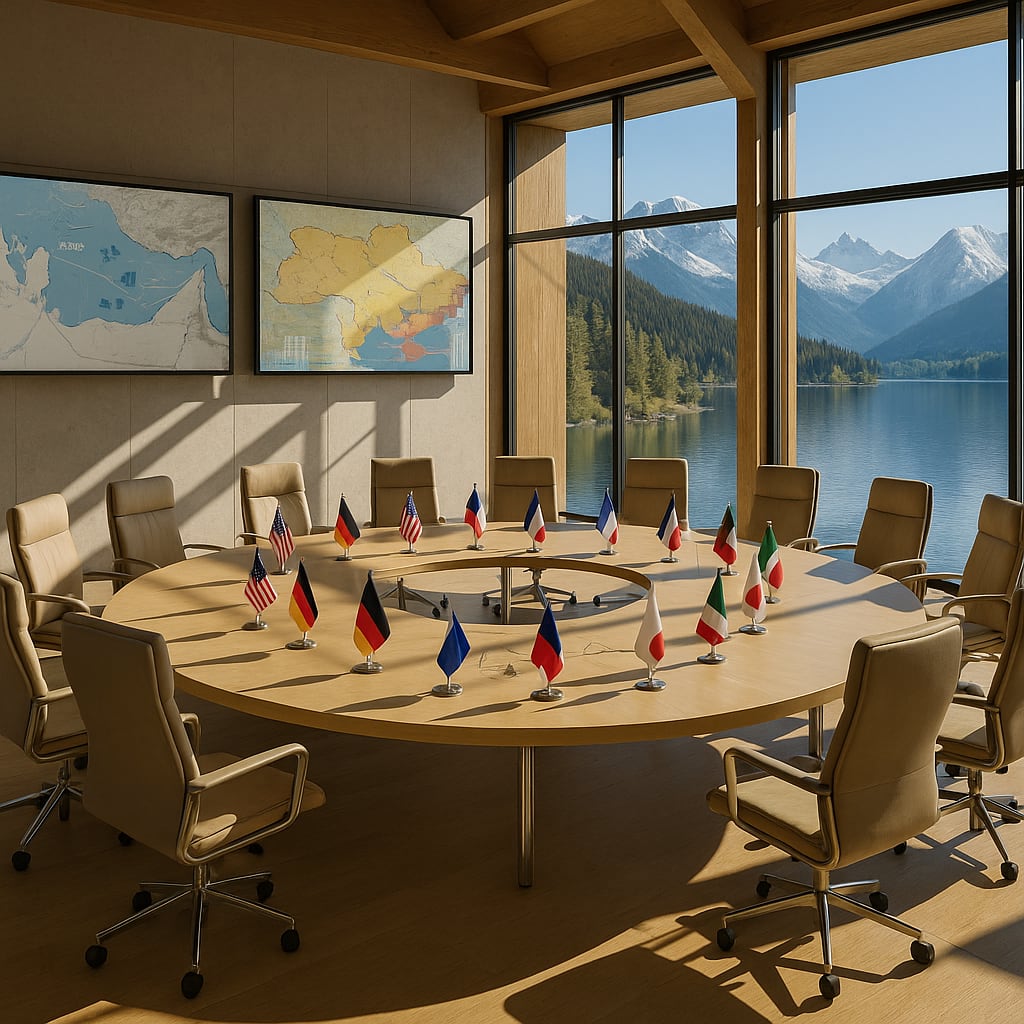
G7 opens in Évian as leaders balance Iran ceasefire implementation, Hormuz security, Ukraine strategy, and a US–France tariff clash
Narrative Snapshot
- Most outlets agree the summit is dominated by the Iran conflict’s endgame, Ukraine, and economic headwinds; Évian is heavily secured and sequenced around a Macron–Trump bilateral before a working dinner (ANSA; Le Monde; The Hindu; DW; Al Jazeera).
- The Iran file is cast as “momentum” by US-aligned coverage (Fox News), “cautious optimism” by European outlets (DW), and strategic ambiguity or skepticism by others: BBC highlights mixed US messaging; Tehran Times questions Washington’s approach to Iran; Middle East Eye details still-contested implementation points, including Hormuz fees.
- Europe-focused reporting emphasizes managing Trump: Macron tailoring an agenda to keep him engaged, amid concerns about his attendance and disruptive style (The Guardian; NYT), while French analysis underscores the need for EU unity (La Repubblica/Moïsi) and Macron’s domestic fragility pressing him toward diplomatic activism (Le Monde).
- Trade friction is unambiguously foregrounded: Trump’s threat of 100% tariffs on French wine over the digital services tax (Le Monde; SCMP) meets Macron’s promise of a “respectful but firm” exchange (TASS; Corriere).
What Happened
Leaders arrived in Évian on June 15 for a Macron-hosted G7 built around security and economic coordination, with a Macron–Trump meeting preceding a working dinner (ANSA; Le Monde). The agenda centers on the announced US–Iran peace agreement after a 108‑day war, with several outlets pointing to a signing expected Friday in Geneva while others report electronic signatures already by US and Iranian principals (Middle East Eye; Folha; Clarín). Macron warned Iran against imposing Hormuz tolls and said France and the UK are ready to lead escort and mine-clearance operations once conditions allow; Trump said the strait would reopen Friday and he needed little help (Middle East Eye; Folha; La Repubblica; Le Monde). Trump threatened 100% tariffs on French wine unless Paris drops its digital tax; Macron pledged a firm response (Le Monde; SCMP; TASS). Zelensky is due to join and meet Trump (Le Monde; Corriere). Brazil’s Lula met Macron and ruled out a Trump bilateral (Folha).
Why It Matters
- Alliance management: The summit tests whether the G7 can align on Ukraine and Middle East stabilization while accommodating a US president who couples unilateral trade threats with deal-centric crisis diplomacy (NYT; The Guardian; Le Monde).
- Maritime order and energy security: The Hormuz reopening, and whether Iran charges passage fees, implicate freedom of navigation norms and the feasibility of a European-led escort/deminers mission—key to oil market stability flagged in French coverage (Middle East Eye; Folha; Le Monde).
- Rule-making vs. retaliation: A US–France clash over digital taxation pits national measures (France’s DST) against tariff threats, with implications for the OECD’s digital tax process and EU trade defense posture (Le Monde; SCMP; TASS).
- Systemic signaling: Canada’s prime minister frames a more plural “new world order,” while Macron’s domestic weakness and Lula’s selective engagement underscore how internal politics shape external bargaining and the G7’s ability to convene broader coalitions (CBC; Le Monde; Folha; Clarín).
Diverging Narratives
- Iran deal status and scope: US-friendly outlets celebrate momentum (Fox News), while European reporting is guarded (DW). Middle East Eye cites an expected Geneva signing and notes outstanding implementation issues (notably Lebanon and Hormuz), yet Clarín reports the agreement was already signed electronically by US and Iranian figures. BBC flags prior mixed US messaging; Tehran Times casts US policy as coercive continuity. These threads collectively highlight uncertainty over both timing and content.
- Hormuz “help” vs. European agency: Macron publicly rejects any tolls and cites readiness with the UK for escort and mine-clearing, framing a European contribution to maritime security. Trump asserts reopening on Friday and that he needs little help, implying a primarily US-driven outcome (Middle East Eye; Folha; La Repubblica; Le Monde).
- Managing Trump vs. demonstrating unity: Macron seeks to keep Trump in the room and extract convergence on Ukraine, amid reminders of past early departures (The Guardian; Kyiv Independent). French and Italian outlets also stress necessity-based cordiality—“friends by necessity”—reflecting Europe’s need to avoid US hostility even as it pursues strategic autonomy (Corriere; La Repubblica).
- Trade confrontation framing: French and Asian coverage presents a stark tariff threat tied to France’s digital tax; Macron promises firmness but respect. The dispute sits alongside a broader economic agenda where US coverage lists AI, supply chains, and migration priorities, indicating different emphases across capitals (Le Monde; SCMP; TASS; Fox News).
What Happens Next
- Iran ceasefire implementation and signature: Watch for an official text and signing venue/timing (Geneva vs. already-electronic, per Clarín and Middle East Eye). Indicators: joint communiqués, details on Lebanon-related steps, and monitoring/verification provisions (Middle East Eye; Clarín).
- Hormuz reopening and governance: Key decisions include whether Iran imposes any transit fees and whether a France–UK escort/mines mission deploys. Signals: Iranian transport or maritime authority notices; French/UK operational announcements; US statements about the need for allied support (Middle East Eye; Folha; Le Monde; La Repubblica).
- US–France trade clash: Either the US issues formal tariff actions (e.g., USTR notices) or both sides channel the dispute into talks linked to broader digital tax discussions. Watch French government responses and any EU coordination on countermeasures (Le Monde; SCMP; TASS).
- Ukraine alignment: Outcomes hinge on the Trump–Zelensky meeting and G7 language on pressure tools against Russia. Indicators: communiqués, pledges, or shifts in burden-sharing rhetoric Macron seeks to showcase (Le Monde; Kyiv Independent; The Guardian).