
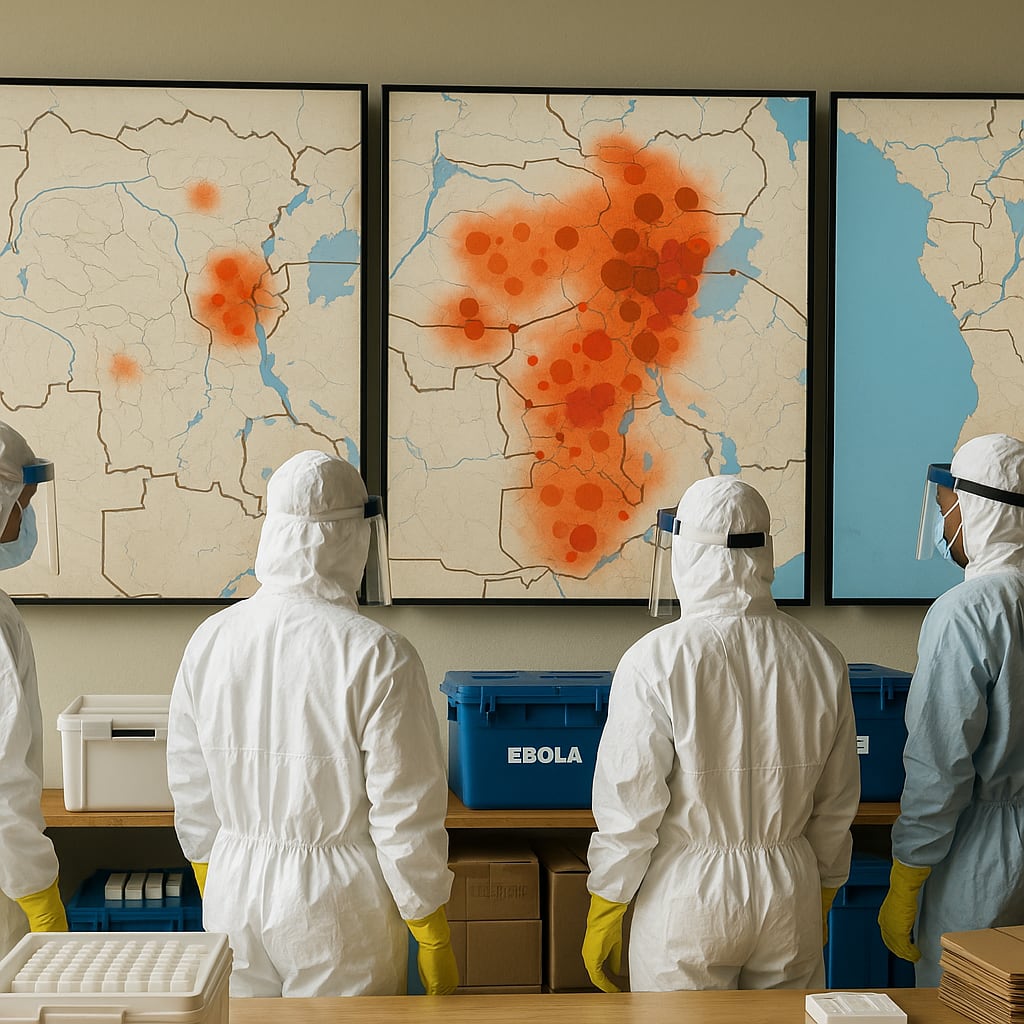
DRC Ebola outbreak accelerates; WHO launches $518m plan as mining, mistrust and shifting alliances shape the response
Narrative Snapshot
- Several outlets trace spread to mobility around artisanal gold sites in eastern DRC, with field reporting from mining towns (New York Times; Clarin; Folha de S.Paulo), while others stress social drivers: rumors and hostility toward responders (Deutsche Welle; AllAfrica/UN News) and uneven community buy‑in and logistics (Le Monde, June 5).
- Case counts and trajectory are read differently: BBC notes lower confirmed figures versus early suspected numbers, urging caution in interpretation; daily tallies then rise sharply (ANSA) and a WHO overview nears 500 (South China Morning Post, June 6), as US CDC modeling flags a “dangerous trajectory” with high uncertainty (The Guardian).
- The response frame splits between system scale‑up and its limits: WHO’s six‑month, $518 million plan (The Hindu), more tests and supplies (Le Monde, June 5), and MSF’s warning that the coming weeks are critical (AllAfrica/MSF), alongside the absence of an approved vaccine or treatment for the Bundibugyo strain (Al Jazeera; AllAfrica/MSF; Le Monde, June 1).
- International role‑setting diverges: one New York Times analysis asks whether China will fill a gap left by a US retreat, while SCMP reports a Chinese expert team’s arrival for a three‑month frontline mission, “filling [a] US void.”
What Happened
The Democratic Republic of Congo declared an Ebola outbreak on May 15 (ANSA). By May 31, the WHO chief visited the hardest‑hit province to urge treatment‑seeking and safe practices, while Brazil investigated a suspected case (Sky News). Confirmed cases reported by Africa CDC stood at 381 with 62 deaths on June 5 (The Hindu/BBC). Within a day, ANSA cited 71 new cases, bringing totals to 452 infections and 82 deaths; a WHO overview then warned of nearly 500 confirmed cases (South China Morning Post, June 6). US CDC modeling suggested spread could approach 2014 levels but remains hard to predict (The Guardian). WHO unveiled a $518 million, six‑month plan (The Hindu) as supplies and testing capacity expanded despite logistics and trust barriers (Le Monde, June 5). Reporting linked transmission to movement through gold‑mining zones (New York Times; Folha/Clarin). China dispatched a medical team for a three‑month mission (South China Morning Post, June 7).
Why It Matters
Eastern DRC’s under‑resourced health system and chronic insecurity complicate outbreak control, with MSF calling the coming weeks critical (AllAfrica/MSF). The Bundibugyo strain lacks an approved vaccine or proven treatment (Al Jazeera; AllAfrica/MSF), raising the stakes for rapid isolation, safe burials, and contact tracing that are already strained by misinformation and community resistance (Deutsche Welle; AllAfrica/UN News). Rising confirmed cases and CDC modeling evoke the risk of a large‑scale crisis (The Guardian), while BBC’s caveats about confirmed versus suspected numbers underscore how surveillance quality shapes perceived trajectory. Cross‑border spread has been reported (Al Jazeera), and even distant investigations, like Brazil’s suspected case, illustrate global vigilance needs (Sky News). The response is also geopolitically salient: WHO’s financing push (The Hindu) coincides with questions about a US retreat and signs of a stepped‑up Chinese role, including a newly arrived expert team (New York Times; South China Morning Post, June 7).
Diverging Narratives
Outlets emphasize different drivers. Field pieces center on artisanal gold mining and conflict‑driven displacement as amplifiers of transmission (New York Times; Folha/Clarin). Others foreground social dynamics: persistent rumors, threats to burial teams, and uneven community adherence (Deutsche Welle; AllAfrica/UN News; Le Monde, June 5). On the trajectory, BBC highlights that confirmed totals can be lower than early suspected counts, cautioning against over‑reading short‑term declines, while ANSA and SCMP register rapid increases and WHO concern; US CDC modeling cited by The Guardian warns of a potentially severe arc but stresses uncertainty. Regarding tools, multiple sources agree there is no approved vaccine or proven therapy for the Bundibugyo strain (Al Jazeera; AllAfrica/MSF; Le Monde, June 1). Le Monde reports planned field testing of several molecules, while The Conversation (via AllAfrica) argues vaccines alone cannot end outbreaks, emphasizing comprehensive public‑health measures. Internationally, one New York Times analysis poses whether China will step in amid a US pullback; SCMP documents China’s concrete deployment, framing it as filling a US gap.
What Happens Next
- Implementation of WHO’s six‑month, $518 million plan and continued expansion of testing and supply lines, while addressing logistical chokepoints and community adherence (The Hindu; Le Monde, June 5).
- Field trials of candidate treatments against the Bundibugyo strain, with no proven therapy yet established (Le Monde, June 1).
- A three‑month Chinese expert mission on the ground, alongside broader questions about longer‑term international support (South China Morning Post, June 7; New York Times, June 6).
- Ongoing efforts to counter rumors, protect burial teams, and rebuild trust to improve tracing and isolation (Deutsche Welle; AllAfrica/UN News).
- Close monitoring of case trends and cross‑border spread in what MSF calls a critical period, with officials noting that projections are inherently uncertain (AllAfrica/MSF; The Guardian). Authorities have also investigated a suspected Brazil case, with outcomes not reported in the provided coverage (Sky News).