
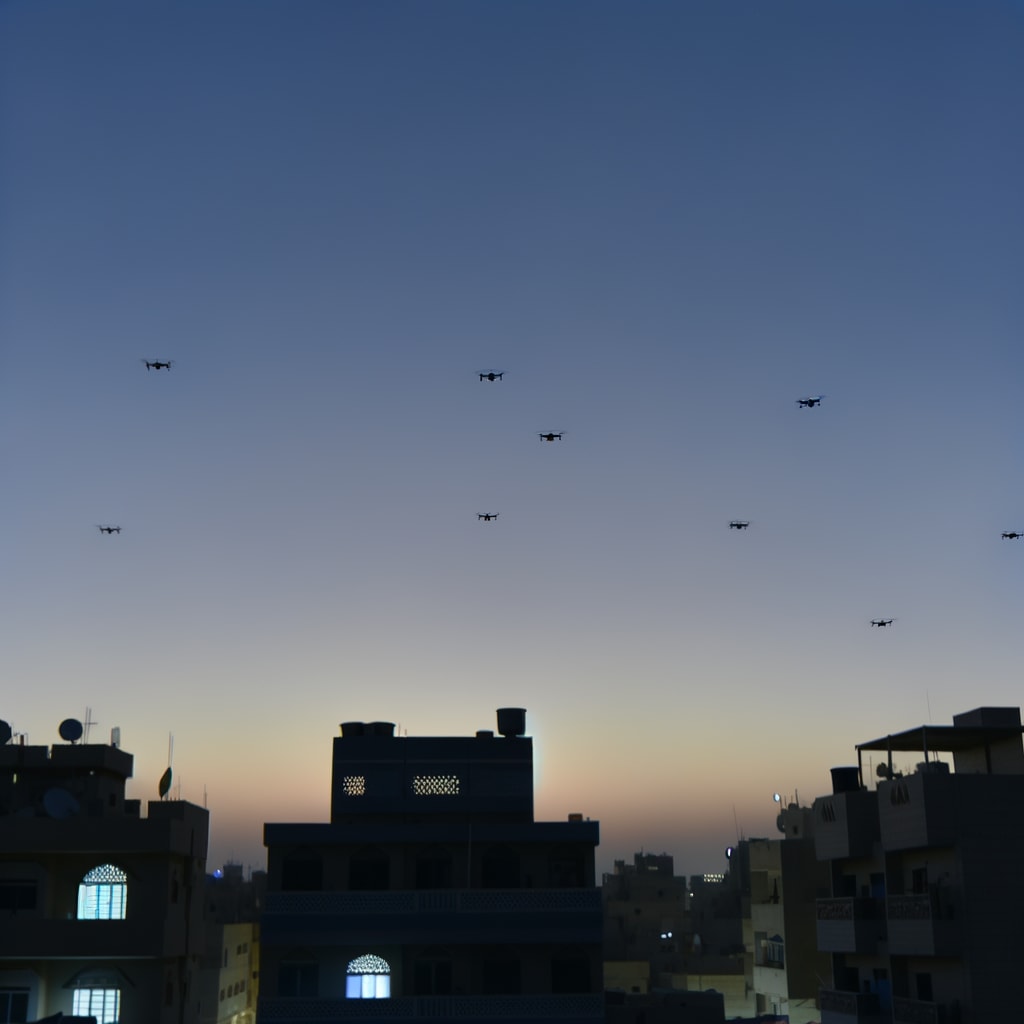
Iran's Mass Drone Strikes Unleash 'Exponential Costs' on US, Allies
Iran is waging a large-scale drone campaign across the Middle East, unleashing waves of low-cost, one-way attack drones, known as unmanned aerial vehicles (UAVs), against Western-linked targets. This strategy, aimed at imposing exponential cost on the U.S.,
comes amid the ongoing war stirred by the US-Israeli strikes on Iran and has elicited mixed reactions and concerns across the globe.
Background and Context
Tehran reportedly launched thousands of Shahed drones across the region in response to the controversial strikes by Washington and West Jerusalem, which led to the death of Iran’s Supreme Leader Ayatollah Ali Khamenei and over 200 other individuals. The US's unilateral decision to launch strikes against Iran has met a mixed response in Congress, with Democrats criticizing it as an undeclared war.
Iran's response, according to defense experts, is designed to inflict collateral damage in neighboring countries and exhaust U.S. and Israeli defences. CEO of drone maker and tech company Draganfly, Cameron Chell, said, The Iranians cannot win the war with these drones, but like the [communist] Viet Cong [during the Vietnam War], they have an asymmetric capability that can prolong this war and create political pressure.
Key Developments
The US Secretary of Defense Pete Hegseth and Chairman of the Joint Chiefs of Staff Dan Caine acknowledged that drones pose a much bigger problem than previously thought. Iranian drones and missiles have reportedly fallen near the Nakhchivan Airport in Azerbaijan, causing terror across the region. Despite these challenges, the Pentagon and Middle Eastern countries claim that most of the drones have been intercepted, although some have slipped through and caused damage.
Implications and Reactions
The Gulf countries, lacking experience in countering drones like Shahed, have appeared helpless against the threat posed by the Islamic Republic. However, an Austrian expert suggests that the Persian Gulf countries could significantly strengthen their protection against Iranian Shahed drones by drawing on Ukraine's experience in building a comprehensive counter-UAV system.
Meanwhile, the war continues to disrupt flights across the Middle East, stranding hundreds of thousands of travelers due to airspace closures. Analysts also predict that the war's outcome may be determined by the size of Iran's drone and missile stocks versus air defense munitions held by the US, Israel, and Gulf states.
Current Status
As the war continues, U.S. forces claim to have struck or sunk over 20 Iranian ships, and there have been at least 560 American military personnel killed or wounded during ongoing Iranian attacks. US President Donald Trump suggested that the Israeli-US war on Iran could continue for up to a month. On the other hand, Iran has declared that everything American or Israeli has become a legitimate target for the Iranian armed forces,
signaling a potential escalation of the conflict.
With the war showing no signs of slowing down, the world watches as the impacts of this drone warfare continue to unfold, shaping the geopolitical landscape of the Middle East and beyond.