
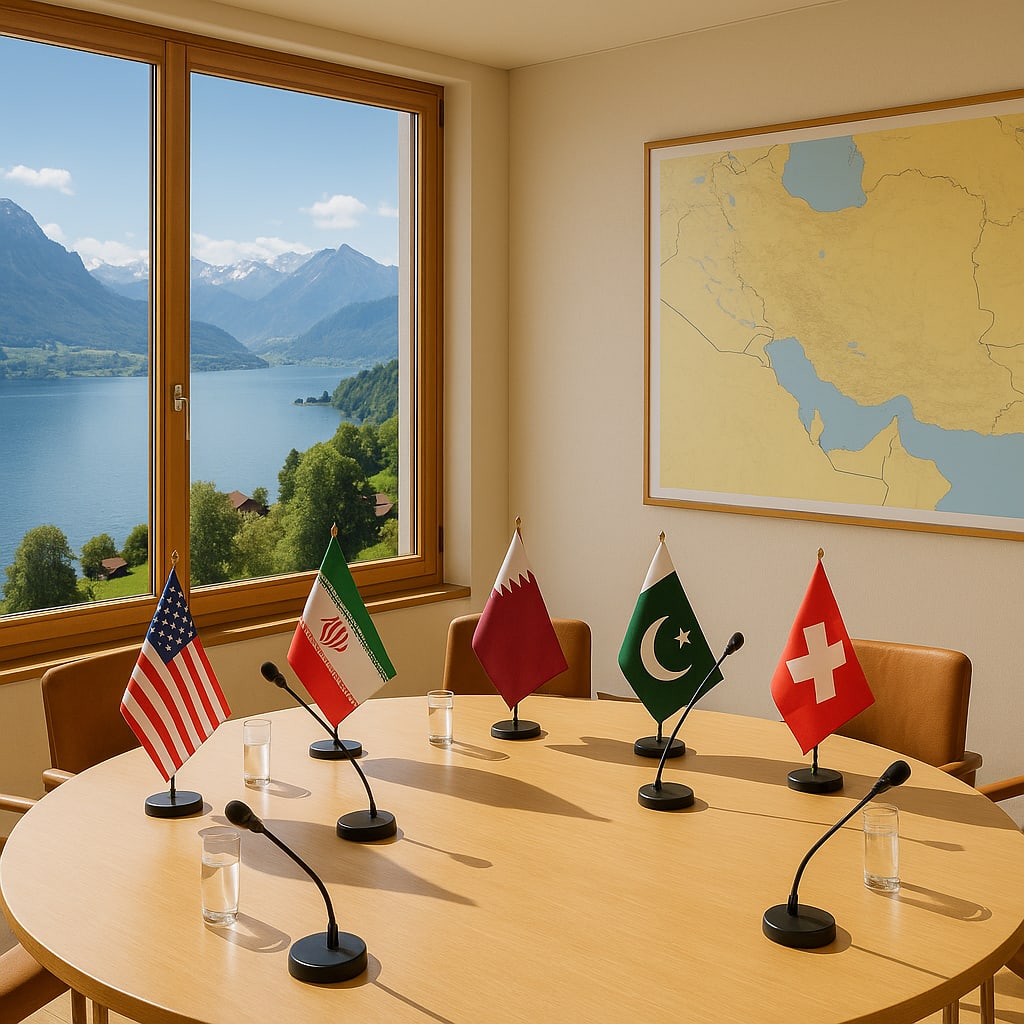
US and Iran open Swiss talks to build out interim deal, as Hormuz claims and Lebanon fighting shape leverage
Narrative Snapshot
- Convergence on process, divergence on conditions: Across outlets, there is agreement that US–Iran talks opened at Bürgenstock with Pakistan and Qatar mediating and a 60‑day roadmap announced by mediators after day one. Reporting diverges on whether the Strait of Hormuz is actually closed: Iranian and several international outlets cite Tehran’s closure announcement, while JD Vance said he saw no evidence the strait was shut.
- Competing leverage narratives: US-aligned sources stress “payment for performance” sequencing on sanctions relief and nuclear steps; Iranian and state-adjacent outlets emphasize guarantees of US compliance and early movement on oil waivers and frozen funds.
- Lebanon as the hinge issue: Multiple sources highlight that Israeli operations in southern Lebanon—and Iran’s demand they end—now condition progress on the nuclear file and maritime reopening.
- Domestic political framing: In Iran, senior leaders distance themselves from the deal even as negotiators press implementation; in the US, Vance touts progress while Trump alternates between engagement and threats, producing mixed signaling captured across coverage.
What Happened
High‑level US–Iran talks opened Sunday at Switzerland’s Bürgenstock resort to operationalize a recently signed memorandum of understanding, with Vice President JD Vance leading the US side and senior Iranian negotiators on the other, joined by mediators from Qatar and Pakistan; Pakistan said it sent a delegation and its army chief arrived to participate. A quadrilateral session (US, Iran, Qatar, Pakistan) convened, and mediators later announced a 60‑day roadmap toward a final agreement with continued technical talks this week. Vance said the agenda includes nuclear constraints and a Lebanon ceasefire; Iranian outlets underscored demands for US guarantees and mediator oversight of US commitments. Tensions framed the opening: Iran announced closure of the Strait of Hormuz following Israeli strikes in Lebanon; Vance said he saw no evidence of closure. Trump publicly warned Iran to reopen Hormuz and threatened force and financial pressure. Oil prices ticked up amid the uncertainty.
Sources: Guardian; Le Monde; NYT (live); BBC; DW; Al Jazeera; MEE; Tehran Times; IRNA; TASS; Times of Israel; SCMP; Japan Times; ANSA; Fox News; CBC; Folha; Clarin
Why It Matters
The talks sit at the intersection of nuclear nonproliferation, regional conflict management, and global energy security. Verification frictions—La Repubblica reports Iran has slowed IAEA inspections—complicate any nuclear glide path and will shape whether Washington’s “payment for performance” approach can unlock sanctions waivers or frozen assets without eroding leverage. Maritime claims over Hormuz directly affect a third of global seaborne oil trade; competing US–Iran messages and modest oil price gains underscore market sensitivity to signaling rather than only deeds. Regionally, Lebanon’s battlefield dynamics now condition core deliverables: Iran ties progress to an end of Israeli operations in the south, while Vance has placed Lebanon alongside the nuclear file. Diplomatically, the prominent mediation roles of Qatar and Pakistan reflect a continued shift toward middle‑power facilitation amid visible US–Israel strains highlighted by Vance’s public warning to Israeli leaders.
Sources: La Repubblica; Guardian; Al Jazeera; Le Monde; MEE; Times of Israel; SCMP; Japan Times
Diverging Narratives
- Status of Hormuz: Iranian and international outlets report Tehran’s military command announced closure of the strait after Israeli strikes in Lebanon, and Iranian media reiterated “Hormuz remains closed.” Vance countered that he saw no evidence of closure. Trump publicly rejected any Iranian plan to impose post‑ceasefire shipping fees, asserting only the US could levy tolls if no final deal is reached. This leaves a gap between pronouncements and on‑the‑water conditions that affects both leverage and energy markets. Sources: Le Monde; Japan Times; SCMP; ANSA; Guardian; Times of Israel; RT.
- Scope and sequencing of relief: An Iranian negotiator told state media a draft for oil sanctions waivers is finalized and would be issued “soon,” while US briefings—reported via Axios—stress no frozen funds or other benefits before verified Iranian actions. The Times of Israel cited plans to channel an initial $6B to Tehran, while Iran publicly presses for mediator‑backed guarantees of sustained US compliance. Sources: MEE (15, 21, 22 Jun); Tehran Times; IRNA; Times of Israel.
- Political ownership and framing: Inside Iran, Ayatollah Mojtaba Khamenei said he dislikes the deal but allowed it, distancing himself and placing responsibility on the president; Speaker/negotiator figures portray the MoU as a victory achieved through strength. President Pezeshkian said Iran does not seek a bomb but will not renounce enrichment. On the US side, Vance hails historic prospects and progress, while Trump alternates between urging a “new leaf” and threatening to “bombard” if Hormuz is not opened. Sources: NYT (19 Jun); RT (18 Jun); ANSA (21 Jun); MEE (21 Jun); TASS; La Repubblica.
- End-state on the nuclear file: Commentary aligned with Fox News argues the MoU is only a framework and presses for verifiable dismantlement and removal of enriched stockpiles, contrasting with reporting that Iran insists on maintaining enrichment within a negotiated framework. Sources: Fox News (opinion, 20 Jun); ANSA (21 Jun).
What Happens Next
- Maritime passage and leverage: Watch for confirmed commercial transits through Hormuz, maritime advisories, and oil price movements. If Iran operationalizes safe passage as envisaged in the MoU while Israeli operations in Lebanon persist, Tehran’s stated linkage could weaken; if transits remain disrupted, US coercive signaling—up to threatened force—will intensify. Sources: RT; Le Monde; Guardian; ANSA; MEE (22 Jun).
- Sanctions sequencing: Indicators include formal issuance of oil waivers, any intermediary‑managed disbursements (e.g., the reported $6B channel), and explicit “payment for performance” milestones tied to nuclear or regional steps. Mediator communications will be key to verifying sequencing. Sources: MEE (15, 21, 22 Jun); Times of Israel; IRNA.
- Nuclear verification: Track IAEA access and monitoring arrangements amid reports of Iran slowing inspections; any technical annexes emerging from working groups will signal whether verification gaps are closing. Sources: La Repubblica; MEE (22 Jun).
- Lebanon de‑escalation: Monitor reported Israeli strikes and Hezbollah activity alongside Vance’s inclusion of Lebanon on the agenda and Iran’s position that attacks violate the agreement. A sustained reduction in cross‑border fire would unlock room for movement on both Hormuz and nuclear issues. Sources: Guardian; Al Jazeera; MEE (16, 18, 21 Jun); Le Monde.