
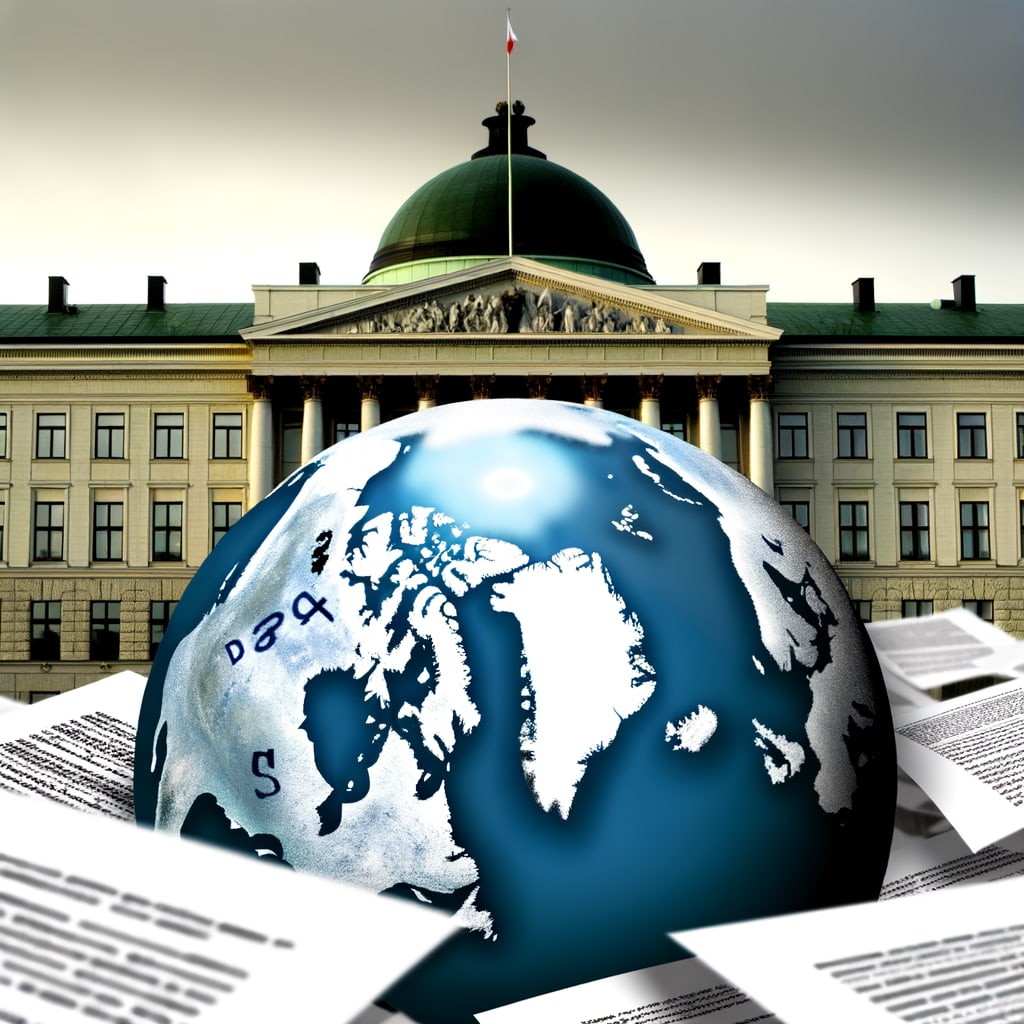
Trump Threatens Tariffs on Countries Opposing His Greenland Ambitions
In a move that has heightened tensions with U.S. trading partners, President Donald Trump has warned that he might impose tariffs on countries that do not support his push to acquire Greenland, a semi-autonomous territory of NATO ally Denmark. The U.S. President has repeatedly asserted the strategic importance of Greenland for U.S. national security and has even hinted at the possibility of using military force to bring the Arctic island under U.S. control.
Background and Context
Trump's pursuit of Greenland, which he has been insistent upon since his first term, has been renewed with vigor since returning to office last year. The territory is seen as a crucial part of the U.S.'s national security strategy due to its positioning and mineral-rich land. It is also believed to be vital for the proposed Golden Dome missile defense system. The President has stated that anything less than U.S. control of Greenland would be unacceptable
, hinting that Russia or China might move in if the U.S. does not act.
Key Developments
President Trump voiced his threats during a White House event last Friday, stating, I may put a tariff on countries if they don't go along with Greenland, because we need Greenland for national security. So I may do that.
This comes after a meeting between foreign ministers of Denmark, Greenland with U.S. Vice President J.D. Vance, Secretary of State Marco Rubio, which did not resolve the differences but did produce an agreement to set up a working group.
In response to these declarations, the European Parliament has postponed a decision on holding a vote on a trade deal with the United States. Meanwhile, a bipartisan Congressional delegation is seeking to lower tensions in the Danish capital.
Implications and Reactions
The threats of tariffs and potential military action have escalated tensions with European allies and cast new uncertainty over NATO unity. The Trump administration's determination to acquire Greenland has been viewed as a serious intention, driven by ideology, neo-imperial expansionism, and U.S. thirst for critical minerals.
Denmark has responded to these developments by inviting the USA to the European exercise in Greenland and has reportedly set a military tripwire as a message more to the U.S. than it does to NATO's adversaries. Danish Foreign Minister Lars Løkke Rasmussen admitted concerns over Greenland's vulnerability to Chinese and Russian influence, though he remained defiant against a U.S. invasion, warning it would be the end of NATO.
Conclusion
The situation remains tense as the U.S. continues to push for control of Greenland, reiterating its strategic importance for national security. The potential implications of the U.S.'s actions on international relations and trade agreements are being closely watched by the global community. The threat of tariffs against countries that do not support the U.S.'s Greenland ambitions adds another dimension to an already complex situation.