
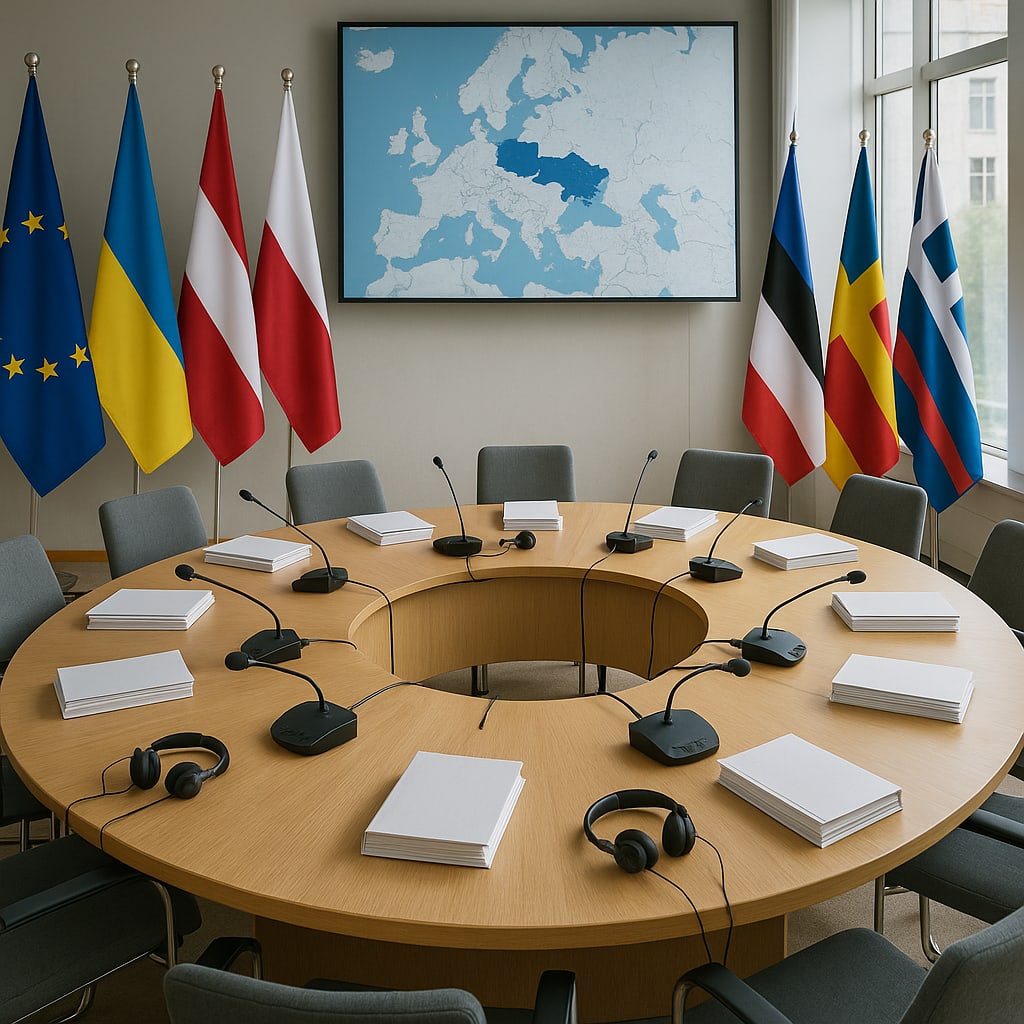
EU moves to open accession talks with Ukraine after Hungary minority-rights deal, as von der Leyen pledges €9 billion
Narrative Snapshot
- Most European outlets frame the Hungary–Ukraine minority-rights understanding as the practical unlock for launching accession talks, while Hungarian and Russian-state reporting stresses the lengthy, rules-bound nature of the process and warns against “double standards.” Balkan Insight and DW describe a veto lift or likely lift; TASS and Hungary’s prime minister stress the 33-chapter path and caution.
- Coverage splits between momentum and conditionality. DW, SCMP, and Le Monde emphasize political tailwinds (regional backing, faster enlargement rhetoric), while Kyiv Independent centers on implementation risks inside Ukraine’s legislature and enforcement questions in EU member states (Ireland’s sanctions exposure).
- The story is nested in a wider enlargement push that includes the Western Balkans. The Guardian and DW situate Ukraine’s track within a broader Commission- and Council-level effort to accelerate integration, raising bandwidth and sequencing issues across candidate files.
- Competing narratives also surface around Budapest–Kyiv ties: non-Hungarian outlets cite an agreement; Russian MFA commentary via TASS denies meaningful change on Hungarian minority rights.
What Happened
Following a Hungary–Ukraine understanding on minority rights, multiple outlets reported a path clearing for the EU to open accession talks with Kyiv. Balkan Insight said Budapest dropped its veto, while DW assessed it would likely do so but remained opposed to fast-tracking. SCMP reported Prime Minister Péter Magyar announced an agreement that could allow approval of the first step. TASS quoted European Commission President Ursula von der Leyen pledging €9 billion for Ukraine by month’s end and saying the first negotiating cluster for Ukraine and Moldova would open in coming days. Poland’s Prime Minister Donald Tusk told TASS Warsaw would not block negotiations, while Kyiv Independent cited the EU enlargement chief saying Polish concerns had been resolved at working level. Le Monde reported Nordic and Baltic leaders publicly backed Ukraine’s EU and NATO paths. Kyiv Independent noted mixed progress in Ukraine’s parliament on EU- and IMF-mandated bills. In parallel, EU leaders met Western Balkan counterparts to signal momentum on enlargement (DW; Guardian). Ireland committed to probe Russian steel links amid domestic scrutiny of the Aughinish Alumina plant and reiterated support for Ukraine’s accession (Kyiv Independent).
Why It Matters
The episode tests whether the EU can operationalize a wartime enlargement track without relaxing the acquis. Hungarian statements highlighted the standard 33-chapter pathway and rejection of “double standards” (TASS), even as the Commission signaled faster pacing across files (DW) and regional leaders voiced political support (Le Monde). The reported Hungary–Ukraine deal shows how bilateral disputes can determine EU unanimity, reflecting a broader pattern seen across enlargement cases. The Commission’s €9 billion pledge (TASS) underscores the fiscal and institutional load of integrating a large, war-affected economy, while Kyiv’s mixed legislative progress (Kyiv Independent) keeps conditionality central. The Western Balkans summit messaging (DW; Guardian) places Ukraine’s track within a multi-front enlargement agenda, raising sequencing, capacity, and credibility issues for Brussels. Member-state enforcement questions—illustrated by Ireland’s promised probe into Russian materials (Kyiv Independent)—connect internal market integrity and sanctions policy to accession politics.
Diverging Narratives
Outlets differ on how definitive the Hungarian pivot is. Balkan Insight reports Budapest has dropped its veto; DW says it will likely do so but resists fast-tracking; SCMP cites an agreement enabling the first step. By contrast, Hungarian and Russian-state reporting emphasizes process discipline: TASS quotes Prime Minister Magyar rejecting double standards and noting the long road through 33 chapters; further TASS coverage highlights his push to meet President Zelensky on minority rights and carries a Russian MFA claim that Kyiv’s promises to Budapest are “false” and conditions unchanged. RT frames the shift as Magyar undoing Viktor Orbán’s longstanding veto. On the EU side, von der Leyen’s funding pledge and imminent “first cluster” (TASS) signal momentum, while the Kyiv Independent highlights friction points: Polish objections handled at a working level and Ukraine’s parliament falling short on some EU/IMF-required bills, with one reform derided by experts as “imitation.” Regional signaling also diverges: Nordic-Baltic leaders affirm an “irreversible” path (Le Monde) even as Hungary warns against acceleration beyond established rules (TASS; DW).
What Happens Next
- Opening step: The Commission signaled the first negotiating cluster for Ukraine and Moldova would open in days (TASS). Analysts should watch for the Intergovernmental Conference scheduling and whether all capitals, including Budapest and Warsaw, align procedurally with this timeline.
- Hungary–Ukraine follow‑through: Magyar’s stated intent to meet Zelensky on minority rights (TASS) and the Russian MFA’s denial of meaningful change (TASS) make on-the-ground implementation a key indicator. Durable arrangements would reinforce the reported veto lift (Balkan Insight; DW; SCMP).
- Conditionality in Kyiv: The Rada’s ability to pass EU- and IMF-linked legislation (Kyiv Independent) will shape chapter screening and early benchmarks. Track expert assessments of enacted bills.
- Financial support: Disbursement of the pledged €9 billion by month’s end (TASS) will test EU execution and Ukraine’s absorption.
- Enlargement bandwidth: Signals from the Western Balkans track (DW; Guardian) and Nordic-Baltic advocacy (Le Monde) will indicate how the Council balances parallel candidates and the Commission’s “faster” enlargement posture.