
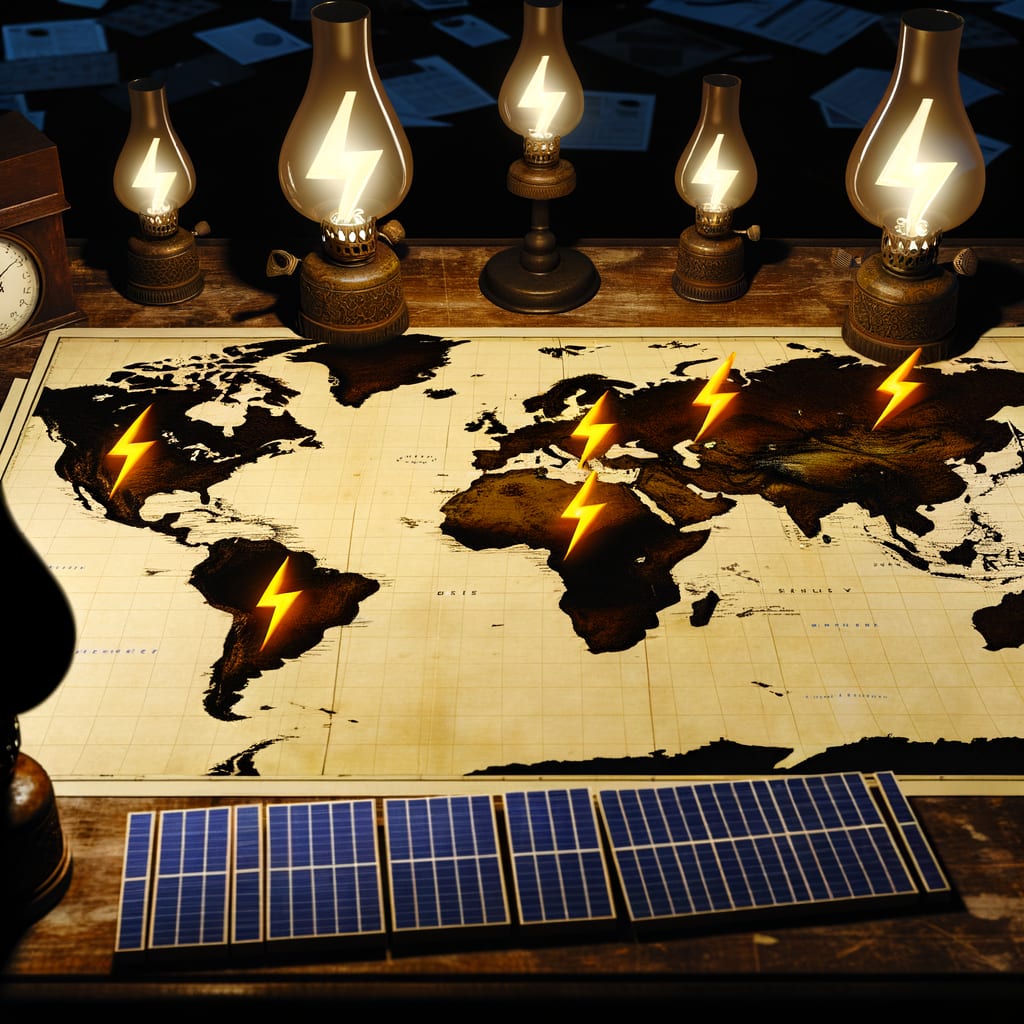
Global Energy Crisis Deepens Amid Rising Tensions and Surging Demand
As the world grapples with the tumultuous fallout from the war in Iran, an escalating energy crisis threatens to destabilize economies and disrupt global markets. Prominent historian Niall Ferguson warns that the current scenario mirrors the 1973 oil shock [1], while the G7 ministers pledge commitment to maintaining price stability and ensuring the resilience of the financial system [2][3]. Meanwhile, nations scramble to secure alternative energy sources, exacerbating the crisis.
A War-Induced Crisis
The war in Iran has ignited the worst global energy supply shock in history [6], with the Gulf's damage leading to an oil supply cut by 11 million barrels per day [13]. This severe shortfall has triggered a surge in energy prices, threatening to drive up inflation, damage purchasing power, and stunt growth [4].
The Global Response
In response to the crisis, nations are exploring a multitude of strategies. Despite a blockade, the US has allowed a Russian oil tanker to deliver oil to Cuba [7], while the UAE is prepared to deploy its Navy to restore maritime traffic in the Strait of Hormuz [8]. The Philippines’ only refiner, Petron Corp., has procured 2.48 million barrels of crude oil from Russia, highlighting the desperate measures being taken to support domestic energy needs [15].
In Australia, Victorian citizens are being encouraged to switch to public transport to ease the surge in fuel demand [14]. Meanwhile, there is growing support for a new gas tax to prevent producers from profiting from the war [11]. However, the Australian Energy Producers' chief executive has cautioned that such a tax would punish trading partners relied on to supply more fuel amid the crisis.
Divided Opinions and Strategies
The crisis has also sparked controversy around the world. In Europe, states are divided on how to respond, with some advocating for electrification and subsidies for electric vehicle purchases, while others resist these investments [5]. The UK government has rejected a call from the energy trade body to produce more homegrown North Sea oil and gas, emphasizing the importance of getting off the fossil fuel market rollercoaster [16].
Despite the escalating crisis, the US President Donald Trump has been accused of ignoring the most severe energy crisis in global history [18]. Conversely, Kremlin envoy Kirill Dmitriev warns that the EU and the UK face deindustrialization after rejecting Russian oil and gas [19].
The Urgency of a Solution
European Commission President Ursula von der Leyen has called for the US and Iran to resolve the Hormuz crisis, stating that the situation is critical for the global energy supply [17]. As the world faces an unprecedented energy crisis, the urgency for a resolution grows, underscoring the interconnected nature of global politics, economics, and energy supply.
-[1]: Corriere della Sera
-[2]: ANSA
-[3]: TASS
-[4]: Al Jazeera English
-[5]: Le Monde
-[6]: Japan Times
-[7]: Deutsche Welle
-[8]: TASS
-[11]: The Guardian
-[13]: Middle East Eye
-[14]: The Guardian
-[15]: South China Morning Post
-[16]: The Guardian
-[17]: The Guardian
-[18]: The Guardian
-[19]: RT (Russia Today)