
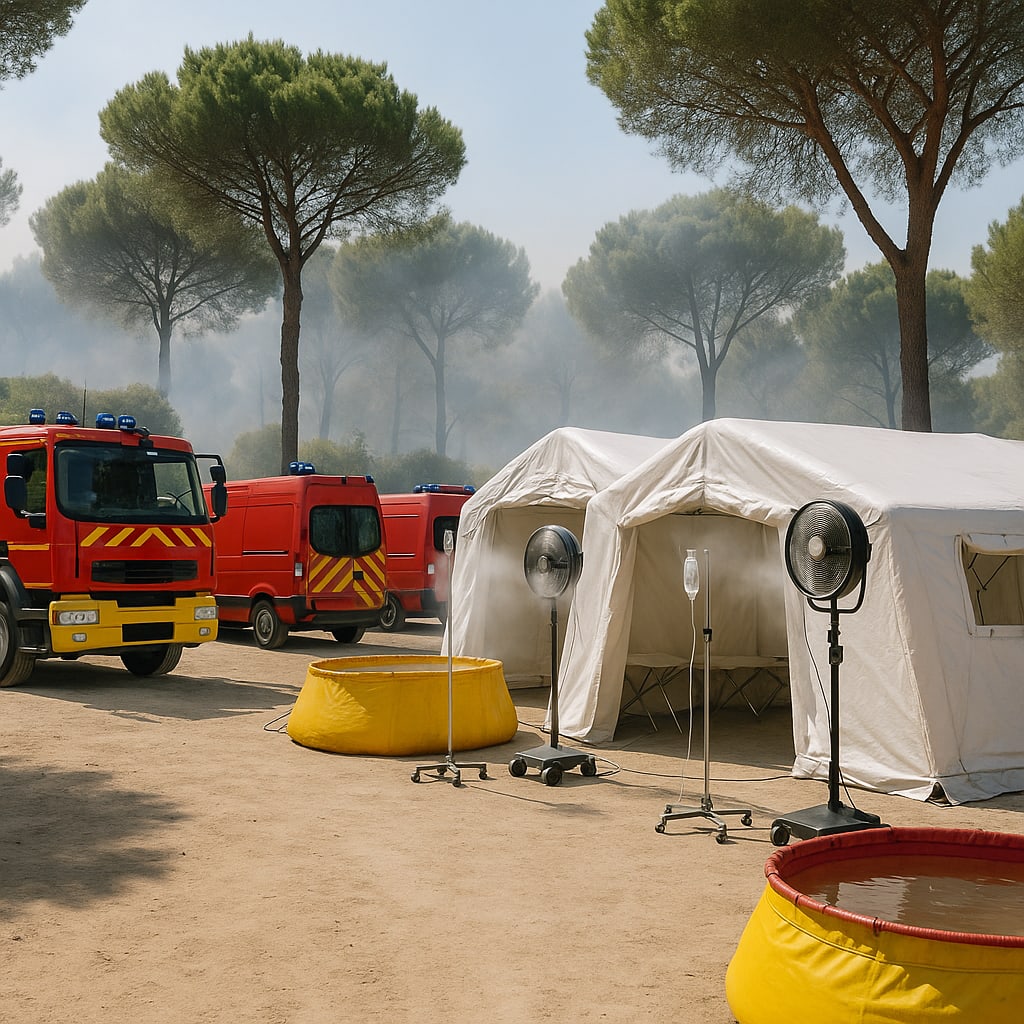
Wildfires sweep southern Europe amid record heat, straining health systems and reshaping climate politics
Narrative Snapshot
- Emergency focus versus structural framing: European and North American outlets track firefighting, evacuations, and event disruptions (DW on the Tour de France risk; CBC on toxic smoke near Thessaloniki and cross-border reinforcements to Portugal), while opinion and analysis pieces center adaptation and infrastructure limits (NYT; Japan Times).
- Causality and quantification: Multiple sources explicitly link the heat and fires to climate change or cite attribution science (The Hindu on World Weather Attribution; DW; Folha de S.Paulo), but quantify impacts differently—“thousands” of excess deaths in June (SCMP; Clarín) versus country-specific counts such as 1,028 in Spain (DW).
- Political recalibration and contention: French coverage details the far right’s rhetorical shift (Le Monde) and activists’ bid for stronger measures (Le Monde), mirrored by German debates over who pays and decides on adaptation (DW). Other pieces surface transatlantic blame frames (Fox News).
- Sectoral stresses broaden the lens: Reporting highlights agricultural losses in Brittany (Le Monde), hospital strain in Paris (Le Monde), and a pragmatic turn toward air conditioning (SCMP) as temperatures normalize above historical baselines.
What Happened
A record-breaking June heatwave across Europe set the stage for early-July wildfires from Portugal to Greece. Scientists with the World Weather Attribution group judged the heatwave “virtually impossible” this early in summer without climate change (The Hindu). Spain recorded at least 1,028 heat-related deaths in June, part of broader “excess deaths” tallied in several countries (DW; SCMP; Clarín). By July 5, more than 17,000 hectares had burned in France, Spain, and Portugal, with temperatures near 40°C (SCMP; Japan Times; Clarín). In Portugal, a large blaze burned for more than three days as Spain and Italy sent reinforcements; in Greece, authorities warned of toxic smoke from a burning recycling facility near Thessaloniki (CBC). In southwestern France, authorities said a fire could affect Monday’s Stage 3 of the Tour de France (DW).
Why It Matters
The coverage situates immediate wildfire response within a broader shift from mitigation-only thinking to adaptation as a core policy imperative. Analyses argue Europe’s infrastructure was built for a milder climate and now requires systematic retrofits and heat planning (NYT; Japan Times). Health systems are already absorbing shocks: Paris hospital chief Nicolas Revel says the latest episode crossed a threshold into a “health shock,” signaling sustained demands on capacity and preparedness (Le Monde). Agricultural impacts in Brittany underscore climate exposure of Europe’s food systems (Le Monde). Politically, debates intensify over responsibility and financing for adaptation, with German outlets describing contention between federal and municipal roles (DW). In France, the far right’s repositioning on climate, and critiques of denialism from leading scientists (Le Monde; ANSA), indicate shifting incentives that will shape legislative agendas, budget priorities, and EU coordination on resilience and cross-border emergency assistance.
Diverging Narratives
Attribution versus repositioning: Scientific attribution work (The Hindu) and outlets’ explicit climate links (Folha de S.Paulo; DW) coexist with political recalibration. Le Monde documents how France’s Rassemblement national is revising past climate-skeptic rhetoric under electoral pressure after June’s heat. ANSA highlights warnings from physicist Giorgio Parisi that denialism carries tangible costs, sharpening accountability debates.
Response horizons: Field reporting emphasizes active firefighting, toxic smoke advisories, and potential disruptions to marquee events (CBC; DW). Commentary pushes systemic adaptation—heat-resilient infrastructure and planning (NYT; Japan Times). Activists call for stronger mitigation alongside adaptation (Le Monde), while SCMP notes a cultural shift toward air conditioning, raising near-term cooling access against long-term emissions and grid implications.
Responsibility frames: Domestic governance questions in Germany—who funds and mandates heat preparedness (DW)—contrast with a transatlantic blame narrative from a Paris deputy mayor assigning significant responsibility to U.S. emissions (Fox News). Impact metrics also differ by scope: country-specific mortality counts (DW on Spain) versus aggregated excess deaths across multiple countries (SCMP; Clarín), reflecting varied data windows and methodologies rather than explicit dispute.
What Happens Next
- Fire operations and public safety: Monitor containment progress in Portugal, Spain, France, and Greece; any extension of cross-border reinforcements reported by CBC; and potential impacts on major events like the Tour de France (DW). Indicators include incident command updates, evacuation orders, and air-quality advisories.
- Health system adaptation: Paris’s AP-HP warns of a “health shock” (Le Monde). Watch for expanded heat-health action plans, surge capacity measures, and early-warning protocols, as well as Germany’s policy moves to clarify federal versus municipal roles and funding (DW).
- Political positioning and policy design: Track the RN’s climate messaging and concrete policy proposals in France (Le Monde), alongside activist mobilization seeking stronger measures after the heatwaves (Le Monde). Key signals: parliamentary debates, budget lines for adaptation, and local implementation mandates.
- Built environment and cooling: Coverage points to growing acceptance of air conditioning and calls to retrofit infrastructure for heat (SCMP; NYT). Watch for changes in building codes, efficiency standards, urban cooling strategies, and grid-capacity planning.
- Scientific attribution: Further assessments like those cited by The Hindu can recalibrate policy urgency and legal or financial accountability debates; monitor new attribution studies and how officials reference them.