
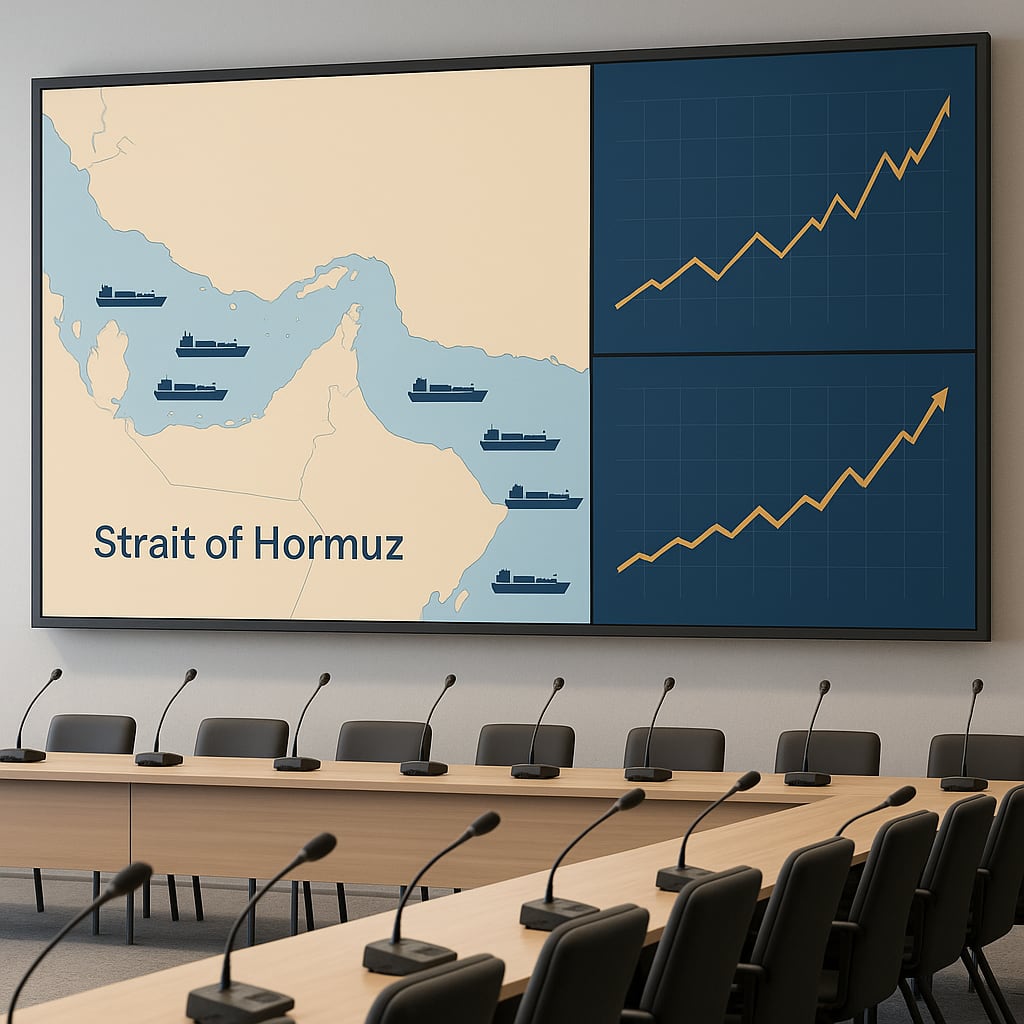
US strikes Iran and revokes oil waiver after tanker attacks in Strait of Hormuz, roiling energy and financial markets
Narrative Snapshot
Across outlets, there is broad agreement on the immediate trigger and response: three commercial vessels were hit near the Strait of Hormuz, the United States blamed Iran for violating a recently signed ceasefire, and US forces launched new strikes while tightening oil sanctions. US Central Command’s framing of “unwarranted” Iranian aggression and a “clear violation” of the truce is consistently reported in international coverage, including from the South China Morning Post, CBC, and the Guardian. Qatar’s foreign ministry publicly asserted that Iran bears legal responsibility after a Qatari liquefied natural gas carrier was damaged, sharpening attribution beyond US statements. The UK’s account via Deutsche Welle adds operational detail, noting a projectile strike and no casualties.
Market reporting is cohesive on direction but varies on magnitude and persistence. Multiple outlets describe a sharp jump in crude—about 5–6%—with Brent crossing $78 and WTI the mid-$70s, while TASS cites an intraday Brent move above $80. Business desks in North America and Europe link the rally to renewed hostilities and the US sanctions shift, alongside equity selloffs. Subsequent Asian trading brought some retracement and sector rotation, with the Toronto Star noting oil’s slip and tech-led gains, underscoring volatility rather than a one-way repricing.
Several sources foreground the sanctions dimension and the collapse of a nascent diplomatic framework meant to stabilize shipping. The Japan Times, Le Monde, and SCMP report Washington’s revocation of a temporary license for Tehran’s oil exports after the attacks. Parallel coverage emphasizes Tehran’s counter-claims and signaling: Iranian state media and regional outlets report explosions in Hormozgan following US strikes; IRNA warns against any external “interference” in Hormuz; Folha de S.Paulo relays threats to close the strait. Al Jazeera highlights Donald Trump’s threat that the US “may take over Kharg Island,” linking it to the centrality of Iran’s export infrastructure.
Regional outlets situate events within a wider Gulf confrontation. ANSA and The Hindu describe reciprocal attacks involving US-linked bases in the Gulf after the US strikes, with Corriere and ANSA also sketching Israeli readiness as a backdrop. These reports, alongside Middle East Eye’s accounts of explosions on Qeshm Island and at Bandar Abbas and Sirik, draw a picture of widening geographic risk around commercial lanes and host-nation facilities.
What Happened
Following strikes on three merchant vessels transiting near the Strait of Hormuz—one a Qatari LNG carrier—US Central Command said Iran had violated last month’s ceasefire and launched “powerful” strikes on targets in southern Iran. Coverage cites reported explosions around Bandar Abbas, Sirik, and Qeshm Island. Washington concurrently revoked a temporary license that had allowed limited Iranian oil sales, with US and European outlets noting the move came after the shipping attacks. Donald Trump told reporters the ceasefire was “over,” and separately threatened to “take over” Kharg Island. Iran rejected US claims, accused Washington of breaching the agreement, warned it would not allow “interference” in Hormuz, and, according to multiple outlets, threatened to close the strait if attacked again. Oil jumped 5–6%—with Brent moving above $78 and, in some reports, briefly topping $80—as equities fell before partially stabilizing in Asia.
Why It Matters
The Strait of Hormuz remains a structural chokepoint for global energy flows; renewed attacks on commercial shipping and retaliatory strikes expose the fragility of arrangements intended to protect it. Le Monde describes the now-shaken memorandum aimed at securing this waterway less than three weeks after signature, while Al Jazeera argues the strait’s status is directly tied to the world economy. The US decision to reimpose constraints on Iranian crude exports compounds physical-risk premiums with policy risk, amplifying volatility noted by the New York Times and Sky News as investors reassess inflation and growth. Qatar’s assertion of Iranian legal responsibility and the reported strikes around Gulf-based facilities draw more regional actors into a liability and escalation ecosystem that can quickly outpace bilateral de-escalation tracks. Trump’s public threats targeting oil infrastructure, including Kharg Island, signal a willingness to test norms against seizing or disabling critical civilian assets.
Diverging Narratives
Competing legal and political frames are explicit. The US position, carried by CBC, SCMP, and the Guardian, is that Iran’s attacks on three ships were unjustified and violated the ceasefire, justifying retaliatory strikes and the sanctions waiver revocation. Iran, via IRNA and the Guardian’s reporting from Tehran, counters that Washington violated the agreement by striking and by re-tightening oil controls, and warns against any external management of Hormuz. Qatar’s foreign ministry goes further than most states by publicly holding Iran legally responsible for damage to a Qatari vessel, while the UK account transmitted by Deutsche Welle offers a narrower operational description without assigning blame beyond noting a projectile hit and no casualties.
Attribution and scale details also diverge in early reporting. The Japan Times cites US officials saying Iran “reportedly” fired missiles at commercial ships, whereas Deutsche Welle’s description remains generic. Market coverage differs on the extent and stickiness of the oil rally: Middle East Eye, Folha de S.Paulo, and CBC emphasize 5–6% gains; TASS reports Brent above $80; NHK highlights a two-week high; the Toronto Star records a subsequent pullback in Asia. On the broader theater, Middle East Eye, ANSA, and The Hindu describe retaliatory fire at Gulf sites hosting US forces; other outlets focus on maritime incidents and sanctions, reflecting varying editorial emphases on military versus market implications.
What Happens Next
Three decision points will shape trajectories. First is the ceasefire’s status and diplomacy: TASS reports US officials still pursuing a final agreement, but The Hindu notes planned talks on restoring safe passage have been thrown into question by fresh strikes. Signals to watch include any public restatement of truce terms, third-party facilitation, or formal complaint mechanisms invoked by either side.
Second is freedom of navigation in Hormuz. Iran’s warnings against “interference” and threats to close the strait, alongside US statements and the vice president’s threat of military response to closure reported by Le Monde, put operational control under scrutiny. Indicators include further ship strikes, naval escorts, or announced exclusion zones.
Third is energy policy leverage. Washington’s revocation of Iran’s oil sales license, reported by the Japan Times, Le Monde, and SCMP, could harden or soften; ensuing OFAC guidance and enforcement patterns will be telling. Markets will remain keyed to incident reports, Qatar’s and other Gulf states’ positions after the tanker damage, and whether crude’s gains persist or unwind as per the NYT and Toronto Star’s volatility framing.