
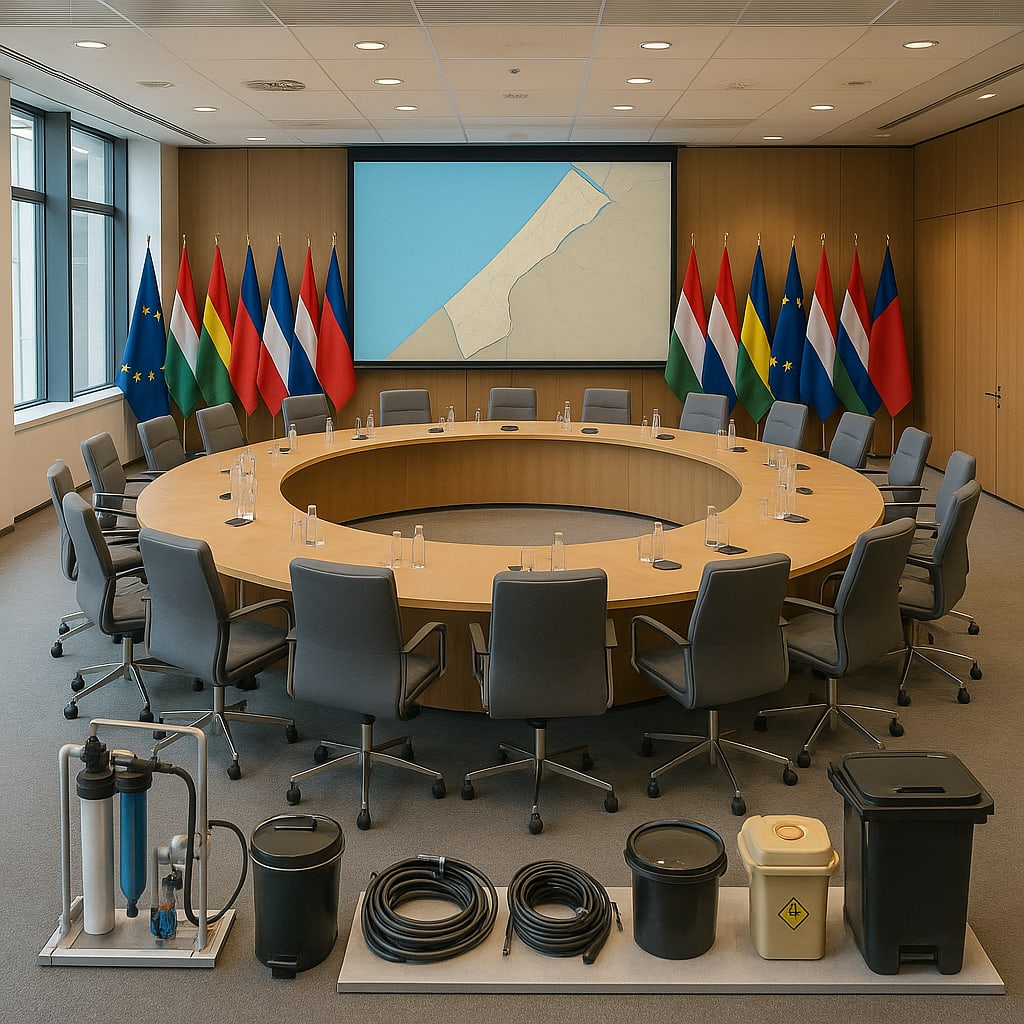
EU launches $1 billion ‘Team Gaza’ initiative to support Gaza’s recovery
Narrative Snapshot
Across outlets, the core facts align: the European Commission convened donors in Brussels to assemble roughly €900 million for early recovery in Gaza under a “Team Gaza” banner, with the European Investment Bank, a group of European countries, and Japan participating. Accounts emphasize the breadth of participation, from 65 governments and organizations including the White House and the United Nations, to Italy’s inclusion among contributing states, and a policy anchor in the 2025 Gaza Peace Plan.
Coverage diverges on scope and conditionality. European and Israeli sources differ on whether Israeli-cleared undertakings constitute reconstruction or are strictly humanitarian. Brussels messaging couples financing to Palestinian Authority reform, while some reports highlight that EU officials pressed disarmament of Hamas. Others stress scale: a $1 billion tranche is framed against reported recovery needs of tens of billions of dollars over a decade.
A second cluster of reporting centers on implementation risks and the political environment. The United Nations accused Hamas of interfering in aid distribution, prompting a World Food Program pause in one area; Hamas rejected the allegations. Parallel mediation with Hamas has reportedly edged forward on civil-service payrolls but remains blocked over disarmament demands while Israeli forces remain in Gaza. Some regional reporting underscores the extent of Israeli territorial control in the strip as an immediate constraint.
What Happened
The European Commission announced the “Team Gaza Initiative” at a Brussels donor meeting, coordinating about €883.6–€900 million (around $1 billion) for early recovery projects aligned with the 2025 Gaza Peace Plan. The effort involves 12 European countries and Japan alongside the European Investment Bank, with Italy among participants, and drew 65 governments and organizations, including the White House and the UN. EU officials said support is tied to reforms in the Palestinian Authority. European and Israeli accounts described Israeli approval or agreement on major waste and water projects, while Israel’s Foreign Ministry characterized approved projects as humanitarian rather than reconstruction. The package is far below reported 10‑year recovery needs of roughly $71 billion. Separately, the UN said a raid by armed personnel linked to Hamas led the World Food Program to suspend operations in one area; Hamas denied obstruction. Egypt‑mediated talks remain stuck over disarmament, though civil‑service pay appears more tractable.
Why It Matters
The initiative tests whether donors can translate a broad political coalition into practical early recovery under layered conditionality. EU leaders are coupling financial support to Palestinian Authority reforms, positioning assistance to reinforce West Bank‑based institutions even as de facto authorities and security conditions in Gaza remain unsettled. Israeli control over access and approvals continues to shape the scope and tempo of projects, and official differences over what counts as “reconstruction” signal potential friction in scaling beyond humanitarian works.
The package also illustrates the gap between pledges and long‑term requirements, with $1 billion set against multiyear needs measured in the tens of billions. Operationally, UN allegations of interference and temporary suspensions point to volatile humanitarian access—an implementation risk for any recovery pipeline. Strategically, EU statements tying aid to demilitarization intersect with Egypt‑mediated negotiations in which disarmament is a central impasse, linking reconstruction pathways to unresolved security and governance arrangements.
Diverging Narratives
European and Israeli messaging splits on project categorization: EU sources speak of approvals for significant works, including waste and water facilities, while Israel frames them as humanitarian, not reconstruction. For implementers, the label matters; recovery infrastructure demands different access, materials, and scale than short‑term relief.
On conditionality, European coverage highlights two tracks. One ties disbursements to Palestinian Authority reforms, as stated by the EU’s top diplomat. Another underscores calls for the disarmament of Hamas. Yet mediation reporting holds that disarmament remains blocked as long as Israel remains in Gaza, even as payroll issues for Gaza’s civil servants appear solvable—signaling a gap between political preconditions and negotiable administrative steps.
The operational lens is also split. The UN described interference by Hamas personnel leading to a localized WFP suspension; Hamas publicly rejected the accusations and defended its conduct. Meanwhile, several outlets frame the initiative’s adequacy differently: some spotlight the $1 billion headline, others the shortfall relative to a $71 billion, decade‑long recovery estimate. Regional reporting adds context on the extent of Israeli territorial control in Gaza as a constraint on any reconstruction rhythm.
What Happens Next
Disbursement hinges on two filters reported by participants and observers. First, whether the Palestinian Authority enacts reforms sufficient to satisfy EU conditions will shape the pace and channeling of funds; stalled reforms would slow or reroute financing. Second, Israeli approvals will define the pipeline: if approvals extend to larger‑scale waste, water, and other utilities, recovery could move beyond humanitarian works; if approvals remain narrowly humanitarian, early recovery remains circumscribed.
Two further determinants will influence implementation. In Egypt‑mediated talks, movement on disarmament and on civil‑service payrolls could unlock additional space for recovery; continued impasse on disarmament keeps larger reconstruction politically frozen. On the ground, humanitarian access conditions—signaled by whether WFP and other agencies can resume and sustain operations without interference—will affect logistics, staffing, and security planning for funded projects. Analysts should watch EU‑PA reform benchmarks, the announcement of specific EIB‑backed projects, Israeli statements on approvals, and any adjustments by UN agencies in Gaza.