
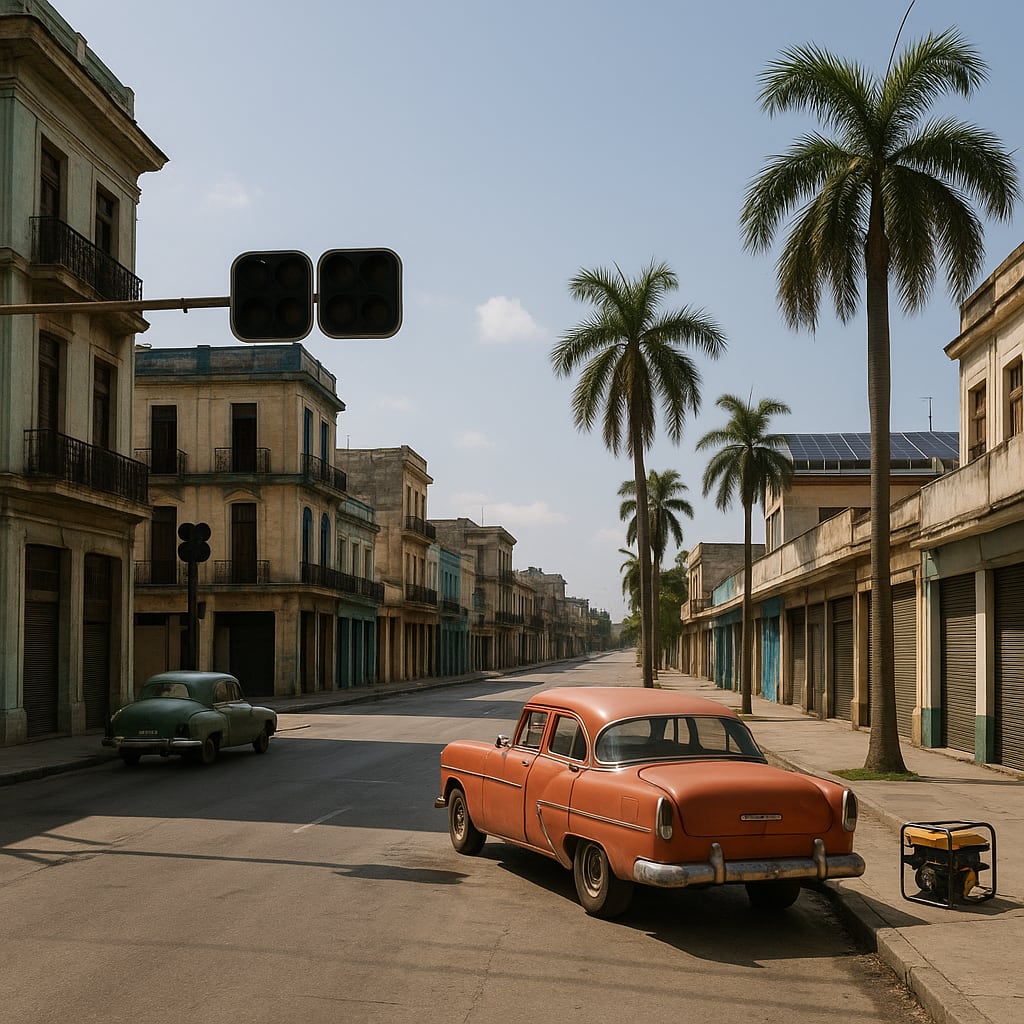
Cuba hit by third nationwide blackout in under two weeks
Narrative Snapshot
Across outlets, there is broad agreement that the latest outage was the third full collapse of Cuba’s National Electric System in a span of roughly one to two weeks, affecting most of the island’s nearly ten million residents. Several international desks center the role of fuel scarcity linked to U.S. restrictions: Folha de S.Paulo and France24 describe a six‑month “fuel blockade,” while Al Jazeera and the Japan Times also foreground U.S. measures, with the latter dating the policy shift to January under President Donald Trump. AP copy carried by the Toronto Star and The Hindu notes the embargo’s stress on the grid without apportioning sole causality.
France24 advances the structural picture with data points on Cuba producing only about 40% of its fuel needs and the exhaustion of a 730,000‑barrel Russian shipment by end‑April, framing energy insecurity alongside a broader economic crisis. Telesur extends the policy angle, highlighting a U.S. congressional delegation’s criticism of sanctions and, separately, a Mexico‑based crowdfunding drive to give a Cuban film school on‑site energy independence—signals of both external political pressure and localized adaptation. Serbia’s Politika emphasizes scale, citing over nine million people without power, while Al Jazeera quantifies the pattern as the fifth nationwide outage of 2026.
What Happened
Cuba’s electric grid suffered another total collapse on Tuesday, 14 July, with Havana’s utility reporting the nationwide outage at 11:05 a.m., the third such failure in the past eight to ten days, according to Telesur, Folha de S.Paulo, and Al Jazeera. Newsrooms carry differing windows—“in two weeks” per AP copy in the Toronto Star and The Hindu, and “in eight days” per Telesur—but converge that millions lost power; Politika reports more than nine million affected. The outage followed a second nationwide blackout on Friday, 11 July, after which power was restored by Sunday, 12 July, Folha and France24 reported. Multiple outlets attribute the deteriorating supply environment to fuel scarcity linked to U.S. restrictions described as a six‑month blockade (Folha, France24), with the Japan Times specifying new measures imposed in January. France24 adds that Cuba produces about 40% of its fuel and that a 730,000‑barrel Russian cargo delivered in late March was depleted by end‑April.
Why It Matters
The sequence of nationwide blackouts exposes how Cuba’s energy import dependence intersects with sanctions, tightening global supply options, and grid fragility. France24’s figures on domestic production and the lapse of Russian deliveries underscore that Havana’s margin for substituting imports is narrow, while repeated nationwide failures translate directly into economic disruption and daily hardship for nearly ten million residents, as France24 reports. The episode feeds into a live U.S. policy debate: AP copy notes the embargo’s stress on the grid, and Telesur reports a visiting U.S. congressional delegation arguing that Trump‑era measures are worsening humanitarian conditions. For governments and multilateral bodies, the case tests the humanitarian carve‑outs and efficacy of sanctions regimes when applied to fuel‑dependent economies. It also points to a growing role for decentralized energy initiatives—illustrated by Telesur’s report on crowdfunding for a Cuban film school—as communities seek resilience in the absence of stable national supply.
Diverging Narratives
Outlets differ in emphasis and attribution. Folha de S.Paulo, France24, Al Jazeera, and the Japan Times present U.S. measures as a central driver, variously termed a six‑month “fuel blockade” or oil embargo, with the Japan Times dating the policy shift to January. AP copy in the Toronto Star and The Hindu acknowledges that sanctions are stressing the grid but stops short of assigning primary causality. France24 layers in domestic constraints—Cuba’s 40% self‑sufficiency and the end of a Russian oil shipment—framing a dual energy‑economic crisis rather than a sanctions‑only explanation. Counting also varies: Telesur calls it the third total blackout in eight days; Folha and Al Jazeera say less than ten days; AP copy cites two weeks; Al Jazeera characterizes it as the fifth nationwide outage of 2026. Political framing diverges too. Telesur highlights U.S. Representative Mark Pocan’s sharp critique of sanctions following a delegation visit, while Politika foregrounds the immediate social scale with an estimate exceeding nine million people without electricity.
What Happens Next
Three decision points emerge from the reporting. First is U.S. sanctions posture: Telesur’s account of a congressional delegation criticizing Trump‑era measures signals potential pressure for policy adjustment; movement here would likely be visible in official statements or licensing changes affecting fuel shipments. Second is Cuba’s ability to secure external supplies: France24 notes reliance on imports and the lapse of a Russian cargo; additional deliveries from partners would be evident in port calls and fuel balance updates, with direct implications for blackout frequency that Al Jazeera has been tracking. Third is domestic resilience measures: Telesur’s report on crowdfunding for on‑site generation suggests a turn to decentralized solutions; watch for replication across institutions and any facilitative policies. Near‑term indicators include restoration timelines like those reported on 12 July by Folha, the cadence of nationwide versus localized outages, and whether outlets continue to register nationwide failures in rapid succession.