
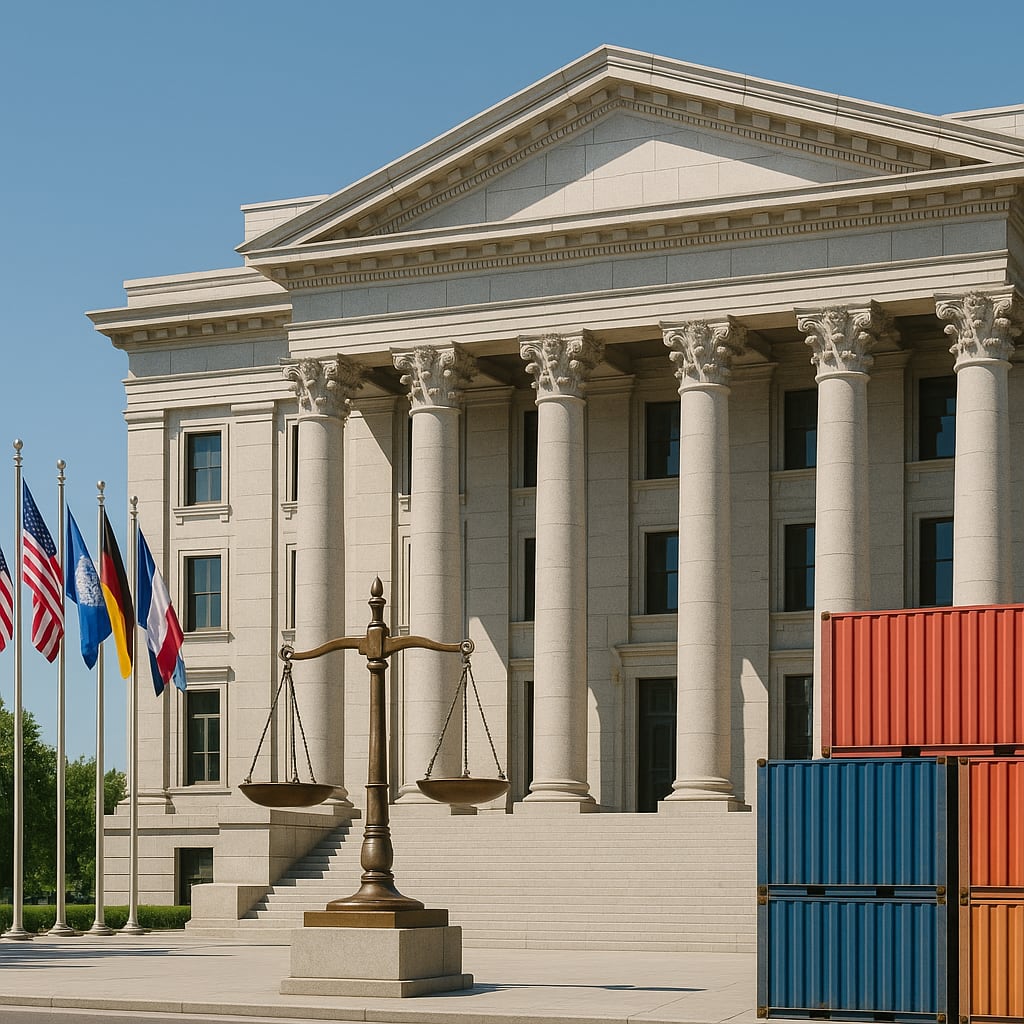
Twenty-five US states sue to block Trump administration’s new tariffs on 60 trading partners
Narrative Snapshot
Across outlets, reporting converges on the scale, venue, and legal stakes of the case: a coalition of 25, largely Democratic-led states filed in the US Court of International Trade in New York seeking to halt and unwind import duties of 10% to 12.5% applied to goods from 60 trading partners, with plaintiffs also asking for refunds of duties already paid. That common frame is consistent from US, European, Latin American, and Asian coverage, including The Guardian, Le Monde, BBC, France 24, Folha de S.Paulo, and NHK.
Emphases diverge on motive and legal grounding. Several outlets foreground the states’ claim that the tariffs are a pretext to replace import taxes struck down by the US Supreme Court in February (Toronto Star/AP, The Guardian, Al Jazeera, Clarín). Others center the administration’s stated rationale that the levies target goods linked to alleged forced labor abroad, with the White House insisting the move is legal (Deutsche Welle, BBC, France 24). Chinese state media CGTN characterizes the measures as “Section 301” tariffs, highlighting their breadth and the legal authority being asserted.
International reporting underscores the sweep and diplomatic reach: Clarín and CGTN note that the affected economies account for roughly 99% of US imports, and NHK specifies that Japan is among the 60 trading partners. Le Monde adds timing detail that the duties took effect on 24 July. The South China Morning Post situates the state action alongside earlier suits by small US businesses filed the day the tariffs took effect, signaling multiple legal fronts challenging the policy.
What Happened
A coalition of 25 US states filed suit on August 3 in the US Court of International Trade in New York to block new Trump administration tariffs on goods from 60 trading partners, arguing the president exceeded his legal authority to tax imports (South China Morning Post; Politika; Folha de S.Paulo). The duties, set at 10% or 12.5% depending on the country, entered into force on July 24 (Le Monde; The Guardian). Plaintiffs say the levies are a pretext to reinstate import taxes the US Supreme Court struck down in February and ask the court to halt the measures, declare them unlawful, and order refunds for duties already paid (Toronto Star/AP; The Guardian; France 24). The administration defends the tariffs as targeting imports linked to alleged forced labor and maintains their legality (Deutsche Welle; BBC). Earlier, small US businesses also sued to block the tariffs as they took effect (South China Morning Post).
Why It Matters
The case tests the current boundaries of US executive authority over trade remedies in the wake of a Supreme Court ruling earlier this year that invalidated a previous tariff program (Toronto Star/AP; The Guardian; Al Jazeera). It places the Court of International Trade at the center of an institutional check on how far a president can go in imposing broad, cross-cutting import duties—especially when justified on human rights grounds such as alleged forced labor (BBC; Deutsche Welle; France 24). Because the measures touch 60 trading partners, including allies such as Japan (NHK), and cover nearly the entire volume of US imports according to some accounts (Clarín; CGTN), the litigation has implications that extend beyond a bilateral dispute or a single sector. For policymakers and multilateral bodies, the outcome will signal how US trade law can be deployed for values-based objectives versus general tariff policy, and how quickly courts can unwind or affirm such actions.
Diverging Narratives
Plaintiff states frame the tariffs primarily as an unlawful end-run around a Supreme Court decision, alleging the new duties simply replace invalidated import taxes under a different label (Toronto Star/AP; The Guardian; Al Jazeera; Clarín). They seek immediate relief and refunds, indicating a view that the levies lack statutory footing and are harming importers in real time (The Guardian; France 24; CGTN). By contrast, the administration’s position, as reported by Deutsche Welle and the BBC, is that the measures address imports produced with or linked to alleged forced labor abroad and are lawful. That justification situates the tariffs within a human-rights frame rather than as generalized protectionism.
Outlets also differ in how they describe the legal basis and scope. CGTN calls them “Section 301” tariffs and emphasizes that the targeted economies account for roughly 99.4% of US imports, a breadth echoed more generally by Clarín’s “99%.” European coverage stresses the standardized rate bands and start date (Le Monde), while NHK underscores inclusion of US allies such as Japan. The South China Morning Post highlights parallel litigation by small businesses, positioning the states’ case within a broader legal push rather than as a standalone challenge.
What Happens Next
Key inflection points will come from the Court of International Trade’s initial responses. If the court grants the states’ request to halt the tariffs, duties would stop accruing and refund questions would move to the foreground; if it denies early relief, the levies at 10% to 12.5% would continue while the merits are litigated (The Guardian; France 24; Le Monde). Analysts should watch for the court’s scheduling orders and any consolidation with existing suits by small businesses filed when the tariffs took effect, which the South China Morning Post reports are already on the docket.
Another decision node is the administration’s legal defense. Deutsche Welle and the BBC report that the White House ties the policy to combating alleged forced labor, so forthcoming government filings will clarify the statutory authority asserted and how that claim is applied across 60 trading partners. The breadth highlighted by Clarín and CGTN also raises the stakes of any refund order, making the court’s treatment of already-collected duties a consequential indicator for importers.