
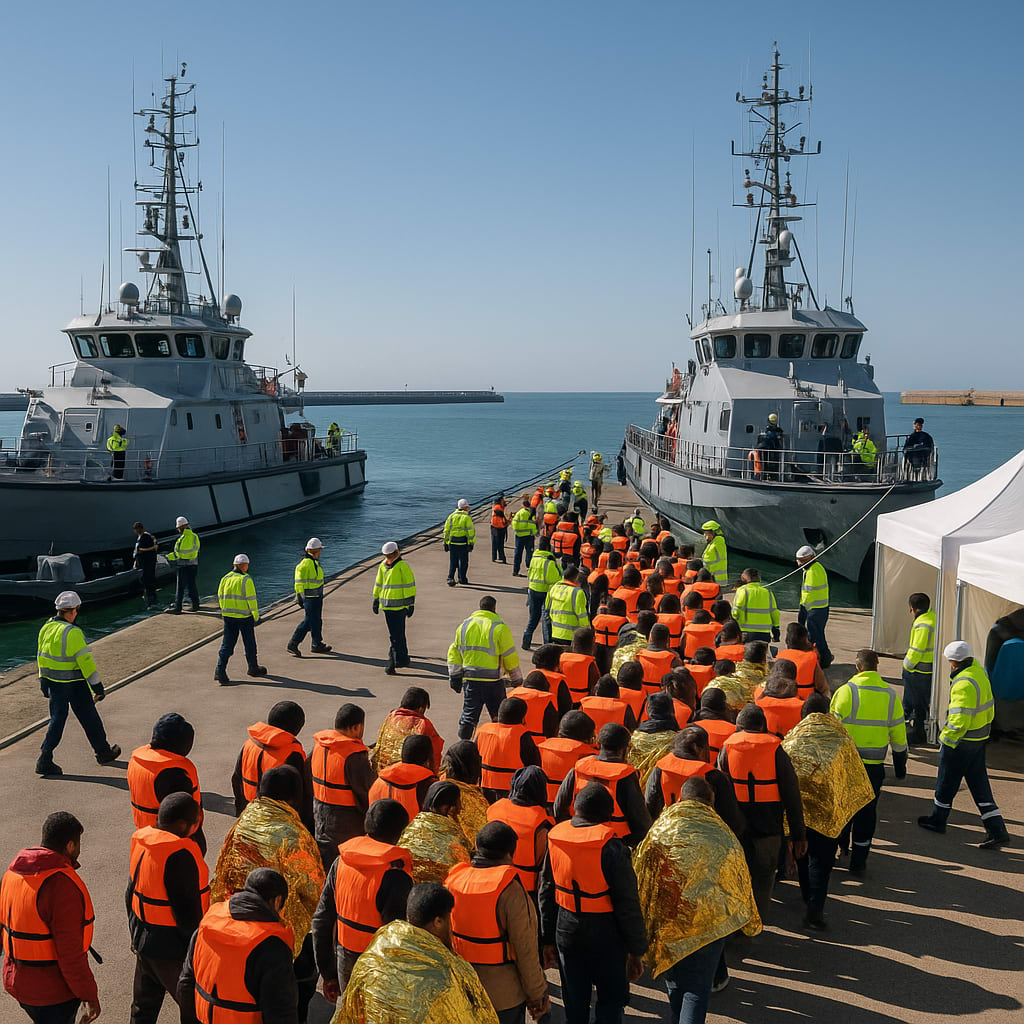
French and UK vessels rescue 157 people after small boat catches fire in the English Channel
Narrative Snapshot
Across European and international outlets, coverage converges on three core elements: the scale of the rescue, the joint French–UK operation, and the location on the maritime boundary. France24 and the South China Morning Post underscore the operation’s magnitude, describing it as among the largest reported since records began in 2018. Le Monde and the Pas-de-Calais prefecture’s account, echoed by BBC News and Al Jazeera, center the fire at the limit of French and British waters and the immediate jump into the sea by passengers, with no deaths reported at the time.
Emphases diverge on incident mechanics and casualty status. The Guardian reports the dinghy capsized after the engine caught fire, while most other outlets describe passengers abandoning the boat without specifying a capsize. Le Monde highlights that no victims were reported “at this stage,” whereas Politika notes that it remained unknown whether there were injuries or fatalities, keeping open an outcome that other coverage implicitly downplays. The Hindu adds a distinctive operational detail: five people had been rescued from the same boat a few hours earlier, implying two separate interventions around the same vessel that other reports do not foreground. Several Anglophone outlets, including the Toronto Star, place the episode against a recent week of Channel fatalities, elevating the stakes for search-and-rescue posture rather than the tactical specifics of this response.
What Happened
French and British vessels rescued 157 people on Tuesday after a small boat attempting to cross the English Channel caught fire near the boundary of French and UK waters, according to the Pas-de-Calais prefecture and multiple outlets. French authorities said the engine ignited, forcing passengers into the water, and reported no casualties at the time of their statements. French assets led the evacuation with assistance from two British Border Security Command boats and a lifeboat, with people taken to Boulogne-sur-Mer in France, The Guardian reported. France24 and the South China Morning Post characterized the effort as one of the largest Channel rescues since 2018. The Hindu noted that five others had been rescued from the same boat earlier that morning. BBC News and Al Jazeera corroborated the cross-Channel nature of the response, while Politika cautioned that injury and fatality status had not yet been confirmed.
Why It Matters
The rescue illustrates operational coordination at a legally and politically sensitive seam: the limit of French and UK waters. Multiple accounts detail that both countries’ assets conducted the evacuation, signaling functional cooperation even as broader migration management remains contentious. The incident’s size, described by France24 and the South China Morning Post as among the largest since 2018, points to continuing capacity demands on search-and-rescue systems in the Channel. The Toronto Star’s reference to multiple recent deaths underscores that mass rescues and fatal outcomes are occurring in close succession, intensifying scrutiny on deployment patterns, response times, and disembarkation arrangements.
Beyond the Channel, the risks posed by marine fires are evident in other theaters. CGTN reported five dead and 41 missing after a ferry ignited in Indonesia’s Java Sea two days earlier, despite evacuations of 225 people by multiple vessels. While unrelated, the juxtaposition highlights that fire-at-sea events quickly become mass-casualty risks without rapid, multi-asset coordination—an operational lesson directly relevant to cross-border SAR planning.
Diverging Narratives
Outlets vary on whether the boat capsized or was abandoned. The Guardian reports a capsize following an engine fire, while Le Monde, BBC News, France24, Al Jazeera, and SCMP emphasize the engine fire and passengers entering the water without explicitly stating a capsize. Casualty framing also diverges. Le Monde and SCMP report no victims “at this stage,” whereas Politika stresses that injuries or fatalities were not yet known. That caution aligns with the volatile nature of early SAR figures; it also leaves space for subsequent updates that others suggest are unlikely.
The operational picture contains a detail largely unique to The Hindu: five people were rescued from the same boat hours earlier, implying the craft continued toward the boundary with a significantly larger complement before the fire. Most other reports do not address this earlier intervention, leaving open questions about sequence and situational awareness that matter for after-action reviews. Finally, several international outlets elevate the rescue’s scale—France24 and SCMP highlight its standing since 2018—while the Toronto Star situates it in a week marked by small-boat deaths, a framing that shifts attention from the singular event to ongoing risk management in the Channel.
What Happens Next
Two decision points follow from the reported facts. First is disembarkation and jurisdiction. The Guardian says people were being taken to Boulogne-sur-Mer, indicating French lead responsibility; analysts should watch for confirmations from the Pas-de-Calais prefecture and UK authorities on final landing sites and custody, which will clarify operational roles in this boundary-area rescue. Second is the status update cycle. Le Monde’s “no victims at this stage” and Politika’s caution on injuries indicate that figures could tighten as authorities complete headcounts and medical assessments; subsequent prefecture or coastguard statements will determine whether the initial no-casualty picture holds.
Operationally, France24 and SCMP’s emphasis on scale raises the question of resource posture for large, heavily loaded small boats. Any official readout specifying the number and type of French and British assets tasked, or clarifying the two-stage intervention referenced by The Hindu, would signal whether agencies are adjusting patrol density, alerting, or coordination protocols for boundary-area incidents involving fire or mechanical failure.