
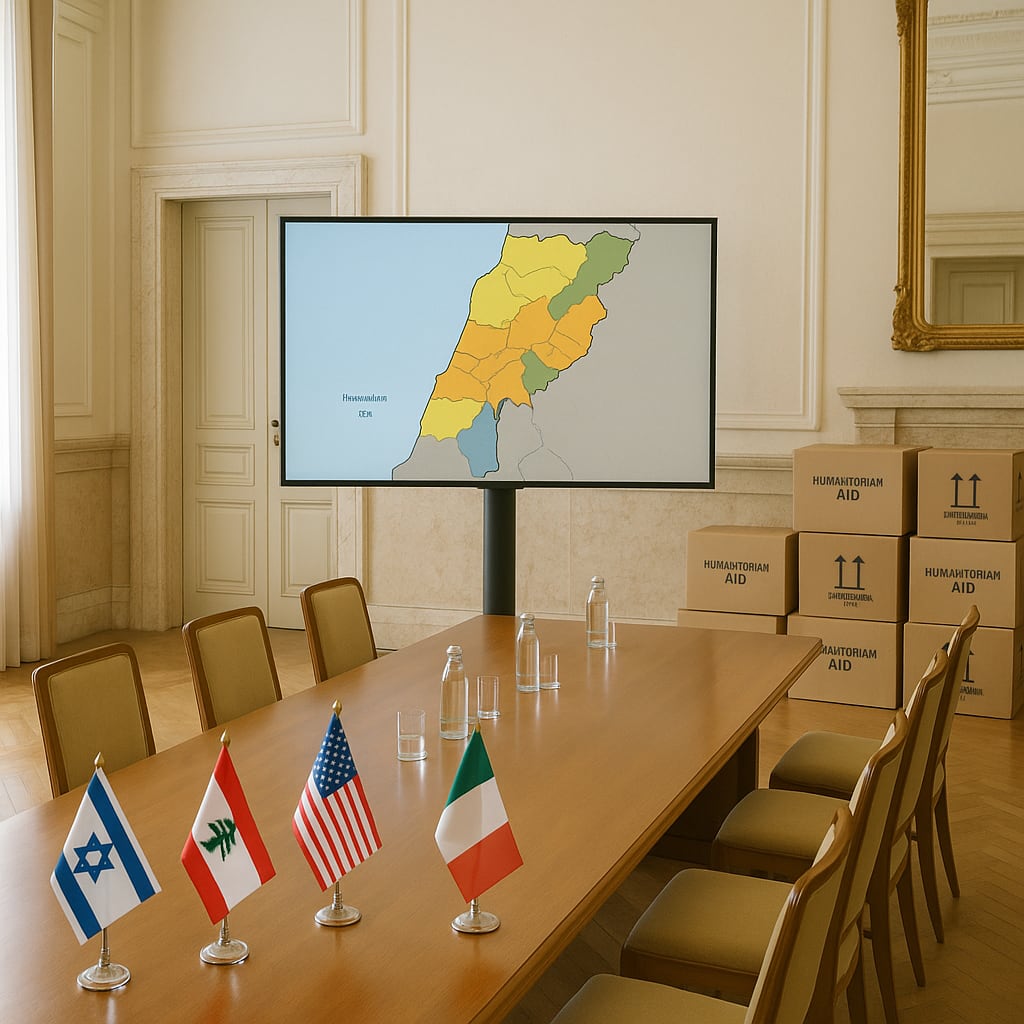
Israel resumes strikes in southern Lebanon and issues first evacuation order in weeks amid Rome talks
Narrative Snapshot
Across outlets, reporting converges on two elements: renewed Israeli strikes in southern Lebanon coinciding with US-backed talks in Rome, and the unusual step of ordering residents to evacuate the village of al-Mansouri after weeks without such alerts. Multiple sources note at least one person killed and more than a dozen wounded in the strikes, with the heaviest damage reported around Tebnine and al-Mansouri, while some add additional locations near Tyre (New York Times; France24; Haaretz; Deutsche Welle; The Guardian; The Times of Israel).
The framing diverges on both the strike rationale and the scope. Israeli statements emphasize “precision strikes” and a response to a “blatant” cease-fire violation, including a claim that civilian returns to al-Mansouri under Lebanese army protection broke the understandings in place (DW; Haaretz). Lebanese officials and several international outlets foreground civilian harm, including a strike on a cemetery prayer hall in Tebnine, and describe broader bombardment across the Tyre area (The Guardian; RT; Le Monde; Middle East Eye). Assessments of intensity vary: some call it among the deadliest incidents since the June truce, while others characterize it as the heaviest bombardment since then (The Guardian; RT).
The stakes in Rome are concrete and immediate. Negotiators are working on phased Israeli withdrawals and Lebanese army deployments, but talks ended their seventh round without agreement on initial withdrawal zones amid disputes over Hezbollah’s disarmament and mounting cross-border violence (CGTN). Reporting from southern Lebanon captures public anger over renewed strikes and displacement orders, highlighting domestic pressure on Beirut that could narrow room for compromise in the negotiations (Al Jazeera English).
What Happened
On August 5, the Israel Defense Forces carried out strikes in southern Lebanon, citing a Hezbollah cease-fire violation and announcing “precision strikes” after ordering residents of al-Mansouri to evacuate, the first such village-wide alert in weeks (DW; France24; Haaretz). Lebanese authorities reported casualties, with one person killed and 11 to 12 wounded. Outlets differ on where the deadliest strike occurred: several cite Tebnine, including a hit on a cemetery prayer hall, while Haaretz reports the casualties in a Nabatieh strike (The Guardian; The Times of Israel; RT; Haaretz). Additional strikes were reported in and around Tyre, including Burj al-Shemali/Bourj Al-Chemali, with four to eight people wounded, and further bombardment near al-Mansouri, including artillery fire (Le Monde; Middle East Eye; TASS). The actions unfolded as Israeli and Lebanese delegations held US-backed talks in Rome; by August 7, the seventh round concluded without a breakthrough on initial withdrawal zones, with disputes over Hezbollah’s disarmament persisting (NYT; France24; CGTN).
Why It Matters
The episode tests whether a fragile June cease-fire can coexist with an ongoing diplomatic track designed to reconfigure the border security architecture. Negotiators are attempting to sequence a phased Israeli withdrawal and the deployment of the Lebanese army, but the IDF’s assertion that civilian returns to al-Mansouri under Lebanese army protection violate existing understandings underscores contested interpretations of interim arrangements (Haaretz; CGTN). Renewed evacuation orders and reported strikes on civilian areas elevate humanitarian and political costs, amplifying local anger in south Lebanon and complicating Beirut’s negotiating posture (France24; Al Jazeera English).
For mediators, the juxtaposition of escalatory incidents and a negotiation round that ended without agreement on withdrawal zones highlights constrained leverage and limited enforcement mechanisms within the current framework (CGTN). For governments and multilateral partners backing the process, the intensity and geographic spread of strikes reported near Tyre are indicators of how quickly localized violations can erode the space for implementing phased security steps (Le Monde; Middle East Eye; RT).
Diverging Narratives
Israeli military messaging frames the operation as a limited, rules-enforcing response to a “blatant” violation, emphasizing precision and the claim that returns to al-Mansouri under Lebanese army escort contravened the cease-fire terms (DW; Haaretz). Lebanese officials and several international outlets stress civilian impact, citing a strike on a cemetery prayer hall in Tebnine and displacement from al-Mansouri, casting doubt on the proportionality and targets of the action (The Guardian; RT; France24). The casualty picture itself contains inconsistencies: reports vary between 11 and 12 wounded and place the fatality either in Tebnine or in Nabatieh, reflecting the opacity that often follows multi-site incidents (The Guardian; The Times of Israel; RT; Haaretz).
Assessments of scope and intensity also split. Some outlets describe the strikes as the most intense or among the deadliest since the June truce, suggesting a qualitative shift in tempo; others simply note a resumption under the existing pattern of cross-border hostilities (RT; The Guardian; France24). Meanwhile, coverage of the Rome track ranges from scene-setting on concurrent diplomacy to concrete reporting that the seventh round ended without agreement on initial withdrawal zones due to unresolved questions over Hezbollah’s disarmament and continuing violence (NYT; France24; CGTN).
What Happens Next
Two decision points emerge from the reporting. First is the status of al-Mansouri and any further evacuation orders. If Israel expands or repeats such directives, that would signal an escalatory enforcement posture the IDF links to alleged violations, with direct implications for civilian return patterns and the feasibility of near-term withdrawal zones (France24; Haaretz). Second is whether the Rome channel can bridge gaps on initial withdrawal areas and the sequence for Lebanese army deployment amid disputes over Hezbollah’s armaments; the seventh round ended without a breakthrough, so watch for any revised US-brokered proposals or adjusted timelines (CGTN).
Operationally, analysts should track whether strikes continue in the Tyre corridor, including Burj al-Shemali, and how casualty reporting consolidates, as indicators of scale and targeting claims (Le Monde; Middle East Eye; RT). Domestically in Lebanon, public reactions to new displacement orders may influence the government’s latitude on deployment commitments in the south (Al Jazeera English).