
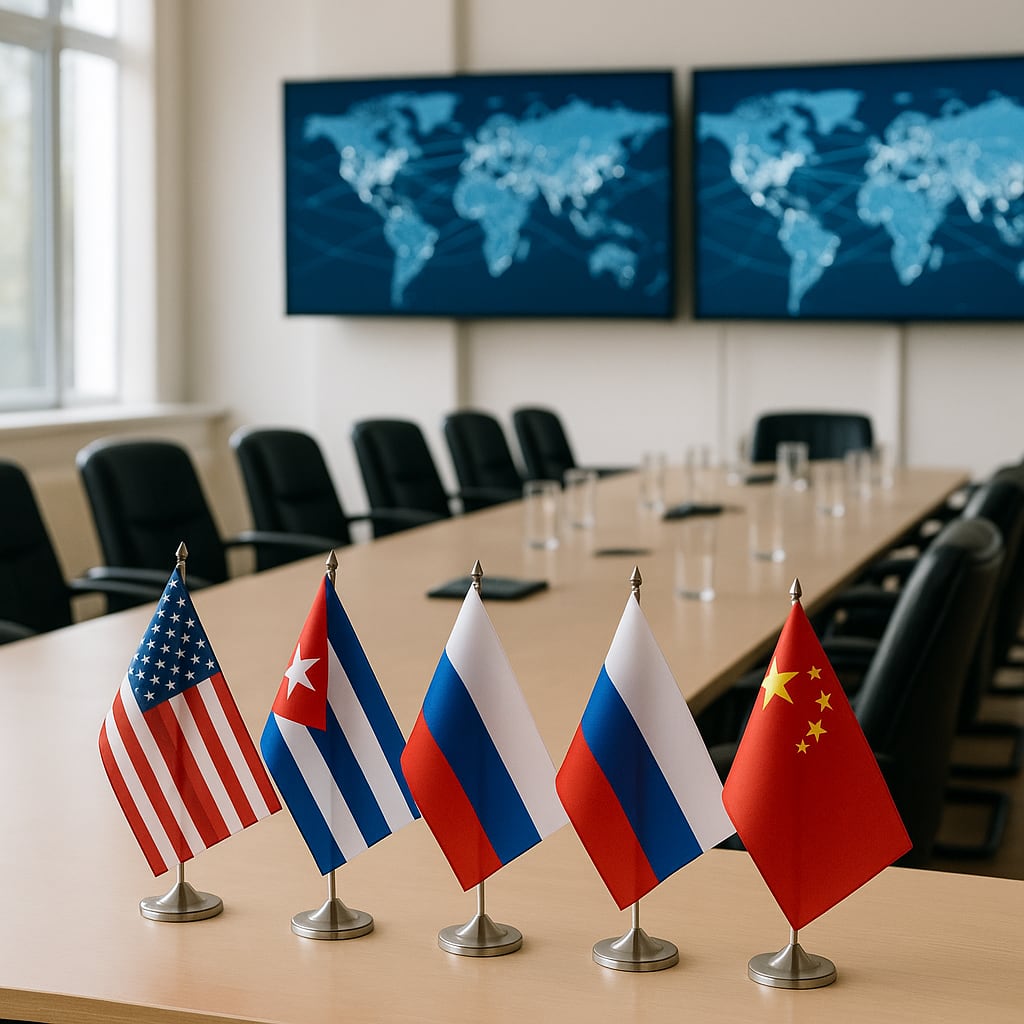
US sanctions Cuban military leaders, state firms, and attachés in China and Russia over arms procurement
Narrative Snapshot
Across outlets, coverage converges on the breadth of the US action and the procurement rationale. Le Monde situates the designations as a network, naming the Cuban armed forces minister, the chief of staff, the army’s external relations and economic affairs heads, and the military attachés posted in China and Russia. Telesur English complements that institutional picture by identifying the state companies Tecnoimport, the Union of Military Industries, and Tecnotex as among the sanctioned entities.
Geographic framing differs by vantage point. The South China Morning Post emphasizes the Beijing channel, naming Waldo Perez Cortes, Cuba’s military, naval and air attaché in China, and linking him to procurement from Chinese sources. TASS foregrounds Moscow, reporting sanctions on Cuba’s military attaché in Russia and noting additional restrictions on the attaché in China, while Al Jazeera explicitly ties the targeted network to acquisition from both Russia and China.
Outlets diverge on counts and sequencing. SCMP reports six Cuban nationals and five entities added to the US Treasury’s Specially Designated Nationals list. Telesur and Al Jazeera report five entities and eight officials. Politika, citing Reuters, adds that two Cubans who were already under sanctions received additional measures—an explanation for why some tallies combine new and amended listings. Clarin frames the move within Washington’s characterization of Cuba as supporting terrorism and quotes the State Department’s focus on overseas acquisition and maintenance of weapons and equipment for Cuba’s military and security forces.
What Happened
The United States announced sanctions targeting Cuba’s military leadership, procurement officials, overseas attachés, and state-linked defense firms. Le Monde reports that General Alvaro Lopez Miera, the minister of the Revolutionary Armed Forces, the chief of the general staff, and the army heads for external relations and economic affairs were designated, alongside Cuba’s military attachés in China and Russia. SCMP names Waldo Perez Cortes, the military, naval and air attaché in Beijing, among six Cuban nationals and five entities newly added to the Treasury’s SDN list. TASS notes sanctions on the attaché in Russia and additional restrictions on the attaché in China. Telesur identifies sanctioned entities as Tecnoimport, the Union of Military Industries, and Tecnotex. Al Jazeera says the designated actors facilitate Cuban acquisition of military equipment from Russia and China. Politika, via Reuters, adds that two previously sanctioned Cubans were hit with additional measures. Clarin cites a State Department statement on overseas weapons procurement and Washington’s view of Cuba as supporting terrorism.
Why It Matters
The designations move beyond symbolic censure to functional chokepoints by naming procurement-facing offices in the Cuban armed forces and the attachés believed to facilitate external sourcing, according to Le Monde, SCMP, and TASS. By also listing Tecnoimport, the Union of Military Industries, and Tecnotex (Telesur), the action targets import, industrial, and logistics nodes that underpin Cuba’s defense sustainment. Al Jazeera’s emphasis on Russian and Chinese supply lines, reinforced by TASS and SCMP’s focus on the respective attachés, signals that Washington is prioritizing third-country procurement vectors tied to those jurisdictions.
Politically, Clarin’s reference to Washington’s categorization of Cuba as supporting terrorism situates the move within a longer-standing coercive framework rather than a one-off response, while Politika’s note on “additional sanctions” for already-designated Cubans suggests a layering approach. For decision-makers, the cross-outlet alignment on who and what functions were targeted clarifies enforcement priorities: procurement intermediaries, external-facing military directorates, and state defense companies linked to Russia- and China-based channels.
Diverging Narratives
Different outlets surface distinct aspects of the same measure set. SCMP frames the action through the China angle, centering on the Beijing-based attaché and procurement from Chinese sources, while TASS elevates the Moscow channel by highlighting sanctions on Cuba’s military attaché in Russia and calling the China-related measures “additional.” Le Monde’s presentation is institutional and systemic, detailing the hierarchy and directorates within the Cuban armed forces that Washington attributes to overseeing procurement. Telesur emphasizes the hit to state entities and names them, consistent with its focus on the economic levers being applied.
There is also variation in accounting. SCMP reports six individuals and five entities added to the SDN list, while Telesur and Al Jazeera describe five entities and eight officials. Politika’s Reuters-based note that two already-sanctioned Cubans received additional measures points to how some outlets distinguish between first-time designations and amendments, a distinction that helps explain differing totals. Clarin’s inclusion of Washington’s “supports terrorism” label underscores the broader policy frame in which it situates the measures, whereas Al Jazeera’s headline associates the action with Marco Rubio and links the network to Russia and China, placing emphasis on US domestic political sponsorship and the supplier geographies.
What Happens Next
Two near-term decision points follow from the coverage. First, scope and sequencing: with outlets reporting different counts and noting both new designations and “additional” measures (SCMP; Politika/Reuters), analysts should watch for Treasury’s formal SDN filings and State Department statements to clarify who is newly listed versus amended and whether further Cuban officials or entities are added, as Le Monde and Telesur outline the network’s breadth. Second, geographic vectors: given explicit attention to attachés in China and Russia and the procurement ties to those countries (Le Monde; TASS; SCMP; Al Jazeera), subsequent US actions will indicate whether enforcement extends to additional intermediaries linked to those jurisdictions.
Institutionally, the naming of Tecnoimport, the Union of Military Industries, and Tecnotex (Telesur) points to a focus on state industrial channels; additional listings of affiliated firms would signal continued tightening. Framing-wise, Clarin’s reference to the “supports terrorism” label suggests one pathway for further measures; Al Jazeera’s emphasis on Russia/China procurement suggests another. Monitoring which rationale predominates in official releases will indicate the likely direction of future steps.