
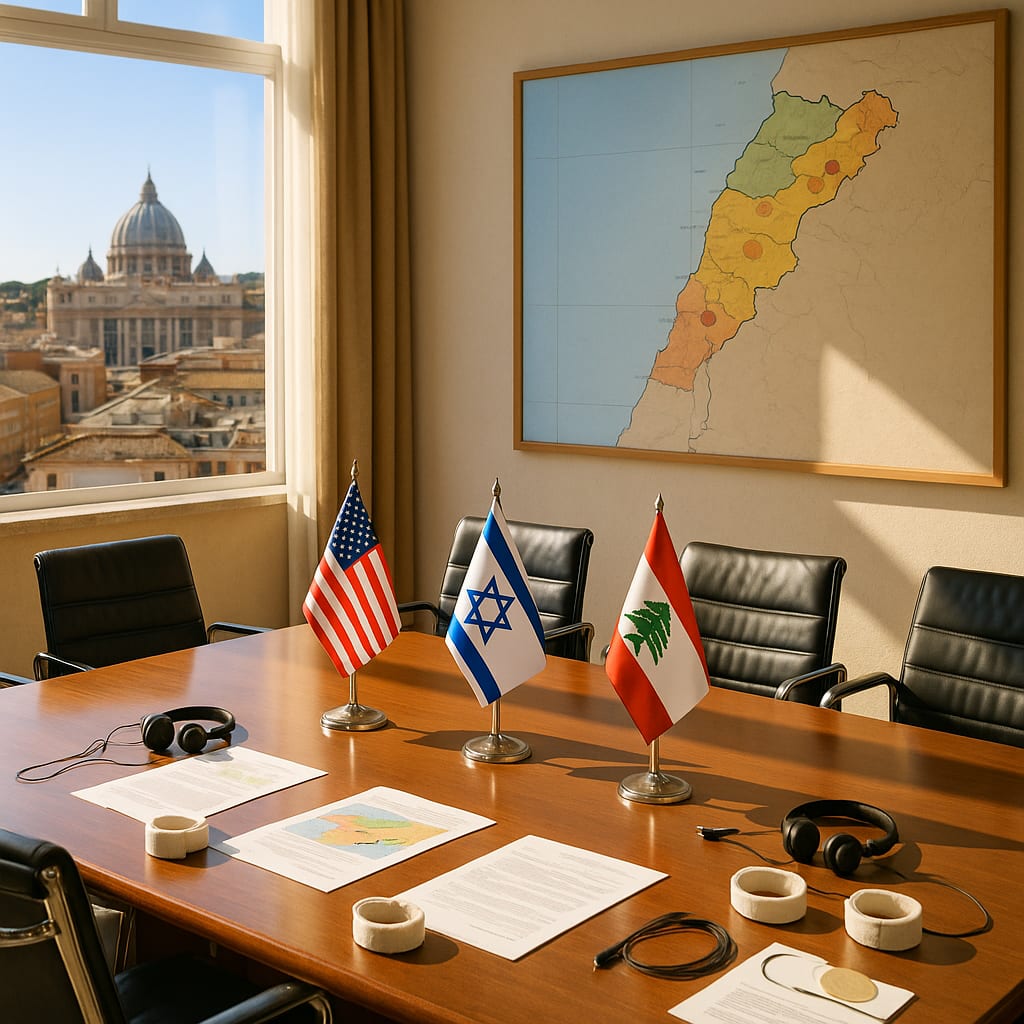
US-mediated Israel–Lebanon talks inch forward as cross-border strikes persist and Israeli minister vows no withdrawal
Narrative Snapshot
Across outlets, there is alignment that US-brokered diplomacy in Rome is active, with Washington describing the seventh round as “fruitful” and “moving in a positive direction,” and a new round scheduled in early September in Rome, according to US and Italian reporting. At the same time, sources differ on depth of progress: US and Middle East Eye accounts emphasize initial implementation of “pilot zones” with standardized maps and procedures, while CGTN notes the round ended without a breakthrough on those zones amid ongoing disputes over the pace of withdrawal and disarmament benchmarks. TASS highlights a firmer Lebanese stance, citing demands to expand areas free of Israeli troops, consolidate the ceasefire, and halt strikes on infrastructure.
Coverage also converges on the continuation of violence in southern Lebanon during and after the talks. European and Qatari outlets document civilian harm and operational pressure on first responders despite an ongoing truce, while Israeli and Chinese outlets tie escalatory Israeli strikes to the killing of two Israeli soldiers by an explosive device. Accounts of environmental damage and tactics vary: the Guardian reports allegations that Israeli forces ignited wildfires by dropping flares; ANSA cites media claims of white phosphorus use near Nabatiye; and Le Monde reports an ambulance damaged in a double strike.
On the political track, several outlets report that the parties, in Rome, produced a shortlist of third countries to verify Hezbollah’s disarmament as part of a June framework linking phased Israeli withdrawal to disarmament verification. Middle East Eye names the UK, Italy, Switzerland, and Indonesia as potential contributors, while the Times of Israel later notes Israel’s denial that it agreed the list with Beirut. Against this, reporting uniformly carries remarks from Defense Minister Israel Katz that Israel will not withdraw from areas it holds in Lebanon, Syria, and Gaza, prompting US criticism, and Lebanese officials accuse Israel of breaching international law.
What Happened
The seventh round of US-mediated Israel–Lebanon talks in Rome concluded on August 6–8 without a final agreement on initial withdrawal zones, though US officials described the process as “fruitful” and said standardization work on “pilot zones” is underway, with the first areas reportedly operational. CGTN reported Lebanese President Joseph Aoun cited “positive progress” on border and prisoner issues and said a US general would follow up in Beirut. Multiple outlets, including Middle East Eye and the Times of Israel, said the sides produced a shortlist of potential third countries to verify Hezbollah disarmament; a subsequent Times of Israel report carried an Israeli denial. In parallel, Israeli strikes intensified after two Israeli soldiers were killed by an explosive device, with injuries reported around Tyre and Burj Shemali, as well as allegations of wildfires, white phosphorus use near Nabatiye, and damage to an ambulance. Defense Minister Israel Katz declared Israel would not withdraw; US officials criticized the remarks. Another Rome round is slated for early September.
Why It Matters
The Rome process is testing whether a negotiated, sequenced trade—Israeli pullback for verifiable reductions in Hezbollah’s military footprint—can be operationalized amid active hostilities. US statements about standardized maps, procedures, and initial “pilot zones” suggest an emerging implementation architecture, while reports of a third-party verification shortlist indicate movement toward an external monitoring role by select states rather than by the parties themselves. Yet Hezbollah is not a party and has refused to disarm, and Israel’s defense minister publicly rejects withdrawal, underscoring the gap between negotiating frameworks and core security positions. Persistent strikes despite a truce, including alleged incendiary and white phosphorus use and reported damage to medical services and homes, point to norm stress and rising humanitarian and environmental costs. For policymakers, the credibility of verification, the enforceability of any ceasefire, and alignment between political rhetoric and military posture will shape whether phased de-escalation is viable.
Diverging Narratives
Accounts diverge on the degree and nature of diplomatic progress. US and Middle East Eye reporting highlight forward movement on pilot zones and technical standardization, while CGTN emphasizes the absence of a breakthrough and continuing disputes over the pace and sequencing of withdrawal and disarmament. On verification, Middle East Eye and an earlier Times of Israel article report a jointly produced shortlist of potential contributor states, later contradicted by a Times of Israel report that Israel denied agreement with Beirut on such a list. The rationale for ongoing military action is framed differently: Israeli and Chinese outlets link intensified strikes to a lethal explosive attack on Israeli soldiers and cite the IDF’s view of ceasefire violations; European and Qatari outlets emphasize civilian harm, strain on first responders, and operations continuing “despite” a truce. Environmental and munitions claims vary in evidentiary posture and attribution, from firefighters alleging deliberate wildfires to ANSA relaying media reports of white phosphorus near Nabatiye. Finally, there is a sharp contrast between the negotiating premise of phased withdrawal tied to verification and the defense minister’s categorical rejection of withdrawal, which drew US criticism and Lebanese accusations of international law breaches.
What Happens Next
Three decision points emerge from reported positions. First, the scope and sequencing of pilot zones: the next Rome round is expected to focus on roadmaps, with Washington signaling that initial zones are already operational, while Lebanese sources press for expansion and a halt to strikes; movement will be visible in any detailed zone maps, terminology releases, or US follow-up via the visiting general. Second, the verification mechanism: reports of a shortlist naming the UK, Italy, Switzerland, and Indonesia contrast with an Israeli denial of agreement; watch for formal US selection announcements, clarifications from Jerusalem and Beirut, and indications of troop or observer contributions. Third, Israeli force posture: Katz’s assertion of no withdrawal elicited US pushback; subsequent cabinet statements, operational orders within the Israeli-declared buffer zone in southern Lebanon, and reporting on detainee exchanges or border files flagged by Lebanese officials will indicate whether the military track aligns with or diverges from the Rome framework.