
US inflation slows to 3.4% in July; Fed debate persists as energy swings
Narrative Snapshot
Across outlets, there is broad alignment that July’s US inflation reading showed incremental cooling but not resolution of underlying pressures. The BBC highlights the mechanics—food costs slowed while housing kept prices elevated—an emphasis echoed by the New York Times’ description of a “benign” report that nonetheless leaves the Federal Reserve’s internal debate unsettled. Al Jazeera draws attention to the divergence inside the energy basket, noting a 1.5% monthly decline alongside a 14.7% year-over-year increase, while a second New York Times account underscores that energy costs fell after a spring surge even as other categories pushed prices up.
Where coverage diverges is in framing risk and policy salience. Clarin centers distributional stress—prices still outpace wage growth—while stressing uncertainty from oil and gasoline and divisions within the Fed over rates. Folha de S.Paulo pairs the data with market spillovers, reporting the dollar opened lower in Brazil as investors digested the print and earnings season. Domestic political lenses also differ: Fox News situates the data in an affordability-focused US gubernatorial primary and notes House passage of a bipartisan housing-supply bill, whereas the Guardian surfaces a parallel policy battle in Australia, where a proposal to scrap home energy standards is condemned by critics as a “cost-of-living timebomb.” The AP framing, carried by the Toronto Star, distills the stakes to a core question—stubborn versus steadily cooling—mirroring the unresolved balance of risks in monetary and energy markets.
What Happened
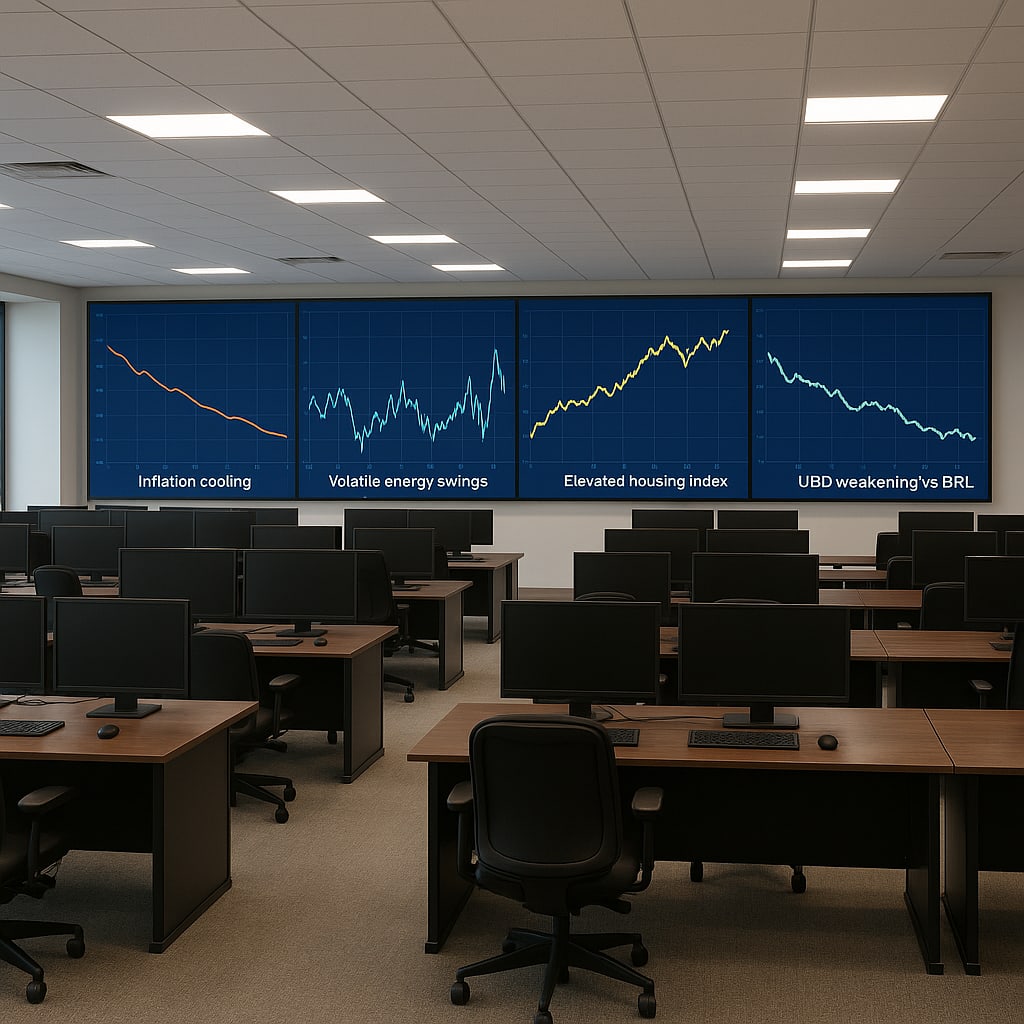
US consumer inflation eased to a 3.4% annual rate in July, down from 3.5% in June, according to multiple reports citing official data released Wednesday. Folha de S.Paulo reported a 0.1% increase in prices in July on a monthly basis. The BBC said food costs cooled while housing continued to keep overall inflation higher. Al Jazeera noted that energy prices fell 1.5% in July but remained 14.7% above year-earlier levels. The New York Times added that energy prices declined after a spring surge, with other categories contributing to cost pressures. The inflation print offered a reprieve to Federal Reserve officials inclined to be patient about further rate increases, though the Times reported the internal debate remains unresolved. In Brazil, Folha de S.Paulo said the dollar opened lower against the real as investors reacted to the US report and tracked corporate earnings.
Why It Matters
The data feed directly into the Federal Reserve’s rate path, which the New York Times describes as guided by a patient cohort but still contested internally—an institutional posture with global spillovers. Market sensitivity is already visible in currency moves reported by Folha de S.Paulo, underscoring how US inflation prints propagate into emerging-market FX and broader risk sentiment. Energy’s dual signal—monthly relief amid high year-over-year levels and oil/gasoline uncertainty highlighted by Al Jazeera and Clarin—keeps external price shocks central to the outlook. Distributional dynamics matter: Clarin reports that prices continue to outpace wages, framing the policy challenge beyond headline disinflation. Politically, affordability is salient in US state races, per Fox News, and in policy design choices abroad, as the Guardian’s coverage of Australian building code standards links energy efficiency rules to household bills. Housing costs, flagged by the BBC and addressed by a bipartisan US House push to expand supply (Fox News), are a structural channel through which policy can affect inflation persistence.
Diverging Narratives
Two interpretations recur. One, reflected in the New York Times’ “reprieve” framing and the BBC’s component breakdown, sees steady, if modest, progress as food costs cool and headline inflation ticks down to 3.4%. The other, emphasized by Clarin and a separate Times article noting prices remain elevated “as war drags on,” stresses that underlying pressures persist: housing is sticky, year-over-year energy costs remain high, and wages have not kept pace. Al Jazeera’s figures—energy down 1.5% month-on-month but up 14.7% year-on-year—capture the volatility that sustains this tension.
Policy prescriptions differ accordingly. For monetary policy, the New York Times reports many Fed officials prefer patience, yet the debate on raising rates is unresolved—an institutional split also noted by Clarin. For real-economy levers, Fox News points to a bipartisan US House vote to expand affordable housing supply as an affordability response, while the Guardian’s reporting from Australia highlights a contrary policy push to scrap energy standards for new homes that critics argue would raise long-run bills. The AP framing in the Toronto Star distills the meta-question—stuck versus cooling—without closure, mirroring the mixed signals from components and policy forums.
What Happens Next
The immediate decision point is the Fed’s rate trajectory. The New York Times reports that July’s “benign” data strengthen a patient approach among many officials, but with debate unresolved; subsequent inflation prints and component trends will be pivotal. Analysts should watch shelter costs (a key driver per the BBC), monthly energy moves versus still-elevated year-over-year levels (per Al Jazeera), and the oil and gasoline uncertainty Clarin highlights.
Market transmission will matter outside the US. Folha de S.Paulo’s account of the dollar opening lower in Brazil after the data suggests emerging-market FX remains sensitive to US inflation surprises and earnings season cues. On the policy front, the bipartisan House push to expand affordable housing supply, cited by Fox News, signals one domestic channel to address persistent shelter inflation. Internationally, the Guardian’s coverage of Australia’s proposed rollback of home energy standards and the criticism it has prompted will test whether cost-of-living strategies prioritize near-term construction costs or long-run household energy bills.